India-UK FTA to Take Effect on July 15 After Steel Quota Breakthrough
Trade pact to open wider UK market access for Indian exporters while reducing tariffs on key British products
The India-UK Free Trade Agreement will officially enter into force on July 15, opening broader access to the British market for Indian exports such as textiles, footwear, agricultural products, gems and jewellery. The implementation follows the resolution of a long-pending issue concerning steel import quotas.
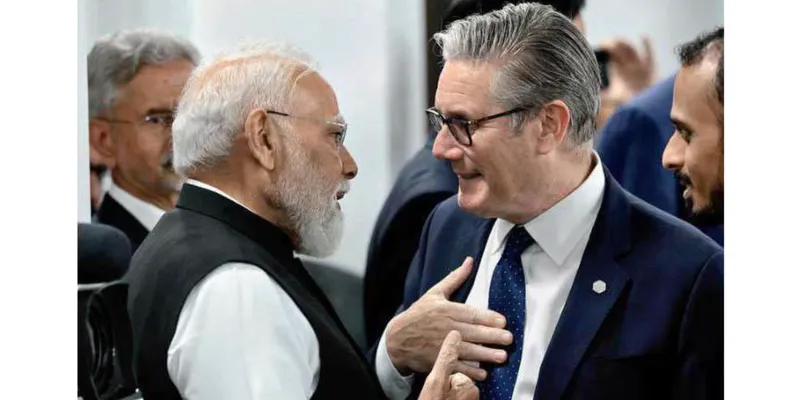
The announcement was made after a bilateral meeting between Prime Minister Narendra Modi and UK Prime Minister Keir Starmer on the sidelines of the G7 meeting in Evian, France.
According to a statement issued by the British High Commission in New Delhi, the agreement is expected to increase UK GDP by £4.8 billion, Indian GDP by £5.1 billion, and bilateral trade by £25.5 billion every year over the long term.
Alongside the trade agreement, the UK-India Double Contributions Convention Agreement will also be implemented on July 15, 2026. The social security arrangement is intended to protect transferred workers from being taxed twice under local social security systems.
Indian exporters in labour-intensive sectors including textiles, leather products, gems and jewellery, footwear and agricultural goods are expected to gain wider access to the UK market.
The Commerce Department said in a statement:
“The simultaneous enforcement of the CETA and the Double Contribution Convention on July 15, 2026, will open up significant new opportunities for India’s exports. By securing immediate duty-free access on 99 per cent of our tariff lines, we have systematically dismantled long-standing tariff walls. This will effectively level the playing field, allowing our textiles, leather, marine, engineering and processed food sectors to compete with no disadvantage and supply their world class products.”
The department further stated:
“For British exporters, Indian import duties on Scotch whisky will plummet from 150 per cent to 40 per cent. Automotive tariffs will drop from 100 per cent to 10 per cent under a specialised quota, and various cosmetic duties topping 22 per cent will be systematically phased out,” the British statement noted, adding that 90 per cent of India’s tariffs were being slashed.
The agreement had been delayed after the UK proposed steel safeguard measures under which tariff-free import quotas were to be reduced from July 1, 2026, while duties on shipments exceeding the quota were to be nearly doubled to 50 per cent.
The proposal had raised concerns in New Delhi because it placed nearly $900 million worth of Indian iron and steel exports at immediate risk. Negotiations continued between both sides until a breakthrough was reached on Wednesday, allowing the agreement to proceed.
UK Business and Trade Secretary Peter Kyle said in a statement:
“We are bringing our landmark trade deal with India into force as quickly as we can,”
He added that the agreement provides British companies with an immediate competitive advantage in global markets and encouraged businesses in both countries to use the 28-day countdown before implementation to prepare their logistics, noting that first-year tariff savings alone are expected to reach £400 million.
The UK-India Double Contributions Convention Agreement extends the period during which corporate transferees and expatriates can remain under their home country's pension framework from 36 months to 60 months.
The statement said:
“This is reciprocal for both British and Indian professionals and will be applicable to highly skilled professionals on pre-existing visa routes. This is in line with our arrangements with other countries such as Korea, Japan, and Canada.”
The reduction in duties on bulk Scotch imports is also expected to lower input costs for bottling and blending operations in India. Sanjit Padhi, CEO, International Spirits and Wines Association of India, said the measure would help manufacturers improve product quality and competitiveness.