India-UK FTA Sets Strict Local Value Addition Rules for Duty Benefits
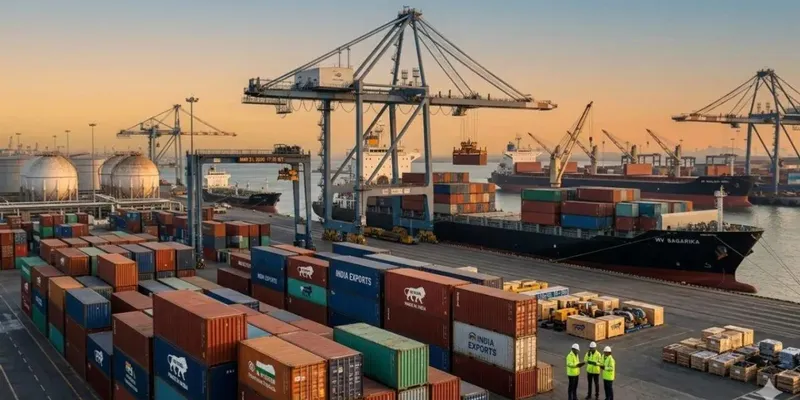
Agricultural products must be wholly local, while manufactured goods require 35–55% qualifying value content to access preferential tariffs under the trade agreement.
The India-UK Free Trade Agreement has fixed minimum local value addition requirements ranging from 35% to 55% for manufactured products to qualify for reduced import duties, depending on how the value of the finished product is calculated.
For agricultural products, the agreement requires that goods be of largely local origin.
The minimum local value requirement forms part of the Rules of Origin applicable to products traded between India and the UK once the Comprehensive Economic and Trade Agreement (CETA) becomes operational. The agreement is scheduled to take effect from July 15, following notification by the Central Board of Indirect Taxes and Customs (CBIC).
Passenger motor cars and motor vehicles intended for personal use must have a qualifying value content (QVC) of at least 35% to be eligible for preferential duties when traded between India and the UK.
For partially assembled kits of cars, public and goods transport vehicles, tractors and other equipment, the required local value addition ranges from 45% to 55%, depending on the method used to calculate the product's value—either at the factory gate or at the point of loading onto the ship.
The same requirement applies to parts for motor vehicles. However, the QVC for motorcycles has been fixed at 40–55%.
Under CETA, India will reduce duties on UK-made passenger cars to 10% from 110% over 15 years under an annual quota of 378,000 units, which will increase each year. Indian-made EVs, hybrids and hydrogen passenger cars will receive duty-free access to the UK market beginning in the first year, starting with a quota that will expand by 15% annually.
For wines and spirits, imported content is permitted, but it must undergo substantial transformation before qualifying for lower duties under CETA. For whisky and gin imported from the UK, India will reduce duties from 150% to 75% immediately, followed by a reduction to 40% by the tenth year.
Similar substantial transformation requirements will apply to processed food products such as chocolate bakery items, sauces derived from fruits and vegetables, and other food preparations.
Certain products—including meat, dairy products, fish, fruits, vegetables, nuts, spices, tea and coffee—must be wholly obtained locally to qualify.
For iron and steel, the agreement specifies a "melted and poured" condition, requiring that iron or steel first be produced in an iron or steel-making furnace in a liquid state before being poured into its first solid shape. The qualifying value content requirement for iron and steel products and alloys ranges between 45% and 55%.
The QVC is a key element of trade agreements designed to ensure that benefits are available only to manufacturers carrying out genuine local production and to prevent products from being routed through third countries.
The local value content requirement is generally 35–40% for standard manufacturing and 50–60% for sensitive sectors such as automobiles, electronics and mobile phones.
The CETA will allow 99% of Indian exports to enter the UK duty-free and cover almost 100% of the trade value. For the UK, India will reduce or eliminate duties on 90% of tariff lines, accounting for 92% of imports.
The agreement aims to increase bilateral trade between India and the UK to $120 billion by 2030, up from $64.1 billion in 2025.