India-Oman CEPA Takes Effect; First Duty-Free Export Consignments Dispatched from Major Indian Ports
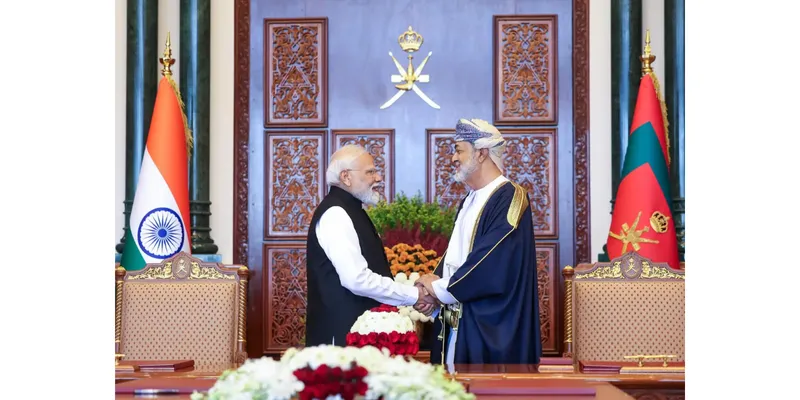
Agreement grants preferential tariff access to 99.38% of India’s exports to Oman and covers 99% of export value
India-Oman CEPA Comes Into Force
The free trade agreement between India and Oman has become operational, providing duty-free access to 99 per cent of India’s exports to Oman. The coverage includes sectors such as textiles, engineering goods, gems and jewellery, while also incorporating provisions aimed at enhancing mobility opportunities for professionals.
Indian consumers are expected to benefit from lower-cost Omani dates, while imports of certain fruits will receive quota-based duty concessions under the agreement.
The implementation of the Comprehensive Economic Partnership Agreement (CEPA) comes at a time when Indian exporters have faced challenges in shipping goods to Gulf markets due to disruptions linked to the US-Iran conflict.
Among the six Gulf Cooperation Council (GCC) nations—Oman, Bahrain, Kuwait, Qatar, Saudi Arabia and the UAE—India has granted duty concessions on 77.79 per cent of its total tariff lines (12,556), covering 94.81 per cent of India’s imports from Oman by value.
For products of export interest to Oman and those considered sensitive to India, the agreement primarily follows a tariff-rate quota (TRQ) based tariff liberalisation framework. This includes products such as dates, marbles and petrochemical items.
Under CEPA, duty-free access is provided to 99.38 per cent of India’s exports to Oman by value, covering 98.08 per cent of Oman’s tariff lines.
First Preferential Tariff Shipments Flagged Off
To mark the agreement’s implementation, the first consignments receiving preferential tariff benefits were flagged off from Mumbai, Kolkata and Chennai. The shipments included agriculture products as well as gems and jewellery exports.
Indian enterprises have established a notable presence in Oman, with more than 6,000 establishments operating across sectors. India received $615.54 million in foreign direct investment from Oman between April 2000 and September 2025.
Commerce and Industry Minister Piyush Goyal said on Monday, "With 99.38 per cent of India's exports receiving duty-free access, the agreement unlocks new opportunities for our exporters and professionals to gain opportunities. Oman is our trusted partner, a bridge for our people and a gateway to the Gulf and East Africa."
He further stated that by delivering benefits to labour-intensive sectors, the agreement is expected to support employment generation, encourage investment and strengthen the competitiveness of Indian enterprises.
According to the minister, sectors expected to benefit include gems and jewellery, textiles, leather, footwear, marine products, engineering goods, processed foods and pharmaceuticals. Labour-intensive goods that previously faced a 5 per cent duty in Muscat will now compete on equal terms with suppliers benefiting from preferential market access.
Bilateral Trade and Market Access
Bilateral trade between India and Oman reached $11.18 billion in FY 2025-26, up from $10.61 billion in FY 2024-25.
The agreement is expected to support MSMEs, manufacturing activity and employment by improving competitiveness in labour-intensive industries.
Earlier, under the Most Favoured Nation (MFN) regime, only 15.33 per cent of India’s exports entered Oman duty-free. Under CEPA, Indian exporters are expected to gain greater price competitiveness in Oman’s nearly $28 billion import market.
All zero-duty concessions under the agreement take effect immediately, providing exporters with greater certainty and market access opportunities.
Oman’s logistics hubs at Sohar, Duqm and Salalah are also expected to provide Indian exporters with enhanced access to wider GCC and East African markets.
Experts Highlight Energy Security Benefits
Experts stated that the India-Oman free trade agreement could strengthen India’s energy and economic security in the Gulf region.
India remains heavily dependent on imported oil, gas and petrochemicals, and deeper economic integration with Oman is viewed as contributing to a more stable and predictable framework for trade and energy cooperation.
The agreement was implemented on June 1.
CRF President Shishir Priyadarshi said, "First, it strengthens India's energy and economic security in a volatile region. Oman has long been one of India's most reliable partners in the Gulf."
He added that India’s dependence on imported oil, gas and petrochemicals makes stronger economic integration with Oman important for creating a stable and predictable framework that supports India’s energy requirements.
Priyadarshi also noted that disruptions arising from the US-Iran conflict and the closure of the Strait of Hormuz have affected supply chains across sectors, including agricultural goods and energy products.
He further stated that Oman could serve as a manufacturing, logistics and re-export hub for Indian businesses targeting West Asian markets.
"So, the significance of this free trade agreement is larger than bilateral trade numbers. It is about securing critical economic relationships, creating new opportunities for the Indian industry, and signalling that India intends to be a leading player in shaping the next phase of global trade and connectivity," Priyadarshi added.