India-EU Free Trade Agreement: Insights from Textile Leaders
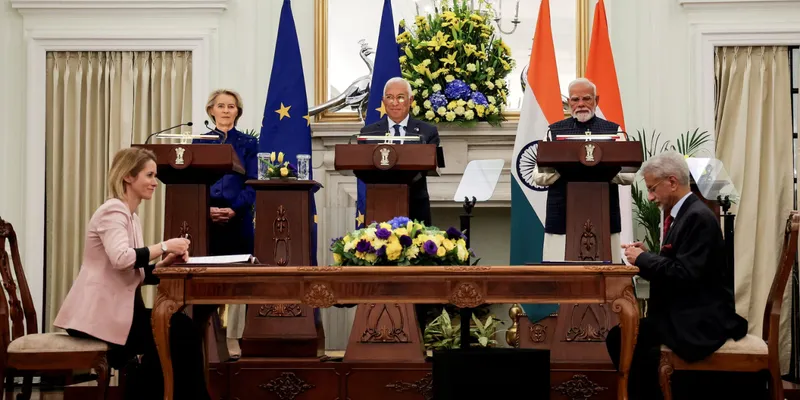
India-EU Free Trade Agreement: Industry Leaders Share Insights
The India–EU Free Trade Agreement (FTA), concluded on January 27, marks a major milestone for India’s textile and apparel sector. With tariffs set to reduce to zero for most textile and apparel products, industry leaders have shared their perspectives on how the deal could boost competitiveness, drive exports, and enhance market access in Europe.

Sammir Dattani, Executive Director, Sanathan Textiles
Sammir Dattani, Executive Director, Sanathan Textiles, said:
"The progress on the India - EU Free Trade Agreement will benefit the Indian textile and apparel sector, as tariffs on textile and apparel products will reduce from 12% to 0%, thereby enhancing cost competitiveness and market access in the European Union. This development creates opportunities for us to expand and explore demand across various European countries.
Europe is home to some of the world’s leading fashion brands and automotive manufacturers, both of which rely extensively on imported textiles for apparel, upholstery, technical fabrics, and automotive interior applications. Enhanced access to this market provides Indian manufacturers like Sanathan Textiles an opportunity to participate more deeply across fashion-led consumption as well as value-added technical and automotive textile segments."
Sanjay Jain, Group CEO, PDS Ltd, commented:
"The India–EU Free Trade Agreement represents a defining moment for the textile and apparel sector and for export-led companies, as tariff elimination offers exporters a compelling alternative to the U.S. market, where duties are as high as 50%. Given that ready-made garments constitute nearly 60% of India’s textile exports to the EU, tariff elimination is set to improve buyer sentiment and outlook towards India and spur higher orders and investment throughout the textile value chain. Zero-duty access is also expected to improve price competitiveness, expand labour-intensive segments like handlooms, and drive capacity expansion across key states, boosting employment for artisans, weavers, and women workers.
For the European textile value chain, the agreement sets several strategic dynamics in motion. We are witnessing a gradual shift in sourcing away from China amid trade tensions and regulatory pressure, alongside an upscaling of supply capacity as India capitalises on its recognised strengths in cotton, spinning and weaving. For PDS, our factory Knit Gallery is well placed to see higher order volumes and longer-term sourcing commitments from EU brands. We believe our present level of 33% of total annual revenue of USD 1.5 bn coming from EU region could further meaningfully benefit from India-EU FTA. We welcome this development and, over the long term, are ready to scale up, invest in quality and sustainability, and deliver world-class products to fashion buyers across Europe."
Pallab Banerjee, Managing Director, Pearl Global Industries Ltd, said:
"Europe is overall a bigger market than the USA for garments. The US exports were $5.5bn and EU was at $4.5bn. Pearl Global Industries Limited is already servicing prominent EU customers from its other countries of production and a small amount from India as well. Approximately 20% of the total revenue of PGIL is from EU. India-EU FTA is expected to bring significant improvement to the total number and also the percentage share.
With the European Union continuing to tighten requirements around ESG compliance and end-to-end traceability, Pearl Global Industries believes India is well positioned to emerge as a stronger sourcing destination. The Company already has the necessary infrastructure and compliance frameworks in place across its Indian operations, enabling it to scale capacity quickly in line with evolving regulatory expectations.
Historically, India’s apparel exports have operated at a disadvantage in the EU market due to tariff-free access enjoyed by competing countries, while Indian exports were subject to duties of 9.96% under the GSP regime and, following its withdrawal, approximately 12%. This differential has impacted India’s price competitiveness despite strong capabilities in quality and compliance.
The proposed removal of this tariff under the India–EU FTA would be a significant positive step, helping level the playing field for Indian manufacturers. It is expected to catalyze fresh investments in advanced synthetic raw materials, modern processing technologies and capacity expansion across the textile and apparel value chain. Over the medium term, this would strengthen India’s position as a reliable, compliant and scalable supplier to the European market."
Suketu Shah, CEO, Vishal Fabrics Ltd, added:
"The India–EU Free Trade Agreement marks a significant milestone for Indian textiles, addressing long-standing tariff disadvantages and improving market access to one of the world’s largest export destinations. Until now, Indian textile exporters entering the European market had a tariff disadvantage of nearly 9-12%, making our products less competitive compared to countries that already have preferential access. This was a key reason why India’s textile exports to the EU have remained low, at US $7.6 billion, despite the EU importing close to US $125 billion of textiles every year.
The India-EU trade agreement is a structural shift that removes these tariff barriers and improves market access which enhances price competitiveness, strengthens integration with European supply chains, and unlocks new export opportunities. We believe sustained focus on quality upgrades, compliance standards, and capacity expansion will be key to fully leveraging this agreement, driving growth for both Indian textile manufacturers and the country’s global trade footprint."
Rahul Mehta, Chief Mentor, Clothing Manufacturers Association of India, noted:
"The India - EU treaty will be a game changer for the Textile Sector, currently undergoing massive stress due to the US tariffs. It is now up to the industry to rise to the occasion to meet the other compliance requirements of the EU Markets. If we are able to get our factories, products, and compliances as required by the buyers, I see the potential to grow our exports by 25% in the next couple of years."
The comments reflect a shared optimism in India’s textile sector, emphasizing market access, compliance, and strategic expansion as the industry positions itself to leverage the new EU trade framework.
Jitendra Srivastava, CEO, Triton Logistics & Maritime, said:
"An India-EU trade deal has the potential to significantly improve export competitiveness for Indian textile and apparel manufacturers by easing tariff barriers and expanding market access. However, the opportunity goes beyond pricing benefits. EU markets demand high compliance standards, sustainability alignment, and reliable delivery timelines. From a logistics perspective, this will put greater emphasis on efficient ocean freight planning, predictable transit schedules, and seamless coordination across ports and supply chains. Trade agreements create momentum, but real gains will depend on how well exporters and logistics partners are operationally prepared to meet European expectations.”