Semiconductor Defect Inspection Equipment Market Growth Outlook
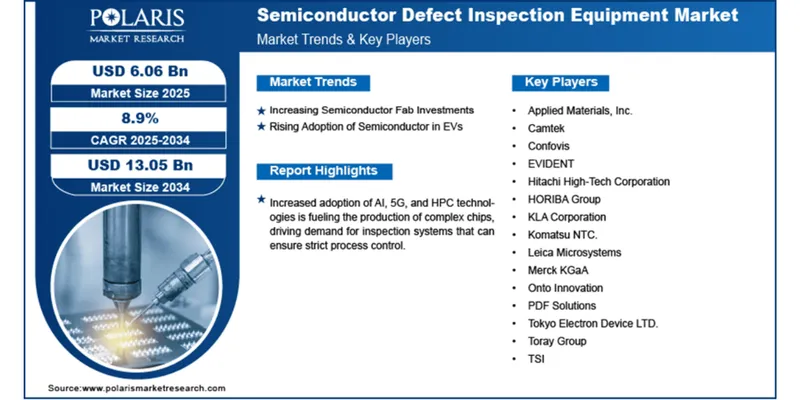
As semiconductors become smaller and more powerful, even the slightest defect can lead to significant failures. Semiconductor defect inspection equipment plays a vital role in preventing such issues, operating silently during chip production to detect the tiniest flaws before they affect performance. This technology is indispensable in ensuring the seamless functioning of the devices we use every day.
Globally, the semiconductor defect inspection equipment market was valued at USD 5.57 billion in 2024 and is projected to grow at a CAGR of 8.9% from 2025 to 2034. The rising adoption of advanced technologies such as AI, 5G, and high-performance computing (HPC) is driving demand for defect inspection systems, as these chips require precise quality control.
What is Semiconductor Defect Inspection Equipment?
These tools identify and analyze defects on wafers during semiconductor manufacturing. By detecting problems such as particles, scratches, or misalignments, they help safeguard yields and maintain consistency in chip quality.
Types of Inspection Tools:
- Wafer Inspection Systems: Detect defects on wafer surfaces or within layers to maintain in-line process control and reduce waste.
- Mask Inspection Systems: Examine photomasks for imperfections that could replicate across thousands of chips, ensuring accuracy in lithography.
- Package Inspection Systems: Inspect diced and packaged chips for physical damage, solder bump issues, and alignment faults before shipment.
- Optical Inspection Systems: Utilize light-based imaging for quick, large-scale inspections in early and mid-production stages, ideal for high throughput.
- Electron Beam (E-Beam) Systems: Provide superior resolution for detecting microscopic defects, especially at advanced nodes like 5nm, though they are slower and more costly.
Key Technologies in Inspection:
- Optical imaging for larger defects and high-volume inspections.
- E-beam systems for precise defect detection at advanced nodes.
- AI and deep learning to improve defect classification and reduce false alarms.
- Multi-beam inspection to accelerate e-beam processes without sacrificing resolution.
- Infrared and UV imaging for specialized defect detection in sub-surface or transparent materials.
Conclusion
With the growing complexity of chip designs and shrinking nodes, advanced defect inspection is more critical than ever. These systems not only ensure high yields and minimize waste but also serve as essential enablers of next-generation semiconductor innovations. As AI, 5G, and HPC adoption accelerates, the demand for defect inspection technology will continue to expand, reinforcing its role as both a quality assurance tool and a key driver of semiconductor progress.