Global Dialogue Advances Trade at WTCA Asia Pacific Conference
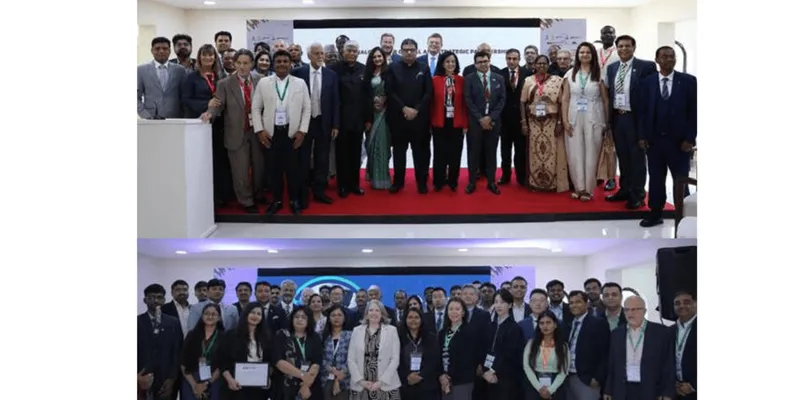
Diplomatic Roundtable Highlights Maharashtra’s Economic Vision
The Diplomatic Roundtable and WTCA Asia Pacific Conference brought together global diplomats and WTC leaders to strengthen international cooperation, trade connectivity, and Maharashtra’s growing economic leadership.
The Diplomatic Roundtable led by Kaustubh Dhavse, alongside the WTCA Asia Pacific Conference, placed strong emphasis on global connectivity, regional cooperation, and Maharashtra’s growing role as an economic hub.
“Maharashtra has long been a frontrunner in development, economic planning, and investment attraction. With a progressive outlook, the state continues to lead India’s journey toward a 5 trillion-dollar economy,” stated Mr. Kaustubh Dhavase, Chief Advisor to the Chief Minister of Maharashtra. He shared this during the Diplomatic Roundtable held with Ambassadors and Consul Generals from more than 30 nations at the 10th Global Economic Summit and WTCA Asia Pacific Conference. The event also recorded participation from over 50 World Trade Centres across the Asia Pacific region—further establishing Maharashtra as a convergence point for ideas, investments, trade, and development.
Mr. Dhavase added, “Except for the Covid years, the state has maintained double-digit CAGR growth, reinforcing its position as India’s growth engine over the last 12 years. This expansion is driven by substantial focus on social and physical infrastructure, transforming Maharashtra’s landscape.” He described major initiatives such as the coastal road network built through land reclamation, running parallel to the suburban rail system that carries nearly 9 million passengers daily, thereby enhancing mobility.
Discussing Maharashtra’s ambition of becoming a trillion-dollar economy, he highlighted ongoing reforms aimed at improving productivity. He also elaborated on the Chief Minister’s vision for Navi Mumbai, including developments like Edu City for international universities, an Innovation & IT City for service sectors, the new Navi Mumbai airport to bolster connectivity, and the Wadhawan Port to strengthen maritime trade.
Welcoming global diplomats, Mr. Dhavase encouraged investment opportunities across Maharashtra. The roundtable saw participation from diplomats representing Bangladesh, South Africa, Egypt, Thailand, Ghana, Ukraine, Argentina, Malaysia, Japan, Mali, the UK, Vietnam, Yemen, Kuwait, Belarus, Ecuador, Czech Republic, Sri Lanka, Guyana, Tanzania, and Uganda.
Alongside the Roundtable, the WTCA Asia Pacific Conference brought together senior leaders from more than 50 countries across the World Trade Centers Association network to exchange perspectives on how WTCs support regional economic growth, attract investment, develop infrastructure, and promote connectivity-driven innovation.
The conference hosted panel discussions featuring WTC representatives from across the region. Speaking about WTCs’ contributions to facilitating trade, Ms. Crystal Edn, Executive Director of Member Services at the World Trade Center Association, emphasized how WTCs help countries and regions build strong trade partnerships and foster dialogue. WTC Vice President Mr. Scott Wang added, “The WTC community provides a platform for members to present the unique opportunities offered by their respective regions.” He noted that WTC-hosted events are designed not for revenue generation but to uplift communities through trade-promoting activities.
Mr. Vijay Kalantri, Chairman of World Trade Centre Mumbai and Board Director of WTCA in New York, welcomed regional WTC participants. He said, “The WTCA movement has delivered remarkable advantages to global trade. WTC Mumbai, as India’s first WTC, has led this movement and supported its expansion across the region.” Highlighting the economic significance of Asia Pacific, he stated that the region contributes nearly 40% of global merchandise trade and is expected to account for over 60% of global growth by 2030. “This growth, however, must translate into shared prosperity. With a strong WTC network, the region will continue progressing toward collective well-being,” he added.
The event also marked the premier accreditation of WTC Kochi and accreditation of WTC Goa, WTC Jaipur, and WTC Bhubaneshwar. New members added to the WTC community included WTC Coimbatore, WTC Future City, WTC Hinjawadi, WTC Kozhikode, WTC Nashik, WTC Thane, and WTC Nhava Sheva.
Conference discussions began with insights on how WTCs play a transformative role in empowering communities through exhibitions, events, and business programs. Speakers emphasized that exhibitions hosted by WTCs are not simply showcases—they are strategic engines for economic activity, enabling SMEs to engage with global markets. Sector-focused initiatives in healthcare, manufacturing, service industries, and innovation continue to strengthen knowledge exchange and business expansion. These efforts contribute substantially to job creation, investment promotion, and community development.
Further discussions emphasized the importance of purpose-driven WTC infrastructure in driving long-term economic growth. Speakers outlined how modern WTC facilities have evolved into integrated trade ecosystems combining sustainable design, intelligent real estate, innovation hubs, flexible workspaces, and logistics-linked infrastructure. Successful WTC developments were showcased as models that help attract foreign investment, facilitate global business activity, and position regions as competitive international destinations. The message underscored that WTCs are not merely buildings—but transformative environments designed to empower enterprises and support global trade.
The conference also highlighted the growing role of digital platforms, cross-border networks, advisory services, and B2B matchmaking in supporting global business expansion. WTCs were recognized as vital connectors in the global innovation ecosystem, helping SMEs and start-ups explore new markets, adopt emerging technologies, and collaborate globally. The discussion concluded that physical, digital, and institutional connectivity now forms the backbone of modern trade facilitation, shaping the competitive edge of businesses across the Asia Pacific region.