Recycling Leaders Advocate Policy Reforms for India’s Circular Economy
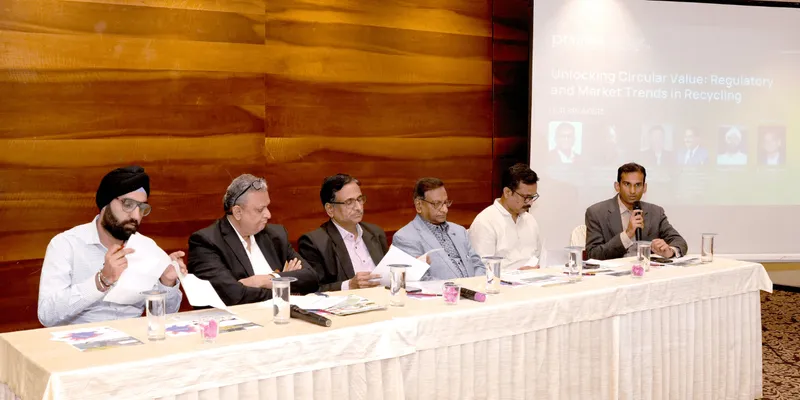
Experts emphasize regulatory clarity, informal sector inclusion, and tech innovation to unlock circular value.
Ahead of the Bharat Recycling Show (BRS) 2025 and Plastics Recycling Show (PRS) India, industry leaders gathered in Mumbai to discuss strategies for strengthening India’s circular economy, highlighting regulatory reforms, technology adoption, and formal recognition of the informal recycling sector.
The upcoming BRS 2025, co-located with PRS India, is poised to become India’s largest recycling-focused platform. In a pre-event high-level panel discussion on “Unlocking Circular Value: Regulatory and Market Trends in Recycling,” experts underscored the urgent need for enhanced regulations, adoption of innovative technologies, and the integration of India’s informal recycling network. Organized by Media Fusion and Crain Communications, the shows will host 150 exhibitors and welcome 8,000 visitors from over 10 countries, presenting a comprehensive showcase of recycling solutions at the Bombay Exhibition Center from November 13–15, 2025.
Informal Economy and Plastics Challenges
Panelists included Mr. Ajit Salvi (Director, RCUES of AIILSG), Mr. Sandeep Vakharia (Honorary Secretary, BNMA), Mr. Anuj Maheshwari (Co-Founder, Trace Resource), Mr. Gurashish Sahni (Co-Founder & COO, ReCircle), and Mr. BK Soni (Chairman & MD, Eco Recycling Ltd).
Discussing plastics, Mr. Gurashish Sahni emphasized that while India’s Extended Producer Responsibility (EPR) policies are modeled on the EU, they must be adapted to local realities, especially considering the informal sector, which underpins high recycling rates. He urged the adoption of digital tools such as IoT, AI, and robotic sorting to improve traceability and efficiency. Mr. Sahni also highlighted that the 18% GST on raw materials like bottles hinders circularity, suggesting that taxes on recycled materials should be reduced or waived to support sustainability.
Mr. Taher Patrawala, MD of Media Fusion, noted that fragmented compliance and high GST remain key challenges, which forums like BRS and PRS India aim to address by encouraging dialogue between policymakers and industry stakeholders.
Integrating the Metal Economy
On metals, Mr. Sandeep Vakharia pointed out that India’s circular economy has long ensured no valuable metals are wasted. Recycling copper is essential to meet alternate energy needs, reduce imports, and lower carbon emissions, helping India achieve its NDC targets. He highlighted that India’s parallel informal recycling economy significantly contributes to the actual GDP, exceeding $5 trillion, and urged its integration into the formal system with ESG education.
Regulatory Capacity and Infrastructure Needs
Experts across waste streams stressed India-specific regulatory clarity. Mr. Anuj Maheshwari noted gaps between waste generation and recycling capacity, warning that EU-inspired regulations often lack local fine-tuning, creating hurdles for compliance and innovation. Strengthening regulations and recognizing compliant players are crucial for unlocking true circular value.
Mr. Ajit Salvi highlighted urban local bodies’ critical role in waste management, praising Indore, Surat, Panaji, and Navi Mumbai for effective segregation. He emphasized that water recycling and reuse are essential, given finite water resources and population pressures, underscoring the importance of technology adoption for sustainable circular practices.