PolyU pioneers smart sustainable cooling against extreme heat
Global warming continues to endanger health and work productivity, with around 3.6 billion people living in climate-sensitive areas. Between 2000 and 2019, more than 480,000 heat-related deaths occurred each year worldwide. Extreme heat also impacts concentration, mood, and sleep by elevating stress hormones. Addressing these urgent challenges, scholars from The Hong Kong Polytechnic University (PolyU) are pioneering next-generation personal cooling solutions that move beyond conventional clothing while embedding sustainability.
Prof. Dahua Shou, Limin Endowed Young Scholar in Advanced Textiles Technologies, Associate Professor of the PolyU School of Fashion and Textiles, Associate Director of the Research Centre of Textiles for Future Fashion, and Associate Director of the PolyU–Xingguo Technology and Innovation Research Institute, has published a peer-reviewed paper in Science, offering new insights into sustainable personal cooling using advanced textiles and intelligent wearables.
Prof. Dahua Shou, Limin Endowed Young Scholar in Advanced Textiles Technologies, Associate Professor at PolyU’s School of Fashion and Textiles, and Associate Director of both the Research Centre of Textiles for Future Fashion and the PolyU-Xingguo Technology and Innovation Research Institute, has published a peer-reviewed paper in Science. His work explores sustainable cooling methods through advanced textiles and intelligent wearables.
“According to the World Meteorological Organisation, there is an 80% chance that at least one year between 2025 and 2029 will be the hottest on record, making personal cooling increasingly vital for well-being, health and productivity,” said Prof. Shou. “We have been creating intelligent, superhero-like garments that provide on-demand adaptive cooling and clinician-like health monitoring to help address the challenge of extreme heat.”
By combining the cooling effects of radiation, conduction, convection, and evaporation, the study outlines adaptive methods to regulate body temperature in real-world environments. It also proposes an AI-driven closed-loop system linking sensing, prediction, and actuation for personalised, energy-efficient cooling, designed with scalability and recyclability in mind.
PolyU’s research highlights emerging technologies such as spectrum-selective textiles to release body heat while blocking solar gain, moisture-responsive fibres for ventilative and evaporative cooling, and lightweight active wearables powered by flexible solar modules. These innovations expand comfort zones and reduce reliance on air conditioning.
Challenges remain, particularly around sweat management, adaptive thermoregulation, and developing user-centric metrics for fair evaluation. Prof. Shou emphasized, “We also need interdisciplinary integration across textiles, thermodynamics, flexible electronics, and AI, along with scalable, recyclable manufacturing that balances sustainability, wearability, fashion, and performance.”
Key PolyU innovations include:
- iActive™ sportswear with artificial sweat glands that eject perspiration three times faster than peak human sweating.
- Omni-Cool-Dry™ fabric offering directional sweat routing and spectrum-selective cooling, lowering skin temperature by ~5°C.
- Thermo-adaptive Soft Robotic Clothing, which adjusts insulation dynamically, keeping interiors 10°C cooler under extreme external heat.
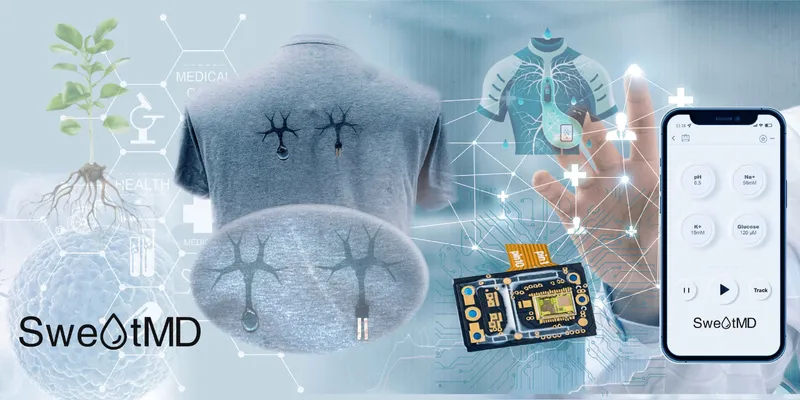
- SweatMD, a non-invasive textile-based wearable that tracks biomarkers in sweat, providing real-time health data via smartphone.
iActive™ intelligent sportswear uses low-voltage-driven artificial “sweat glands” and a root-like liquid network mapped to sweat zones to quickly eject perspiration as droplets, reducing weight and cling, keeping the skin dry, and removing sweat up to 3-time faster than peak human sweating.
Together, these systems form an AI-ready ecosystem, combining textile sensors, fiber coolers, and on-body energy harvesters for self-sustained cooling across daily wear, sports, and protective clothing.
PolyU’s cross-disciplinary collaborations and translational research centres are accelerating these technologies into real-world deployment. The work has already received major international recognition, including a Gold Medal with Congratulations of the Jury (2025) and Gold Medal (2024) at the Geneva Invention Exhibition, the TechConnect Global Innovation Award, and The Fiber Society’s Distinguished Achievement Award to Prof. Shou.