Keys, Graffiti, and Mishti: A Bengal Story for Issey Miyake
BY
Dr Vidhu Sekhar P
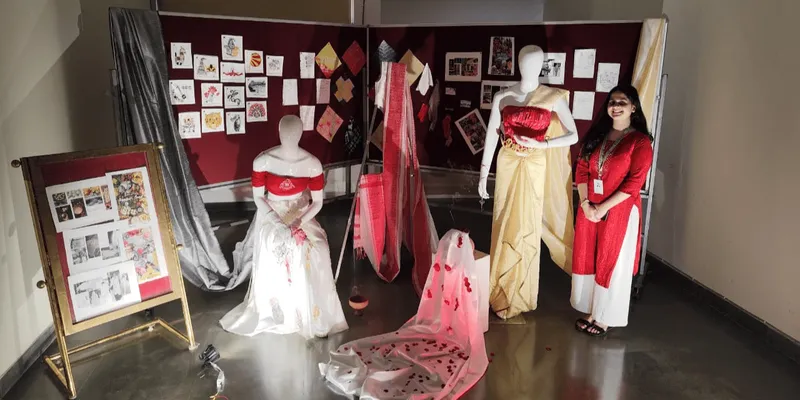
The visual merchandising concept, developed by Pranjali Parab as part of an academic jury assignment at the National Institute of Fashion Technology, Daman campus, translates the cultural landscape of Bengal into a contemporary high-fashion context for the brand Issey Miyake. The work uses form, texture, symbolism, and surface construction to create an immersive visual story rather than relying on literal motifs, allowing Bengal’s identity to be experienced both visually and emotionally. Pranjali is a second-year Bachelor of Textile Design student at NIFT Daman campus.
Concept and colour narrative
The VM is rooted in Bengal’s rituals, everyday life, and sensory world, reinterpreting them for a global fashion consumer. Red and white—deeply associated with Bengali saris and ceremonies—anchor the palette, symbolising femininity, ritual, and purity, while off‑white and gold evoke heritage, sanctity, and prosperity. Soft tones inspired by Bengali sweets and textiles introduce warmth and tactility, reinforcing a sense of comfort and indulgence. Garments, fabric manipulations, accessories, and background visuals are orchestrated as a cohesive composition, creating a dialogue between craft, food culture, and urban expression.
Designer–brand alignment: Issey Miyake
Issey Miyake is selected as the client brand because his design philosophy emphasises innovation in textile technology, sculptural form, and surface manipulation over heavy ornamentation. The use of pin‑tucks, smocking, layered construction, and structural detailing in this project reflects the same experimental spirit seen in Miyake’s pleating and fabric-engineering techniques, making the garments conceptually and aesthetically compatible with his label. The Bengal-inspired palette is moderated and refined to sit naturally within Miyake’s visual language, ensuring the work feels both regionally grounded and globally relevant.
Graffiti and evolving femininity outfit
The first outfit explores Bengal’s contemporary urban graffiti culture, where walls become spaces for assertion, protest, and storytelling. Instead of literal graffiti prints, the garment uses extensive pin‑tuck detailing to simulate the layered surfaces of city walls, overlapping posters, and painted textures, echoing Miyake’s interest in topography-like surfaces created through textile manipulation. The restrained colour story allows the richness of relief and structure to communicate the idea of multiple voices inscribed onto the city.
A critical symbolic element is the ancient key. In traditional Bengali households, women often carried a bunch of keys tied discreetly at the back of the sari blouse, signifying responsibility and control over domestic resources. In this outfit, the key is deliberately repositioned to the front of the body, shifting the symbol from hidden authority to visible agency. This gesture speaks to the changing roles of Bengali women—independent, self-assertive, and publicly recognised—bridging generational ideas of power and identity. The look thus becomes a commentary on cultural evolution, using a single object to connect past, present, and future womanhood.
Bengali sweets as textile language
The second outfit translates the sensory world of Bengali sweets (mishti) into structure, texture, and surface embellishment. Bengali confections such as rasgulla, mishti doi, and sandesh—central to celebrations and everyday indulgence—inform the garment at multiple levels.
- Rasgulla inspires the smocked skirt. Its soft, rounded, spongy form is abstracted through dense smocking that creates pillowy, puffed volumes, giving the skirt a three-dimensional, tactile quality reminiscent of clustered sweets.
- Mishti doi, known for its glossy, creamy surface, is translated via satin fabric. The smooth sheen and fluid drape echo the dessert’s richness, lending the ensemble a luxurious yet gentle character.
- Sandesh and its garnished tops inform the placement and colour of embroidery. Delicate, jewel-like embroidered accents scattered across the surface echo dry-fruit garnishes, turning the skirt into a visual platter of texture and colour.
The look is further enriched with layered garments, coordinated accessories, and varied embellishment techniques that allude to the multiplicity of flavours and forms present in a Bengali sweet shop, achieving a balanced visual opulence suitable for a contemporary luxury label.
Visual merchandising language and academic contribution
Across the VM setup, Pranjali employs multiple garments, accessories, and surface-embellished textile developments to build a strong focal narrative within the display. The arrangement leverages scale, layering, and rhythmic repetition of textures to attract the viewer from a distance and reward close-up inspection. This approach mirrors professional VM practice where storytelling, brand alignment, and spatial composition are as important as the garments themselves.
This project demonstrates the student’s ability to translate intangible cultural cues (rituals, food, street expression) into a coherent fashion and VM language. Align concept, colour, and construction techniques with the DNA of an international designer brand like Issey Miyake. Use symbolism (such as the key) and sensory translation (sweets into textures) to move beyond literal representation into nuanced, globally legible design storytelling.
Thus, the work presents a sophisticated synthesis of Bengal’s heritage and contemporary fashion thinking, showcasing advanced visual merchandising, textile, and conceptual skills appropriate for a Textile Design Undergraduate scholar.