Igers Opens Textile Recycling Plant in Italy with Capacity of 19,200 Tonnes Annually
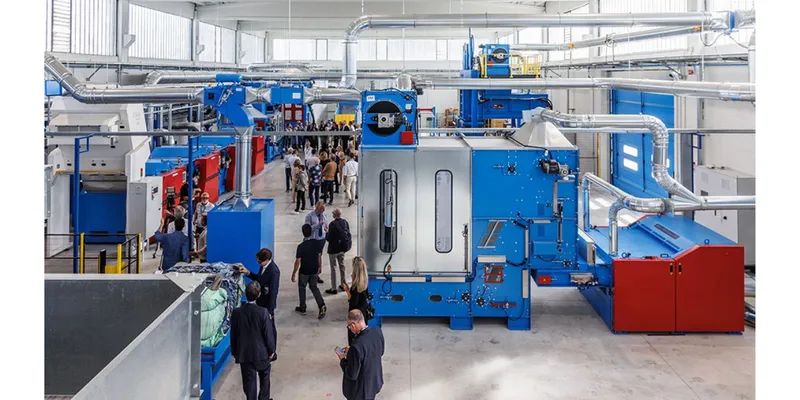
The €8 million facility in San Pietro Mosezzo integrates automated textile sorting, fibre regeneration and digital traceability to process post-consumer and post-industrial textile waste.
Igers s.r.l., in partnership with technology provider Stadler, has inaugurated a textile recycling plant in San Pietro Mosezzo, in Italy’s Piedmont region. The facility, inaugurated on 21 September, has a processing capacity of four metric tonnes per hour and is authorised to process up to 19,200 metric tonnes of textiles annually, producing recycled flakes and frayed material for the spinning industry.
Facility Integrates Textile Recycling Stages
The new plant is described by Stadler as the first facility in Italy to include all treatment phases for textile recycling. It processes post-consumer and post-industrial textile waste, with traceability throughout the process.
The total investment was nearly €8 million, including €1.3 million in co-financing from Italy’s National Recovery and Resilience Plan (PNRR).
Germany-based Stadler supported the project during the design phase, integrating treatment equipment purchased by Igers and designing and supplying the fully automated sorting line.
"Stadler worked with us not simply as a supplier but as a technology partner, understanding the specific requirements of a project that is both new and ambitious within the Italian context," says Igers CEO Gian Luca Miceli.
The facility comes amid growing attention to textile recycling in Europe, where separate textile collection requirements and extended producer responsibility measures are increasing the need for industrial sorting and recycling infrastructure.
Patented Process for Textile Waste
Textile waste can contain different fibre types, composite materials, accessories and contaminants, with considerable variation in quality. Igers has developed a complete process, patented in Italy, covering the stages from initial buffering and sanitising to sorting, tearing and final output.
"The distinctive value of our process lies in the integration of impurity separation, technology-based material sorting, mechanical regeneration and digital traceability," Miceli says. "We do not consider these stages as isolated activities: They are parts of a single system that enables more accurate decisions to be made about the destination of each material stream."
The integrated approach is intended to support the separation of different textile fractions and direct them towards appropriate downstream recycling processes.
Stadler Supports Engineering and System Integration
According to Stadler, the project required coordination among multiple suppliers and the integration of existing equipment into a system designed to provide flexibility across sorting operations.
Miceli said Igers selected Stadler for its international experience and ability to translate complex project requirements into an engineering solution.
"We chose Stadler because we were looking for a partner with international experience and a proven ability to translate complex requirements into a reliable engineering solution," Miceli says. "In a project like this, technology is fundamental, but technology alone is not enough: You also need a structured approach, responsiveness, rigorous interface management and attention to detail."
Matteo Zaninelli, project manager at Stadler, said the project began with an assessment of Igers’ objectives, the characteristics of the incoming material and the required outputs. The teams then developed process flow diagrams, selected equipment and designed the plant layout around the available building.
"It was very much a step-by-step development, with Igers bringing its knowledge of textile recycling and Stadler contributing its experience in plant engineering, material handling and sorting," Zaninelli said.
Automated Sorting with Two-Stage NIR Technology
The Stadler sorting line includes two dosing units, two Tomra near-infrared (NIR) optical sorters and 16 conveyors. It prepares textile material for subsequent recycling stages by separating different textile fractions and removing impurities.
In the first sorting stage, the initial NIR sorter separates pure textiles, such as 100% cotton or 100% wool, from blended textiles and impurities. The second sorter separates mixed textile material from impurities and nonconforming items, including pieces of hangers and leather.
During the second stage, buffered material is recirculated through the same sorting equipment, with the NIR sorters configured to separate it according to fibre type.
The plant can direct output fractions to a baler, storage containers, a recirculation buffer or the fibre-opening process. According to Stadler, this flexibility allows Igers to adjust the plant to different incoming materials and sorting strategies.
The line is fully automated and requires one plant manager to start and stop operations and adjust the NIR sorters’ settings as needed.
Handling Variable Textile Materials
Textiles present specific processing challenges because they are soft, flexible and available in different shapes and sizes. Materials can fold, overlap or become entangled during handling.
Stadler conducted trials at its Test Center, while Igers carried out additional tests and contributed practical knowledge of textile recycling. The findings helped determine configurations for feeding, dosing, conveying and distributing textiles throughout the plant.
"These may seem like relatively small details, but they have a significant impact on the stability of the material flow and therefore on the performance of the entire sorting process," Zaninelli notes.
Plans for Further Textile Recycling Hubs
Igers aims to develop the San Pietro Mosezzo facility into an industrial and technological platform and progressively establish additional recycling hubs, depending on material availability, regional requirements and demand for recovered materials.
"Our objective is to consolidate San Pietro Mosezzo as a leading industrial and technological platform," Miceli says. "Building on this foundation, we intend to progressively develop additional recycling hubs, in line with the availability of material streams, regional requirements and demand for high-quality recovered materials."
Stadler said the project combines textile sorting technology with plant engineering and system integration to address the complex and variable nature of textile waste.
"We expect textile sorting and recycling to become increasingly industrialized," Zaninelli concludes. "Sorting technology has to develop together with the recycling processes it is feeding. Ultimately, our job is not simply to separate textiles, but to provide downstream processes with the right material, at the right quality and in a consistent way."