ICAC Launches Free Carbon Footprint App for Cotton
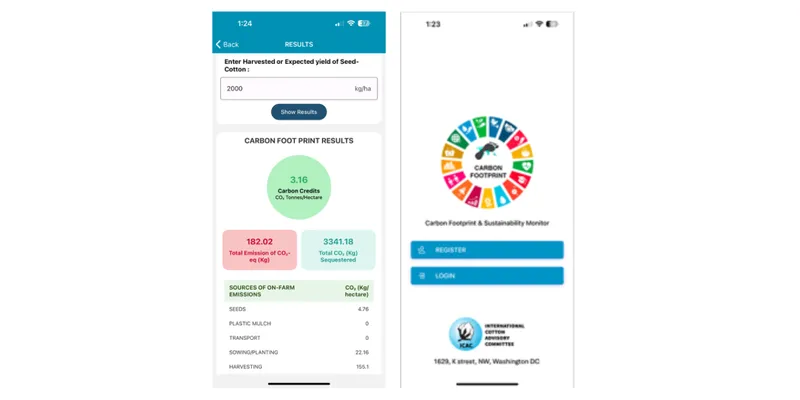
The International Cotton Advisory Committee (ICAC) has officially launched the ICAC Carbon Footprint Application, a free, comprehensive tool available in English and French. It can be accessed via the web or downloaded on iOS and Android devices.
This innovative platform is designed to help farmers, researchers, and policymakers measure the net carbon footprint of cotton production and associated activities. By entering data, users can calculate CO₂-equivalent (CO₂-eq) greenhouse gas emissions and estimate carbon sequestration achieved through various practices.
Key Highlights of the App:
- Farm & Household Emissions: Calculate emissions at farm level or aggregate data for larger areas (villages, towns, districts) to track progress toward net-zero goals.
- Customizable Assessments: Covers soil types, seed usage, mulching, transport, 30+ tillage operations, 10+ planting methods, pesticide techniques, weeding practices, and 14+ harvesting methods.
- Comprehensive Inputs: Includes animal/human labor, nine irrigation systems (electric or diesel), 30+ fertilizers, 16+ composts/manures, and over 550 pesticide molecules in 4,400+ commercial formulations.
- Carbon Sequestration & Land Use: Considers emissions from land-use change and sequestration through cotton fiber, crop residue management (mulching, fuel, biochar), and regenerative practices like cover crops and reduced tillage.
- User-Friendly Dashboard: Offers a detailed breakdown of CO₂-eq emissions per hectare, carbon sequestration potential, and net carbon credit calculation.
Dr. Keshav Kranthi, ICAC Chief Scientist and the developer of the application, emphasized:
“With its comprehensive capabilities, the ICAC Carbon Footprint Application provides farmers and policymakers with a practical and science-based tool to evaluate and reduce emissions, enhance carbon sequestration, and work toward climate-smart, sustainable cotton production. By enabling assessments from individual farms to entire regions, this app supports the global drive toward net-zero targets and responsible carbon management.”
This tool is expected to significantly advance climate-smart cotton production and strengthen the industry’s contribution to sustainability goals worldwide.