IBC Trends Q2FY26: CIRP Delays Persist, Recovery at 32%
CIRP admissions rise, recoveries stagnate, and timelines continue to extend.
India’s insolvency landscape in Q2FY26 shows marginal recovery movement, steady CIRP volumes, and continued delays across resolution and liquidation processes, as major reforms under the IBC Amendment Bill, 2025, await implementation.
Synopsis
• The overall recovery rate under the Insolvency and Bankruptcy Code (IBC) stayed largely stable, slipping slightly to 32.44% in Q2FY26 from 32.57% in Q1FY26, meaning creditors continue to take an average haircut of about 67% on admitted claims.
• CIRP admissions increased by 8.2% y-o-y in Q2FY26, although total admissions for FY25 were still under 1,000—significantly below the levels seen during the preceding five years. Prolonged resolution timelines have resulted in a sectoral distribution pattern that has remained largely consistent.
• The number of ongoing CIRPs dropped to 1,898 in Q2FY26, from 1,963 in Q2FY25, continuing to hover near the 1,900 mark. The manufacturing sector still represents the highest share of cases.
Overview
The IBC (Amendment) Bill, 2025 proposes the most substantial restructuring of India’s insolvency framework since its 2016 inception. The reform aims to resolve persistent implementation challenges and eliminate ambiguities created by judicial interpretation.
Key amendments include:
- Streamlining Creditor-Initiated Insolvency Resolution Process (CIRP)
- Introducing Committee of Creditors (CoC) oversight in liquidation
- Clarifying treatment of security interests
- Strengthening rules on PUFE (Preferential, Undervalued, Fraudulent, Extortionate) transactions
The Bill also introduces a new Creditor-Initiated Immediate Resolution Process (CIIRP) and allows for rules on group and cross-border insolvency. Its objective is to improve transparency, speed, and commercial predictability. The Bill was tabled in the Lok Sabha on August 12, 2025, and is currently under review by a Parliamentary select committee.
Moderation in CIRP Initiations During Q2FY26
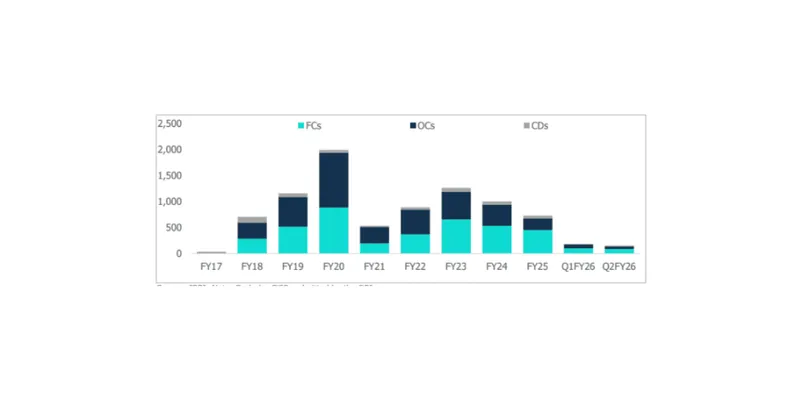
CIRP filings rose steadily until FY20, followed by a sharp decline in FY21 due to the pandemic. Activity rebounded in FY22 and FY23, with FY23 exceeding FY19 levels. However, annual initiations softened in FY24 and FY25.
In Q2FY26, around 154 cases were initiated, slightly lower than Q1FY26. Over time, cases initiated by corporate debtors have dropped significantly, while filings by operational creditors have also declined.
Cumulatively, 8,659 companies have entered CIRP since 2016:
- 4,096 cases initiated by financial creditors
- 4,022 cases filed by operational creditors
- 536 cases initiated by corporate debtors
Cumulative CIRPs: Admitted vs. Ongoing
Since the IBC’s launch, there has been a sharp increase in admitted cases, reinforcing its importance as a debt-resolution tool.
• Admitted cases rose 8.2% y-o-y in Q2FY26.
• Despite this growth, total admissions remain below the five-year average.
• Ongoing CIRP cases held close to 1,900, reducing to 1,898 in Q2FY26 from 1,963 in Q2FY25.
Sector-wise distribution (Sep 2025):
- Manufacturing: 37%
- Real Estate: 22%
- Construction: 12%
- Trade (Wholesale/Retail): 10%
This distribution has remained stable over recent periods.
Status of CIRPs
As of September 2025, out of 8,659 admitted cases:
• 15% have resulted in approved resolution plans (vs. 14.4% in March 2025).
• 21.9% remain in the resolution phase (vs. 23.2% in March 2025).
• Liquidation continues to be the primary closure route—around 33.4% cases (approx. 2,900).
- Nearly 77% of liquidation cases involved former BIFR entities or defunct companies.
• 15.5% were closed on appeal/review/settlement.
• 14.1% were withdrawn under Section 12A, mainly due to full settlements with creditors.
Recovery Rate Stagnates Around 30%
The recovery rate dipped marginally to 32.44% in Q2FY26. Creditors continue to recover roughly one-third of admitted claims. Many long-pending cases now include accumulated interest and overdue charges, inflating admitted claim amounts and reducing the recovery ratio.
Case Resolution Timelines Remain Prolonged
Resolution timelines remain high across stakeholder segments.
• Cases initiated by corporate debtors tend to close faster than those initiated by financial or operational creditors.
• Average timelines increased slightly across categories, showing persistent delays.
As of September 2025:
• 77% of ongoing CIRP cases have been pending for over 270 days (vs. 71% in June 2024).
• Cases resolved within 180–270 days remain the smallest share.
• About 8% of cases fall under both the ‘<90 days’ and ‘90–180 days’ categories.
Delays Persist in Liquidation Cases
Nearly 55% of liquidation cases have been pending for over two years, highlighting extended delays even after firms enter liquidation.
Insolvency Resolution of Personal Guarantors
Cumulatively 4,292 applications were filed (FY20–Q2FY26):
• 121 were withdrawn/rejected/dismissed before RP appointment
• RPs appointed in 1,943 cases
• 721 cases admitted
- Of these:
- 216 were closed
- 12 withdrawn
- 157 closed due to plan rejection/non-submission
Only 44 cases led to approved repayment plans, realising ₹102.78 crore, just 2.16% of admitted claims.
Status of Avoidance Transactions
Resolution professionals have filed 1,570 applications involving approximately ₹3.97 lakh crore.
Breakdown:
- Combination transactions: 774 cases, ₹2.36 lakh crore
- Fraudulent transactions: 493 cases, ₹1.28 lakh crore
- Preferential transactions: 246 cases, ₹30,625.6 crore
- Undervalued transactions: 52 cases, ₹2,230.7 crore
- Extortionate transactions: 5 cases, ₹75.7 crore
Conclusion
The IBC continues to be a central pillar of India’s resolution framework, with recovery rates stabilising near 32% in Q2FY26. While CIRP admissions increased by 8.2% y-o-y, FY25 saw fewer than 1,000 admissions—subdued compared with earlier years. Ongoing cases remain near 1,900, though delays continue to extend beyond statutory timelines.
The IBC Amendment Bill, 2025 is expected to significantly modernise the system by resolving procedural inefficiencies, improving oversight, and enabling alternative resolution mechanisms. These changes aim to reduce delays, enhance recoveries, and improve confidence in the insolvency ecosystem.