How Tariff Wars Are Redefining the Textile Supply Chain?
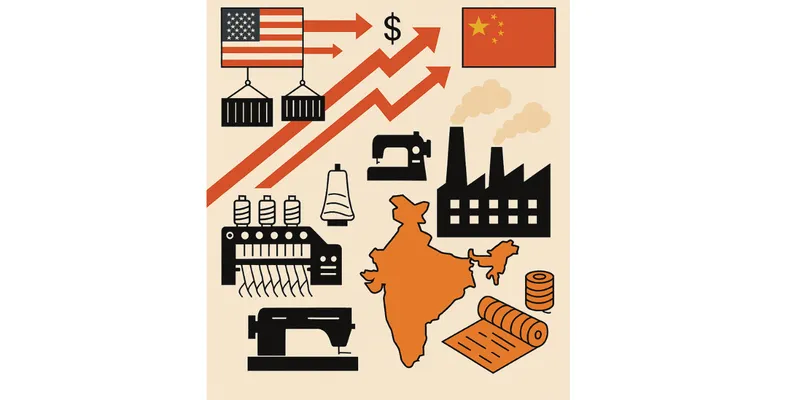
Amid the shifting tides of global trade, few forces have been as quietly transformative for the textile industry as the ongoing tariff wars between major economies. As tensions between the United States and China continue to simmer, their ripple effects are being felt across the world — and India may be among the unexpected beneficiaries.
For decades, China has been the unrivaled manufacturing powerhouse for textiles and apparel, leveraging scale, speed, and cost-efficiency to dominate global supply chains. But with the U.S. and EU intensifying tariffs on Chinese goods and encouraging domestic firms to diversify their sourcing strategies, a tectonic shift is underway — one that is pushing global brands to rethink where, how, and with whom they manufacture.
“Tariff wars are reshuffling the global textile deck faster than many anticipated,” said Pawan Gupta, Co-Founder of Fashinza, a tech-driven platform that connects fashion brands with manufacturers. “We’ve seen a surge of enquiries into India from marquee US and EU buyers trying to diversify away from China. They’re looking for a supply chain that can match price points while delivering agile, design-led production.”
India, with its strong textile heritage and deep manufacturing base, stands at a critical juncture. The opportunity to become a preferred sourcing destination for global brands is real — but the challenge lies in execution. Speed, integration, and innovation are key.
“To capitalise on this once-in-a-lifetime opportunity, India’s large manufacturers and buying houses must move quickly towards inorganic growth and pursue swift consolidation, including acquiring factory capacity and smaller houses that already hold key buyer relationships,” Gupta emphasized. “A large group can then quickly expand the relationship value 2-5x in the short term. The winners will be those who can present a unified, tech-enabled supply chain capable of delivering on-trend SKUs at quick lead times. If industry leaders hesitate, the window will close and the orders will migrate to other emerging hubs.”
This redirection of global sourcing is already being felt in India's textile hubs — from Tiruppur to Panipat and Surat — where increased demand is putting pressure on manufacturers to scale sustainably. At the same time, smaller players with strong buyer ties are emerging as attractive acquisition targets for larger firms seeking immediate global access.
The evolution is also being accelerated by technology. Companies like Fashinza are playing a critical role in modernising the production pipeline, enabling brands to digitize sourcing, gain transparency, and compress lead times — a far cry from the slow, opaque processes of traditional supply chains.
As the world looks for alternatives to China, the race is on. Vietnam, Bangladesh, and even African nations are vying for the same opportunity. India's advantage lies in its breadth of capabilities — spanning raw material production, spinning, dyeing, finishing, and design — and the sheer scale of its workforce.
But in a fast-shifting geopolitical and economic environment, these advantages must be paired with bold, strategic moves. Industry leaders will need to act not just as manufacturers but as supply chain architects — building networks that are responsive, resilient, and globally competitive. The tariff war may have ignited the shift, but it’s vision, speed, and collaboration that will determine who seizes the moment.