How Fabric Care and Detergent Manufacturers Are Cutting Packaging Costs With Automated Case Packers
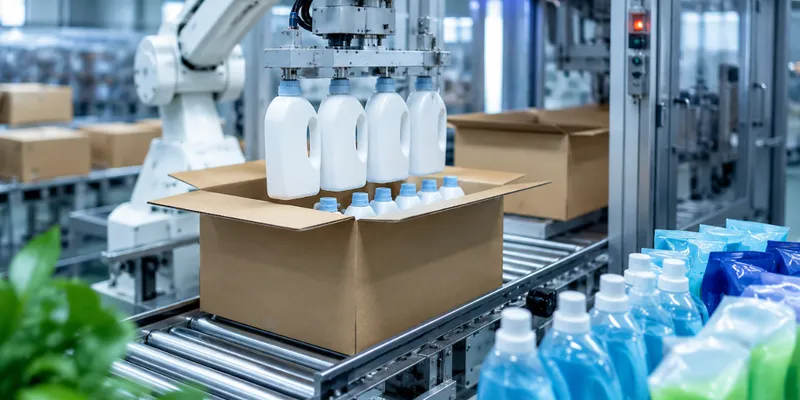
End-of-line packaging for the case packing of fabric care and detergent products is a hugely labor intensive process. As the production volumes increase and as the production shifts lengthen, it becomes costly more quickly. A lot of manufacturers resign themselves to the fact that they have no idea how much it is costing them to carry out manual case packing on a weekly basis.
Once a company looks at its case packing costs, the return on investment from automating case packing becomes a no-brainer. A modern case packer machine eliminates manual handling for the loading, erection and sealing of cases. Case packing machines will always outperform manual case packing as a function of time.
The End-of-Line Packaging Problem Most Manufacturers Ignore
Big investments as a manufacturer of fabric care products have traditionally been in the filling and labeling stages of the production process. However, the end of the production line where the finished goods are packed into shipping cases has usually been left to manual case packing. The result is that the production line cannot operate to its optimal speed.
With manual case packing comes costs that are associated with labor, case packing mistakes, injuries caused through repetitive strain and cases that do not have a consistent packing weight. In years to come, even mid-sized manufacturers will be left with no choice but to invest in fully automated end-of-line case packing systems if they want to remain competitive in a market characterized by low margins and high volumes.
Task of a Case Packer on a Production Line
An example of an automated case packer would be a machine that automatically takes products from a conveyor belt, places them into a shipping case in a particular pattern, seals the case, and prepares it for palletising. Once set, the machine runs the entire process automatically.
Case Packing for Bottles, Pouches, and Cartons
- Bottles, pouches, bags, and cartons come in different forms. Thus, they require different methods when packing.
- Bottles: these can be placed (depending on the transformation of the system) either upright or sideways into a case. This can be done in a speed of 600 cases per hour.
- Pouches and bags: these can be placed into cases either in a position parallel or perpendicular to the case, but pouch packaging cannot be done if it will distort the shape of the pouch.
- Cartons: these will require the use of a packer that will wrap the case around the rigid carton.
Where Automated Case Packers Make the Biggest Difference
Here is where manufacturers in the fabric care and textile auxiliary space see the most direct impact:
Product Type | Manual Packaging Challenge | Case Packer Solution |
Liquid detergent bottles | Inconsistent case counts, spillage risk | Top-load packer with servo-driven placement |
Powder detergent pouches | Pouch deformation, slow manual loading | Horizontal case packer with gentle transfer |
Textile dye cartons | Heavy cartons cause worker fatigue fast | Wraparound packer handles weight automatically |
Fabric softener bottles | Varied bottle heights cause alignment issues | Adjustable guides and vision systems correct in real time |
Each of these applications has a direct solution in the automated case packing category. The payback period on the investment is typically 12 to 24 months depending on current labour costs and production volume.
Key Benefits for Fabric Care and Textile Auxiliary Manufacturers
These gains compound over a full year of production and show up clearly in both labour cost reports and customer complaint rates for damaged goods. The business case for switching from manual to automated end-of-line packaging is straightforward:
- Labour cost reduction
- Consistent case quality
- Higher throughput
- Reduced product damage ing
- Scalability
What to Look for When Choosing a Case Packer
Not all case packers can pack all shapes of products. It is important to determine if the case packer can pack all the pouches, cartons, and products of different shapes, and if not, how much would it cost to customize the machine.
The ideal case packer should have a quick changeover time, which is less than 15 minutes. Additionally, the packers speed should be consistent with the rate at which products will be packaged.
Conclusion
Manual end-of-line packaging holds back detergent and textile auxiliary manufacturers more than most production managers realise until they run the numbers properly. Automated case packers remove the bottleneck, cut labour costs, and bring consistency to a stage of the line that directly affects how products arrive at the customer. Make sure you match the machine to your specific product mix and production volume. The right system pays for itself faster than most capital investments on the production floor.