How China’s Custom Machining Supply Chain Is Evolving Beyond Cost-Based Labor Advantages
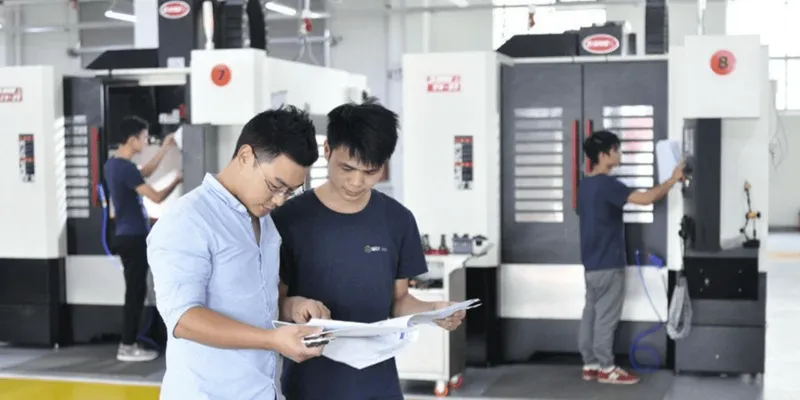
The custom CNC machining industry of China is of high value to its manufacturing sector. China’s domination over global supply chains can be explained by its smart use of cost-competitive labor. However, since the technological revolution has shaken the world, this fails to be an advantage. Additionally, strategic investments in human capital and a growing demand for precise manufacturing have evolved the industry for good.
The value of CNC’s machine tool market was 268.7 billion yuan in 2021. This value shows that China has great potential for serving high-end industrie, such ass aerospace, medical devices, and electronics.
In this article, you will learn what factors contribute to this transformation.
China’s Manufacturing Infrastructure and Scale
Industrial Ecosystem and Supplier Networks
A strong industrial ecosystem is the backbone behind China's successful custom machining supply chain. This ecosystem takes great pride in extensive supplier networks, quick logistics, and easy raw material access. These three factors combine to form the rapid supply chain used by companies like Wayken Rapid Manufacturing for prototype development.
Industrial clusters help facilitate efficient production by linking manufacturers, suppliers, and logistics providers. These clusters reduce lead times and eliminate the need for transportation. Due to this, China shows excellent potential for meeting industrial demands, shown by its production of 50.5% of global machine tools and exports worth $13.6 billion.
In this way, manufacturers can easily share expertise and resources, which improves scalability and operational efficiency.
Policy Support and Industrial Strategy
The improvement in China’s manufacturing can be heavily credited to the “Made in China 2025” initiative. This is a policy that was introduced in 2015 and has great ambitions to make China a global leader in high-end manufacturing. For this, it has a keen focus on aerospace, electronics, and automotive industries.
It prioritises being on par with technological upgrades and innovation, while also manufacturing smartly.
Additionally, despite the rise of labor costs, China has been able to gain a competitive edge because of government incentives. These incentives include subsidies and tax breaks that have fostered the development of advanced manufacturing facilities and prioritised producing high-value goods.
For example, domestic CNC machine tool brands were developed because they were funded by the state. This funding allowed China to be independent of foreign technologies.
Demographic and Economic Shifts
One extensive look at Chinese history shows that its manufacturing growth was fueled by a cheap and large labor force. This quality was of great interest to foreign investors and outsourcing.
However, this no longer remained an advantage because of demographic changes, which were an aging and declining population paired with fast-paced economic growth. As a result, manufacturers were pushed to adopt more innovative competitive strategies.
Regardless, China has a thriving supply chain and economies of scale, which continue its progress towards precise manufacturing so that it remains relevant in global markets.
Changing Cost Dynamics in Custom Machining
One reason behind the evolution of China’s custom machining industry is the changing cost structure.
Firstly, there have been significant changes in labor costs. In 2021, average hourly labor costs for CNC machining in China were in the range of $10 to $50. This rate was significantly different compared to $100 or higher in North America and Europe.
You can see that the cost gap was narrowing despite still being competitive. This results from wage demands and urbanization and prompts a shifttoward automation.
Secondly, manufacturers have reduced their dependency on labor by 40% in some facilities because they prefer robotic arms and automated CNC systems. So, production is efficient, and there is a reduction in rising wage costs.
Additionally, China has access to raw materials that normally have competitive prices, giving it an advantage in cost. However, materials like titanium are high in value and harder to machine, which balances the cost advantage to some extent.
So, these adaptations show that China prioritises technological efficiency and quality to maintain competitiveness.
Technological Advancements in CNC Machining
Technological innovation is at the heart of China’s custom machining evolution. Some of these technologies include:
Industry 4.0 Technologies
Every day, CNC operations are transformed by Artificial Intelligence (AI) and the Internet of Things (IoT).
For example, systems run by AI and following predictive maintenance reduce downtime by 20-30%. They do this by analysing the machine’s data and predicting future failures.
Additionally, sensors that have been installed with IoT give you data on how the machine is performing, which helps to conserve energy and improve the overall process.
As a result, Chinese manufacturers exhibit a competitive nature as these technologies improve productivity and reduce unnecessary money usage during operations.
High-Precision CNC Systems
The production of complex components with 0.001 mm tolerances is of great importance to manufacturers. They use high-speed machining (HSM) and 5-axis CNC systems for this task.
This ability is highly valued by industries like aerospace, where precision is vital for production, and medical devices, where intricate designs are the norm.
For example, 5-axis machines enable simultaneous multi-angle machining. This machining helps reduce setup times and improve accuracy.
Specialized CNC Industries
The custom machining sector in China aims to mass-produce specialized applications of high quality. This is why they invest in advancing specific machining technologies.
For example, micromachining is a technology used to produce sub-micron components for medical devices and electronics. It supports the creation of intricate designs with tolerances below 0.005 mm that fulfill the demand of miniaturized applications in high-tech industries.
Another technology worth investing in is Swiss-typeturning. It is used in the automotive and medical industries to produce small parts precisely. One great quality of Swiss–type turning is that it can be machined continuously with minimal vibration and maintains uniform quality for components like surgical implants.
This focus on specialization and China’s compliance with environmental standards like ISO 14001 attracts international clients, giving it a competitive edge.
However, despite these advancements, foreign brands like Siemens, Fanuc, and DMG Mori dominated the high-end CNC systems market in China by having a 67% share in 2022.
Since China heavily relies on imported technology, this has encouraged R&D investments to go for domestic alternatives instead.
For example, the company, Shenyang Machine Tool Co., is hard at work to close this gap by openly collaborating with universities. They are also reliant on funding from the government.
Workforce Development and Skill Enhancement
A shift in advanced manufacturing demands an upgrade in workforce skills that can operate these sophisticated systems.
China has heavily focused on developing its workforce by investing in education and vocational training. These programs teach CNC programming, automation, and Statistical Process Control (SPC) so that operators can meet international standards like ISO 9001.
Additionally, manufacturers like Luxshare Precision and Foxconn offer in-house training programs to improve workers’ skills by training them to handle new technologies.
As a result, China’s proactive approach ensures a steady supply of qualified professionals.
Conclusion
China’s custom machining supply chain has undergone a remarkable transformation by adopting a precise ecosystem that is driven by technological innovation.
This transformation allows China to compete in the realms of quality, precision, and innovation, making it a strong competitor in global custom machining.