How Automated Powder Mixing and Packaging Systems Improve Textile Chemical Production
Textile manufacturing depends on far more than fibers, yarns, and fabrics. Behind every dyeing, printing, coating, washing, and finishing process is a carefully prepared chemical formulation. These formulations may include powdered dyes, pigments, detergents, softeners, binders, bleaching agents, and other textile auxiliaries.
For textile chemical manufacturers, producing these materials consistently can be challenging. Fine powders may generate dust, ingredients can separate during handling, and inaccurate filling can lead to inconsistent package weights. When mixing and packaging are operated as separate manual processes, these problems become more difficult to control.
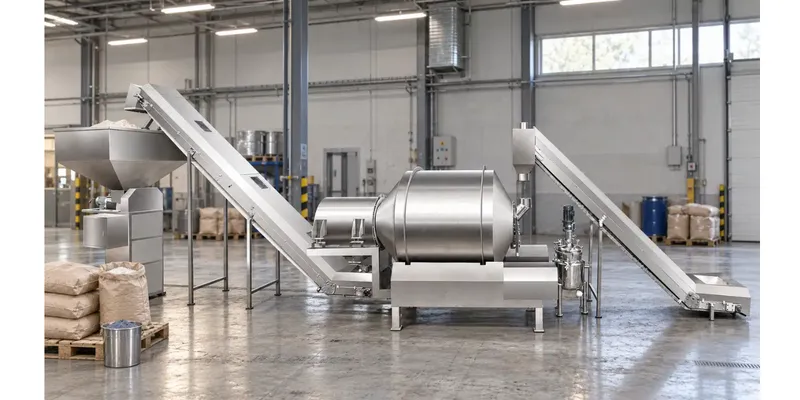
An integrated powder mixing and packaging system can connect material feeding, blending, conveying, weighing, filling, and sealing into one coordinated workflow. This approach helps manufacturers improve product consistency, reduce manual handling, and prepare finished textile chemicals for safer storage and transportation.
Why Consistency Matters in Textile Chemical Production
The performance of a textile chemical product depends heavily on formulation accuracy. Even a small variation in the proportion of pigments, additives, or processing agents may affect shade consistency, solubility, dispersion, or performance during textile production.
Uniform mixing is therefore one of the most important stages in the process. It is not enough for the ingredients to enter the mixer in the correct quantities. They must also be distributed evenly throughout the batch.
Different powder characteristics can make this difficult. Some ingredients are fine and lightweight, while others are denser or more granular. If the mixing method is not suitable, lighter particles may remain near the top while heavier materials settle toward the bottom.
A properly selected industrial mixer helps reduce this separation and creates a more homogeneous finished product. The choice of mixer should be based on bulk density, particle size, flowability, batch capacity, mixing time, and the sensitivity of the formulation.
Common Problems with Manual Powder Handling
Manual handling is still common in small and medium-sized textile chemical plants. Operators may open bags, weigh ingredients, load a mixer, discharge the finished batch into containers, and then transfer the material to a separate packaging area.
Although this method requires less initial investment, it can create several operational problems.
First, repeated exposure to fine powder increases housekeeping requirements and may affect the working environment. Dust can collect around weighing stations, mixer outlets, conveyors, and filling points.
Second, frequent manual transfer increases the risk of material loss and contamination. Every open container or transfer step introduces another point where moisture, foreign particles, or material from a previous batch may enter the product.
Third, manual weighing and filling make it more difficult to maintain consistent package weights. Overfilling increases material costs, while underfilling can create quality and customer satisfaction problems.
Connecting the main processing stages reduces unnecessary transfer points and gives operators better control over the production flow.
Building an Integrated Mixing and Packaging Workflow
A typical automated line begins with raw material feeding and weighing. Depending on the formulation, ingredients may be introduced manually through a dust-controlled feeding station or transferred from storage containers through enclosed conveying equipment.
The measured ingredients then enter the mixing system. Ribbon blenders are often suitable for efficient mixing of free-flowing powders and granules, while other formulations may require gentler blending or specialized agitator designs. The mixer capacity should match the required batch size and the output of the downstream packaging machine.
After mixing, the finished product must be discharged without allowing the formulation to separate. Enclosed screw conveyors, vacuum conveyors, or sealed transfer systems can move the powder from the mixer to a temporary storage hopper or directly to the filling system.
A level sensor can help coordinate the mixer, conveyor, and packaging machine. When the packaging hopper reaches its set level, the conveying system can pause. As the material level falls, feeding can resume. This prevents both material shortages and overfilling at the packaging station.
The final stage includes dosing, bag forming or bag feeding, filling, and sealing. Additional equipment such as printers, checkweighers, metal detectors, dust collectors, or finished-bag conveyors may be added according to production requirements.
Matching the Packaging System to the Material
Not every textile chemical powder behaves in the same way. Fine pigments may be dusty and difficult to control, while granular detergents or additives may flow more freely. Some powders may absorb moisture, form lumps, or retain air during filling.
The dosing system must therefore match the material characteristics. Auger fillers are commonly used for fine or low-flow powders because the rotating screw provides controlled dosing. Free-flowing granules may be better suited to gravity feeding or weighing systems.
Package size is another important consideration. Small retail or sample packs require different equipment from industrial bags used by dyeing mills and textile processing plants. Manufacturers should define the required bag weight, bag dimensions, packaging material, sealing method, output target, and acceptable filling tolerance before selecting a machine.
When evaluating automated powder packaging equipment, manufacturers should also consider whether the system can be adjusted for future products. A factory may initially package one dye or auxiliary but later introduce different formulations, package sizes, or production volumes.
Benefits of Connecting Mixing and Packaging
An integrated system provides benefits beyond faster production. One of the most important advantages is improved batch consistency. When material moves through an enclosed and coordinated process, there are fewer opportunities for segregation or accidental mixing with another product.
Automation can also reduce repetitive manual work. Operators can focus on material preparation, parameter setting, quality checks, and equipment monitoring rather than continuously carrying and filling containers.
Better dust control is another potential benefit. Enclosed conveyors, sealed connections, and localized dust collection can reduce the amount of powder released during feeding, discharge, and packaging. However, the complete dust-control design must be based on the characteristics and safety requirements of the actual material.
Integrated systems can also improve production records. Batch numbers, filling weights, production times, and machine parameters can be recorded more consistently when suitable control and coding equipment are included.
Finally, an integrated line can make production planning easier. Mixer capacity, conveying speed, and packaging output can be balanced to reduce waiting time between processes.
Important Engineering Considerations
Before introducing automation, manufacturers should test the actual material whenever possible. Similar-looking powders can behave very differently inside mixers, conveyors, hoppers, and filling systems.
The supplier should receive representative samples and accurate information about bulk density, particle size, moisture sensitivity, flowability, dust level, and any corrosive or hazardous characteristics.
Material compatibility is also important. Stainless steel contact parts are widely used because they are durable and relatively easy to clean, but the appropriate grade and surface treatment depend on the formulation. Some textile chemicals may require additional corrosion resistance, specialized seals, or other protective features.
Factories should also evaluate cleaning and changeover procedures. If several colors or formulations share the same line, residual material from the previous batch can affect the next product. Accessible mixer interiors, removable contact parts, suitable discharge design, and clear cleaning procedures help reduce cross-contamination risks.
Available floor space, ceiling height, electrical supply, compressed-air requirements, operator access, and future maintenance must be considered during layout planning. A machine that performs well individually may still cause problems if it cannot be integrated efficiently into the existing factory.
A Practical Approach to Automation
Automation does not always require replacing the entire production process at once. Some manufacturers begin by improving the most labor-intensive stage, such as powder filling or material conveying. Other factories install a complete system when increasing capacity or launching a new product range.
The best approach depends on current output, labor availability, product variety, quality requirements, and investment plans. A clear process analysis should identify where material is lost, where delays occur, and which manual steps create the greatest consistency or safety concerns.
Equipment should then be configured around the actual production process rather than forcing the factory to adapt to a standard machine layout.
Conclusion
Textile chemical manufacturers must control formulation accuracy, mixing uniformity, dust, material transfer, and package weight at every stage of production. Treating these steps as one connected process can improve consistency and reduce unnecessary manual handling.
A well-designed mixing and packaging system should reflect the properties of the material, required batch capacity, package format, cleaning procedure, and available factory space. Careful testing and engineering are essential because there is no single configuration suitable for every powder or textile chemical formulation.
By evaluating the complete workflow—from raw material feeding to final bag sealing—manufacturers can build a more stable, efficient, and scalable production process.