Home Textile Products Market 2026: Data-Driven Growth Trends, Consumer Demand, and Industry Insights
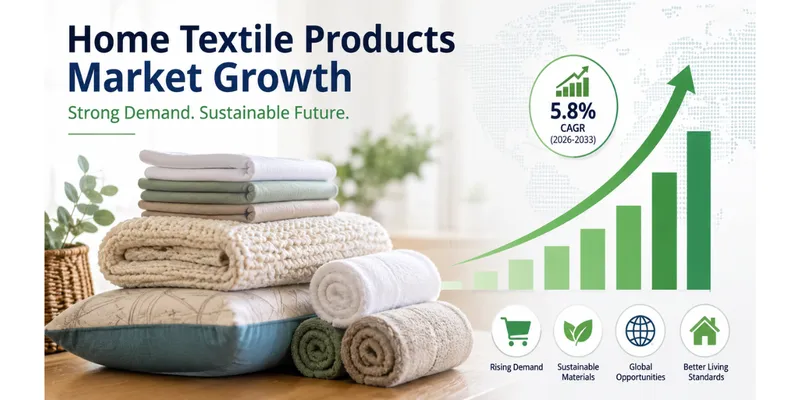
The global home textile products industry is undergoing rapid transformation as consumers prioritize comfort, sustainability, and premium interior aesthetics. According to recent market observations by Dataintelo, the sector crossed USD 135 billion in 2025 and is projected to grow at a CAGR of 5.8% between 2026 and 2033. In the introduction phase of this analysis highlights that rising urbanization, increasing disposable income, and the expansion of e-commerce channels are significantly accelerating demand for home textile products worldwide.
Home textile products include bed linen, curtains, towels, upholstery fabrics, carpets, cushions, blankets, and kitchen textiles. The industry witnessed a notable consumption spike after 2021, with online sales of home décor and textile products increasing by nearly 38% globally between 2021 and 2024. Asia Pacific currently dominates production, accounting for approximately 46% of global textile manufacturing output in 2025.
Key Statistics at a Glance
Metric | Value |
Global market value (2025) | USD 135 Billion |
Expected CAGR (2026–2033) | 5.8% |
Asia Pacific production share | 46% |
Online sales growth (2021–2024) | 38% |
Cotton textile demand increase (2024–2025) | 12% |
Sustainable textile adoption growth | 29% |
Smart textile segment CAGR | 8.4% |
Luxury bedding market growth | 7.1% annually |
U.S. home textile imports (2025) | USD 29 Billion |
Average household textile spending | USD 780 annually |
Recycled fiber utilization growth | 31% |
Hospitality sector textile demand rise | 18% |
Antimicrobial textile demand growth | 22% |
Digital textile printing adoption | 27% increase |
Europe sustainable textile market share | 34% |
2026 Market Performance Metrics Driving Industry Expansion
The home textile products market has become increasingly data-centric, with manufacturers relying on predictive analytics and consumer behavior trends. Between 2022 and 2025, global household spending on home furnishing textiles increased from USD 640 to USD 780 per household annually, representing a 21.8% rise.
Several measurable factors are influencing this growth:
• Urban housing projects increased by 14% globally in 2025
• Premium bedding product sales grew by 19% year-over-year
• Smart textile integration expanded by 26% since 2023
• Demand for eco-friendly materials rose by 29% globally
• Hospitality textile procurement increased by 18% after tourism recovery
The rapid growth of short-term rental platforms and luxury hospitality chains has also increased bulk demand for towels, bed sheets, and upholstery products.
5 Data-Backed Reasons Fueling Home Textile Market Growth
1. Rising E-Commerce Penetration
Online platforms contributed nearly 41% of global home textile sales in 2025, compared to just 27% in 2020. Faster delivery timelines and AI-based product recommendations have significantly improved conversion rates.
2. Sustainability Becoming a Purchase Driver
Consumer surveys conducted in 2025 indicate that 63% of buyers prefer sustainable or recycled textile products. Recycled polyester usage in home furnishings rose by 31% between 2022 and 2025.
3. Smart Homes Increasing Smart Textile Demand
Smart curtains, temperature-regulating bedding, and antimicrobial fabrics are seeing increased adoption. The smart home textile segment is forecast to grow at an 8.4% CAGR through 2033.
4. Hospitality Sector Recovery
Hotel occupancy rates improved by 17% globally in 2024, directly impacting textile replacement demand. Luxury hotels replace linen inventories every 18–24 months, creating recurring revenue opportunities.
5. Digital Textile Printing Revolution
Digital textile printing adoption increased by 27% since 2021, reducing production waste by nearly 18% while enabling customized designs and shorter manufacturing cycles.
Regional Market Insights with Numerical Comparisons
Asia Pacific
Asia Pacific remains the largest manufacturing hub, contributing 46% of total production capacity. China and India collectively exported over USD 52 billion worth of home textile products in 2025.
North America
The United States imported approximately USD 29 billion in home textile products in 2025, with bedding products accounting for nearly 39% of total imports.
Europe
Europe dominates sustainable textile adoption, holding 34% of the global eco-friendly textile market share. Organic cotton bedding demand increased by 24% in 2025 alone.
Middle East & Africa
Luxury hospitality expansion in the Middle East boosted premium textile demand by 15% year-over-year, particularly in UAE and Saudi Arabia.
Emerging Trends Reshaping the Industry
Antimicrobial and Health-Focused Textiles
Post-pandemic hygiene awareness increased antimicrobial textile demand by 22% globally. Healthcare and hospitality sectors remain major consumers.
Luxury Bedding Segment Expansion
The luxury bedding market is growing at approximately 7.1% annually, driven by high-income consumers seeking premium sleep products.
AI and Automation in Manufacturing
Automated textile production systems improved manufacturing efficiency by nearly 18–25%, while reducing labor dependency and production errors.
Competitive Landscape and Industry Challenges
Despite strong growth, manufacturers face several measurable challenges:
Challenge | Impact |
Raw material price volatility | Cotton prices fluctuated 16% in 2025 |
Energy cost increases | Manufacturing costs rose 11% |
Supply chain delays | Delivery timelines extended by 9 days |
Labor shortages | Production efficiency reduced 7% |
However, companies investing in automation, sustainable sourcing, and digital retailing are outperforming competitors by maintaining stronger profit margins.
Future Forecast: 2026–2033 Outlook
Industry projections indicate the home textile products market could exceed USD 210 billion by 2033 if the current 5.8% CAGR continues. Smart textiles, recycled fibers, and premium bedding are expected to contribute more than 48% of incremental revenue growth over the next decade.
E-commerce is also expected to surpass 50% of total industry sales by 2030, fundamentally reshaping distribution channels and customer engagement strategies.
Conclusion
The home textile products industry is evolving rapidly with measurable growth across sustainability, smart fabrics, luxury bedding, and digital commerce. With the global market surpassing USD 135 billion in 2025, strong momentum is expected to continue through 2033 at a projected 5.8% CAGR. Rising online sales, increasing eco-friendly adoption rates, and growing hospitality demand are creating substantial opportunities for manufacturers and retailers worldwide. Companies leveraging automation, recycled materials, and data-driven consumer strategies are likely to capture the largest share of future market expansion.
Read A Full Report: https://dataintelo.com/report/home-textile-products-market