High-Temperature Composite Resins Market to Hit USD 2.36B by 2034
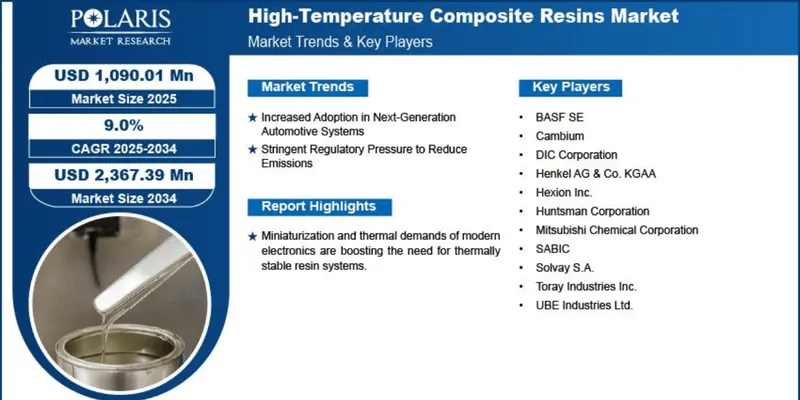
Growing demand in aerospace, defense, and EV industries boosts high-temperature resin market.
The global high-temperature composite resins market is forecast to reach USD 2.36 billion by 2034, driven by aerospace innovation and lightweight material adoption.
Industrial operations such as aerospace, defense, and space exploration often expose materials to extreme heat and stress — with jet engine temperatures surpassing 1,700°C. In these demanding conditions, conventional materials often fail to perform, paving the way for high-temperature composite resins, which have become essential for manufacturing durable and high-strength composite structures.
This report provides an overview of the high-temperature composite resins market, its key material types, and the major factors driving its strong global growth.
Understanding High-Temperature Composite Resins
High-temperature composite resins are advanced polymers engineered to maintain structural, mechanical, and chemical integrity even under intense heat exposure. These thermally stable, oxidation-resistant materials are critical in producing high-performance composites that must withstand harsh environments — particularly in aerospace, automotive, and industrial applications.
Types of High-Temperature Composite Resins
Epoxy Resins
Among the most widely used high-performance polymers, epoxy resins are known for their strong adhesion, excellent chemical resistance, and mechanical strength. Reinforcing them with fibers like carbon or glass enhances their durability and toughness. Modified epoxy systems can operate at temperatures up to 250°C, making them ideal for aerospace fuselages, automotive under-the-hood parts, and sporting equipment.
Phenolic Resins
Phenolic resins excel in flame resistance, low smoke emission, and high heat tolerance, maintaining performance beyond 300°C. Their exceptional thermal stability makes them indispensable for braking systems, clutches, and high-temperature gaskets, where safety and endurance are critical.
Bismaleimide (BMI) Resins
BMI resins combine excellent toughness with high heat resistance, functioning effectively above 230°C. Widely used in aerospace and defense — including jet engines, missile systems, airframes, and radomes — BMI resins resist fatigue and ensure long-term structural stability, supporting mission-critical performance in extreme conditions.
Market Overview and Key Metrics
According to Polaris Market Research, the global high-temperature composite resins market was valued at USD 1,000.93 million in 2024 and is expected to reach USD 2,367.39 million by 2034, registering a compound annual growth rate (CAGR) of 9.0% between 2025 and 2034.
Key Market Growth Drivers
1. Rising Demand in Aerospace and Defense
The aerospace and defense industries are among the largest consumers of high-temperature composite resins. Jet engine casings, missile components, and thermal shielding systems all require materials capable of enduring extreme heat and stress. With increasing air traffic and growing defense budgets, manufacturers are turning to these resins for superior performance, durability, and weight efficiency.
2. Shift Toward Lightweight Automotive Design
As automotive manufacturers strive to reduce emissions and enhance fuel efficiency, lightweight composite materials are gaining traction. High-temperature resins are particularly valuable for electric vehicle (EV) components such as battery housings, under-the-hood systems, and braking assemblies, improving energy efficiency without compromising structural strength.
Emerging Market Trends
1. Advancements in Resin Formulations
Continuous R&D is fueling innovations in resin chemistry, leading to materials that offer greater thermal stability, mechanical performance, and durability. These developments are broadening applications while reducing long-term maintenance costs.
2. Expanding Role in Renewable Energy
The renewable energy sector, especially wind power, is increasingly adopting high-temperature composite resins for turbine blades and structural components. These resins withstand mechanical stress, environmental exposure, and temperature fluctuations — making them essential for reliable and efficient wind energy systems.
3. Focus on Sustainability and Recyclability
Environmental responsibility is shaping material innovation. Manufacturers are investing in bio-based and recyclable resins to align with stricter sustainability regulations and consumer expectations for greener production processes.
Conclusion
High-temperature composite resins represent a significant milestone in material science — enabling the creation of lighter, stronger, and more heat-resistant components. With applications spanning aerospace, defense, automotive, and renewable energy, the market is poised for sustained expansion through 2034.
Read more at www.polarismarketresearch.com.