Heat Sinks Market Projected to Reach USD 19.32 Billion by 2034, Growing at 7.7% CAGR
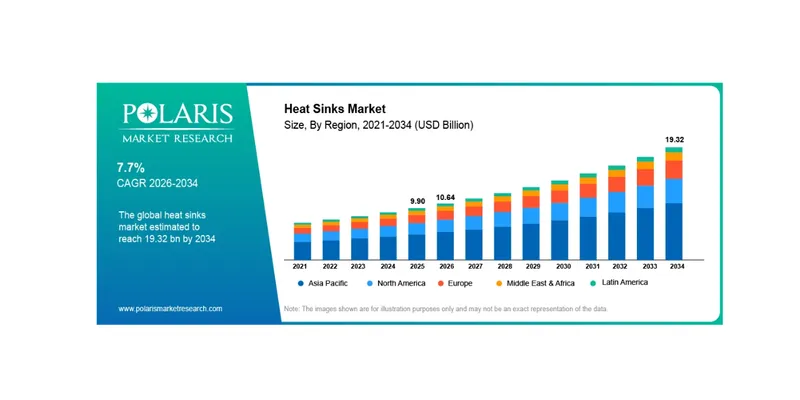
Rising AI computing power, liquid cooling adoption and electric vehicle production are reshaping thermal management, creating opportunities for advanced heat sink technologies.
The global heat sinks market was valued at USD 9.90 billion in 2025 and is projected to reach USD 19.32 billion by 2034, registering a compound annual growth rate (CAGR) of 7.7%. Increasing power consumption in artificial intelligence (AI) chips, expanding data centre infrastructure and growing demand for electric vehicle (EV) cooling systems are driving changes in thermal management technologies.
As AI processors generate increasingly high levels of heat, thermal management is becoming a central consideration in data centre design. NVIDIA has stated that its AI devices are rapidly surpassing 1,000 watts per chip, a level at which air cooling alone can struggle to maintain safe operating temperatures.
Heat Sink Technologies Shift Towards Advanced Cooling
The heat sinks market is developing along two main paths: conventional air-cooled designs and advanced liquid cooling solutions.
Extruded aluminium heat sinks accounted for the largest product share at 35.42%. Their relatively low manufacturing costs, customisation flexibility and suitability for consumer and industrial electronics continue to support demand. Aluminium remained the dominant material, with a 45.28% market share.
At the higher-performance end, liquid cold plates are gaining traction. These systems use circulating coolant to transfer heat away from chips rather than relying solely on fins and airflow. The liquid cold plate segment is forecast to grow at a CAGR of 12.78%, significantly faster than the overall market's projected 7.7% growth.
Copper is also gaining ground in applications where aluminium cannot transfer heat quickly enough.
Data centres and AI servers accounted for 28.64% of heat sink demand. As successive generations of AI accelerators increase power density, cooling requirements are becoming more demanding. Electric vehicles are another growth driver, as silicon carbide power modules require effective thermal management. The automotive and EV segment is projected to expand at an annual rate of 8.22%.
Business Opportunities and Challenges in Thermal Management
The shift towards advanced cooling systems is creating opportunities for suppliers able to develop higher-value products. Liquid cooling modules can command prices several times higher than air coolers, potentially increasing revenue per unit for manufacturers moving into advanced thermal technologies.
For server manufacturers and hyperscale data centre operators, thermal design increasingly influences how densely racks can be configured and which processors can be deployed. Cooling requirements are therefore becoming an early-stage design consideration rather than a final component decision.
However, the transition presents challenges for established suppliers. Liquid cooling is taking a growing share of high-end computing applications, putting pressure on manufacturers focused primarily on conventional fins and fans.
New suppliers also face high entry barriers. Vendors must complete platform-specific testing before supplying AI server programmes, while advanced manufacturing processes require specialised capabilities, including skived fins and brazed cold plates. Demand is also concentrated among a relatively small number of large buyers.
Air cooling is nevertheless expected to remain relevant across consumer electronics, telecommunications and power equipment, where cost-effective thermal solutions continue to be required. Vapor chambers and heat pipes also remain important in air-cooled AI servers, helping spread heat from concentrated hotspots across a larger surface area.
Asia Pacific Leads the Heat Sinks Market
Asia Pacific accounted for 42.46% of the global heat sinks market in 2025, supported by its concentration of electronics manufacturing. China, Japan, South Korea and Taiwan have established semiconductor and server supply chains, while expanding EV production is adding to regional cooling demand.
China's EV sales increased from 11.2 million units in 2024 to 13.2 million in 2025. Taiwanese thermal management suppliers have also reported record monthly revenue supported by orders for liquid cooling technologies.
North America is projected to grow at a CAGR of 7.54%. The region's expansion is being driven primarily by large-scale investment in AI infrastructure and data centres. Meta has committed to investing more than USD 600 billion in the United States by 2028 in AI and data centre infrastructure, increasing the need for cooling systems across new facilities.
Europe accounted for 20.36% of the market, with data centre development and automotive electronics investment supporting demand. Amazon's USD 39.8 billion commitment in Spain is among the investments contributing to the region's infrastructure expansion.
Additional semiconductor manufacturing capacity outside Taiwan could also reshape thermal management supply chains. Tata Electronics' USD 11 billion plant in Gujarat, India, represents one such development that could eventually attract thermal suppliers closer to emerging manufacturing clusters.
Competition Expands from Components to Integrated Systems
Although the heat sinks market remains fragmented, competition is increasingly centred on integrated thermal management systems rather than individual components.
Eaton's USD 9.55 billion acquisition of Boyd Thermal highlighted the growing importance of thermal technologies to power-management businesses. Ecolab has agreed to acquire CoolIT Systems, while Vertiv acquired Strategic Thermal Labs to strengthen its cold-plate design and validation capabilities.
These developments reflect a broader industry shift towards combining heat removal, power delivery and liquid distribution within integrated systems.
Taiwanese specialists are also expanding their capabilities. Asia Vital Components reported revenue of NT$15.9 billion in May 2026, a 61% year-on-year increase, supported by demand for vapor chambers and thermal modules.
Delta Electronics has begun shipping a 3 MW coolant distribution unit, while Advanced Cooling Technologies has expanded a Pennsylvania plant to manufacture cold plates for AI data centres.
In this environment, differentiation increasingly depends on qualification for specific GPU platforms and the ability to manufacture and deliver products at scale, rather than competing on price alone.
Emerging Technologies and Supply Chain Developments
Further consolidation is expected as larger companies combine conventional heat sinks with liquid cooling and other thermal technologies. Two-phase cold plates are among the emerging approaches being explored to support higher cooling capacity as data centre racks become denser. These systems use coolant that boils near the chip and condenses further along the cooling circuit.
The location of manufacturing facilities may also influence future supply chains. Production capacity established near new semiconductor fabrication plants and data centre clusters could encourage thermal management suppliers to establish a stronger local presence.
Thermal Management Becomes a Strategic Consideration
The heat sinks market's projected growth reflects a broader change in computing infrastructure: heat dissipation is becoming a key constraint on the deployment of increasingly powerful processors.
For manufacturers, the challenge is to determine where to invest along the transition from conventional fin-based designs to liquid cooling systems. For buyers, thermal management needs to be incorporated into infrastructure planning from the beginning of a project.
As AI computing, data centres and electric vehicles expand, heat sinks are moving beyond their traditional role as commodity components towards becoming an increasingly important part of system-level design and performance.