Greece Credit Update August 2025 | Fiscal Gains vs Legacy Risks
Legacy Risks Continue to Overshadow Greece’s Fiscal Progress
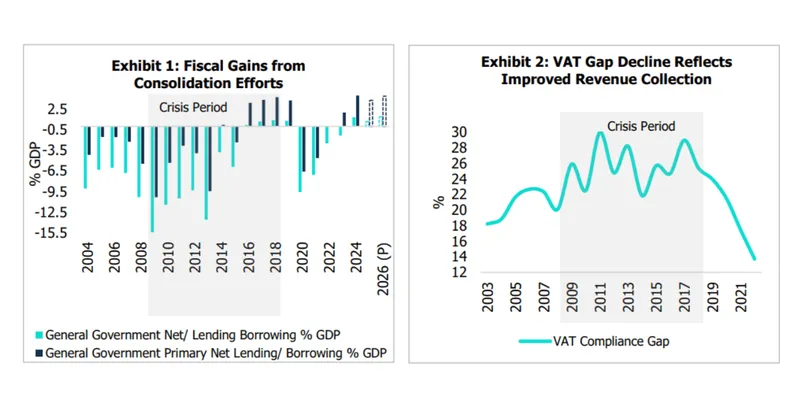
Greece has made notable progress since the sovereign debt crisis of 2009–2018, returning to a general government surplus in 2024. This reflects fiscal discipline and reform momentum. However, the critical issue remains whether such progress is sustainable in the medium term.
Despite fiscal gains, Greece’s credit profile continues to be weighed down by legacy challenges. External debt remains elevated, general government debt is still high, and nominal GDP growth has largely stagnated compared to pre-crisis levels. As Greece gradually shifts from official sector funding (such as the ESM and EFSF) toward market-based borrowing, interest costs are expected to rise moderately. Sustaining fiscal gains while managing vulnerabilities is therefore essential to maintain macroeconomic stability.
Fiscal Performance: Surplus Achieved
- In 2024, the general government balance posted a surplus of 1.3% of GDP, compared with an average deficit of –5.1% between 2020–2023.
- The primary surplus was also healthy, at 4.8% of GDP.
- These improvements stemmed from structural tax reforms, notably in digitalisation, VAT compliance, and anti-tax evasion measures.
- The VAT gap fell from 25% in 2018 to 14% in 2022, with further reductions expected.
- Expansionary measures worth EUR 1.1 billion were introduced in 2025, including rent subsidies, pension support, and increased public investment.
- Looking forward, the surplus is forecast to narrow to 0.7% of GDP in 2025, before rising again to 1.4% in 2026, supported by revenue growth.
Debt Burden: Declining, Yet Still High
- Government debt-to-GDP fell from over 190% in 2018 to 151% in 2024, supported by growth, surpluses, and proactive debt management.
- Early repayments to the IMF and euro area partners since 2021 have reduced refinancing risks and interest costs.
- Debt is projected to fall below 130% by 2029 and under 115% by 2033, though still above pre-crisis levels.
Economic Performance: Growth and Tourism Gains
- Greece’s real GDP grew 2.3% in 2024, outperforming the euro area for the fourth consecutive year.
- Strong private consumption, sustained investment, and EU Recovery and Resilience Facility support underpinned this growth.
- Tourism achieved record highs, with 36 million arrivals in 2024 and receipts of EUR 19 billion.
- The unemployment rate dropped to 10.1% in 2024, down sharply from 27.5% in 2013.
- Banking sector strength improved, with NPLs reduced to 3% in 2024, though still above the EU average of 1.9%.
Continuing Legacy Risks
- External Position: Gross external debt at 227% of GDP in 2024 and NIIP at –126% highlight ongoing vulnerabilities. Current account deficits (6.9% of GDP in 2024) remain persistent due to import-heavy investments and structural trade imbalances.
- General Government Debt: Still high compared to peers. Fiscal risks persist via government guarantees (10.9% of GDP) and SOE liabilities (72% of GDP).
- Past Defaults: The 2012 restructuring and 2015 IMF arrears continue to affect investor perceptions, despite improved statistical credibility.
- Private Debt: Elevated at 96.8% of GDP in 2023, though reforms (such as out-of-court settlements) aim to improve resolution.
Outlook and Key Aspects to Monitor
- Sustaining primary surpluses is critical for keeping debt on a declining path.
- Growth is projected at 2% in 2025, moderating to 1.4% in the medium term as NGEU funds taper and demographic pressures rise.
- Structural weaknesses include low investment rates (15% of GDP vs EU average of 21%), shrinking working-age population, and sluggish productivity.
- Continued reforms will be essential to maintain resilience.
Conclusion
Greece has made significant strides, with stronger growth, improved fiscal balance, and declining debt. Yet, the country’s credit profile remains constrained by high public and external debt, contingent liabilities, and legacy private-sector debt. With greater reliance on market financing, the cost of borrowing may rise, testing fiscal discipline. Dependence on tourism and shipping also exposes Greece to external shocks.
CareEdge Global will continue monitoring Greece’s fiscal trajectory, debt reduction pace, and structural reforms. Addressing legacy vulnerabilities and sustaining reforms will be vital for strengthening long-term resilience.