Government outlines support measures for spinning mills
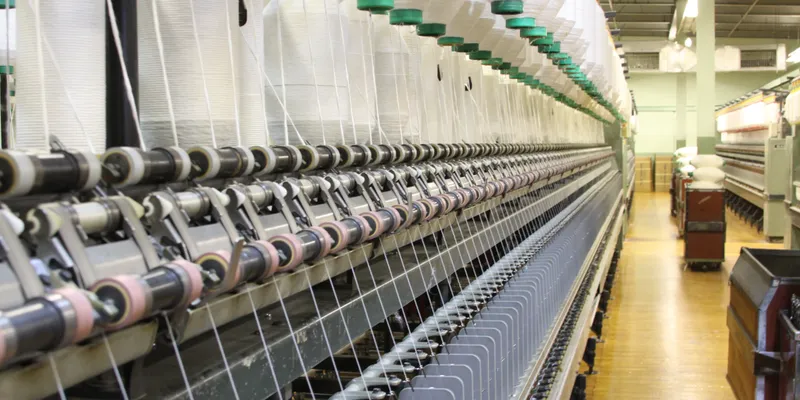
According to the Annual Survey of Industries (ASI), Ministry of Statistics & Programme Implementation (MOSPI), data on spinning mills has been compiled on a State/UT basis, including total factories, factories in operation and other units classified under “Preparation and Spinning textile fibres (1311)”. The Ministry clarified that it does not maintain specific information regarding the closure of spinning mills.
The Government has implemented multiple initiatives to provide support to spinning mills, covering modernization, raw material access, financial assistance and infrastructure development.
Technology Upgradation and Modernization
The Amended Technology Upgradation Fund Scheme (ATUFS) provides credit-linked Capital Investment Subsidies (CIS) to textile units for the purchase of benchmarked machinery. The scheme supports modernization and environmental efficiency.
State-level modernization programmes, including those in Tamil Nadu, provide interest subsidies for replacement of machinery older than five years.
Mini Textile Park Schemes extend subsidies for infrastructure, buildings and machinery to smaller textile units.
Raw Material Availability and Price Measures
The Government directs the Cotton Corporation of India (CCI) to sell cotton stocks procured under the Minimum Support Price (MSP) directly to MSME-category spinning mills.
CCI provides special sales and discounts, including Rs. 300/- per candy, to MSME mills, cooperative sector mills and Khadi industries.
The Yarn Supply Scheme (YSS) ensures availability of raw materials at “mill gate prices” to handloom weavers, supporting demand stability.
The Kasturi Cotton Initiative promotes branding, traceability and certification of Indian cotton.
Financial Support and Incentives
The Production Linked Incentive (PLI) Scheme promotes production of high-value Man-Made Fiber (MMF) fabrics and technical textiles.
The Rebate of State and Central Taxes and Levies (RoSCTL) provides tax rebates on exported garments and made-ups.
Interest Equalization Schemes offer enhanced rates for pre- and post-shipment credit to MSME exporters.
The Special Package for Textiles (2016) included additional production subsidies under ATUFS, EPF contribution support and tax concessions.
Infrastructure and Skill Development
Seven PM-MITRA Parks are being developed as Mega Integrated Textile Region and Apparel Parks with plug-and-play infrastructure.
The Integrated Processing Development Scheme (IPDS) supports new and upgraded Common Effluent Treatment Plants (CETPs).
The SAMARTH Scheme (Scheme for Capacity Building in Textile Sector) provides demand-driven, placement-oriented training for workforce development.
These measures address modernization needs, manpower development, raw material supply and supply chain integration.
Total, operational and other units in Preparation and Spinning textile fibres (1311) | ||||||||||||||||
| 2019-20 | 2020-21 | 2021-22 | 2022-23 | 2023-24 | |||||||||||
Sr. N. | State | Number of Factories | Factories in Operation | Others* | Number of Factories | Factories in Operation | Others* | Number of Factories | Factories in Operation | Others* | Number of Factories | Factories in Operation | Others* | Number of Factories | Factories in Operation | Others* |
1 | Andhra Pradesh | 267 | 220 | 47 | 215 | 168 | 47 | 198 | 142 | 57 | 205 | 151 | 54 | 154 | 137 | 18 |
2 | Assam | 4 | 4 | 0 | 15 | 15 | 0 | 4 | 3 | 1 | 7 | 7 | 0 | 6 | 6 | 0 |
3 | Bihar | 7 | 7 | 0 | 7 | 7 | 0 | 7 | 7 | 0 | 7 | 5 | 2 | 5 | 5 | 0 |
4 | Chandigarh(U.T.) | 1 | 1 | 0 | 1 | 1 | 0 | 1 | 1 | 0 | 1 | 1 | 0 | 1 | 1 | 0 |
5 | Chhattisgarh | 5 | 5 | 0 | 7 | 7 | 0 | 6 | 6 | 0 | 6 | 6 | 0 | 7 | 7 | 0 |
6 | Dadra & N Haveli & Daman & Diu | 116 | 84 | 32 | 118 | 97 | 21 | 136 | 105 | 31 | 116 | 54 | 62 | 81 | 68 | 13 |
7 | Gujarat | 450 | 363 | 87 | 429 | 321 | 108 | 483 | 303 | 180 | 499 | 337 | 162 | 516 | 357 | 159 |
8 | Haryana | 252 | 169 | 83 | 344 | 233 | 111 | 280 | 158 | 122 | 207 | 129 | 78 | 290 | 249 | 41 |
9 | Himachal Pradesh | 28 | 28 | 0 | 35 | 35 | 0 | 39 | 19 | 20 | 37 | 28 | 10 | 30 | 22 | 9 |
10 | Jammu and Kashmir | 15 | 14 | 1 | 11 | 11 | 0 | 11 | 10 | 1 | 13 | 13 | 0 | 6 | 6 | 0 |
11 | Jharkhand | 2 | 1 | 1 | 2 | 2 | 0 | 2 | 2 | 0 | 2 | 2 | 0 | 2 | 2 | 0 |
12 | Karnataka | 81 | 48 | 34 | 72 | 33 | 39 | 32 | 21 | 11 | 59 | 40 | 18 | 69 | 27 | 42 |
13 | Kerala | 74 | 62 | 12 | 79 | 69 | 10 | 51 | 51 | 0 | 99 | 94 | 5 | 64 | 51 | 13 |
14 | Madhya Pradesh | 53 | 52 | 1 | 58 | 47 | 12 | 64 | 59 | 5 | 54 | 49 | 5 | 43 | 42 | 1 |
15 | Maharashtra | 532 | 294 | 238 | 567 | 301 | 266 | 563 | 345 | 217 | 484 | 296 | 188 | 522 | 357 | 164 |
16 | Odisha | 7 | 7 | 0 | 7 | 7 | 0 | 8 | 6 | 2 | 7 | 4 | 3 | 3 | 3 | 0 |
17 | Puducherry | 16 | 13 | 3 | 19 | 19 | 0 | 18 | 18 | 0 | 14 | 14 | 0 | 16 | 14 | 3 |
18 | Punjab | 273 | 210 | 64 | 280 | 213 | 66 | 269 | 177 | 93 | 231 | 177 | 53 | 316 | 235 | 81 |
19 | Rajasthan | 269 | 226 | 43 | 306 | 265 | 40 | 241 | 210 | 31 | 324 | 324 | 0 | 319 | 203 | 116 |
20 | Tamil Nadu | 2,663 | 1,995 | 668 | 2,696 | 2,042 | 654 | 2,773 | 2,121 | 652 | 2,579 | 1,951 | 627 | 2,455 | 1,672 | 783 |
21 | Telangana | 103 | 59 | 44 | 119 | 103 | 17 | 77 | 65 | 12 | 118 | 101 | 17 | 122 | 100 | 23 |
22 | Tripura | 2 | 2 | 0 | 2 | 0 | 2 | 1 | 0 | 1 |
|
|
|
|
|
|
23 | Uttar Pradesh | 49 | 31 | 17 | 98 | 61 | 37 | 44 | 24 | 20 | 55 | 53 | 2 | 67 | 66 | 1 |
24 | Uttarakhand | 8 | 8 | 0 | 8 | 7 | 1 | 8 | 8 | 0 | 7 | 6 | 1 | 7 | 7 | 0 |
25 | West Bengal | 97 | 77 | 20 | 84 | 73 | 11 | 52 | 50 | 2 | 70 | 55 | 15 | 67 | 67 | 0 |
| India | 5,373 | 3,979 | 1,394 | 5,575 | 4,134 | 1,441 | 5,368 | 3,911 | 1,457 | 5,199 | 3,895 | 1,303 | 5,166 | 3,702 | 1,464 |
Source : Annual Survey of Industries (ASI), M/o Statistics & Programme Implementation (MOSPI)