Golden Carpets Limited

1. Introduction
Golden Carpets Limited (GCL) holds a unique position in the complex web of India's textile economy by fusing traditional craftsmanship with contemporary industrial precision. With its 11% contribution to the manufacturing Gross Value Added (GVA), the textile industry continues to be a pillar of India's manufacturing sector.
Within this landscape, the handmade and customized carpet segment represents a critical, export-oriented subset. India’s leadership in this field has seen global exports rise to approximately $1.5 billion, capturing nearly 40% of the world’s handmade carpet market.
This analysis serves as a strategic pulse-check on GCL’s 31-year journey.
Since its founding in 1993, the company has successfully navigated thirty years of economic changes, transforming from a legacy manufacturer into a high-tech specialist. By analysing the fiscal landscape for 2024–2025, we go beyond a straightforward synopsis to evaluate how GCL strikes a balance between the micro-realities of an insolvent balance sheet and the positive macro-outlook of the Indian textile industry, driven by programs like PM MITRA parks.
While the industry trajectory remains vertical, GCL’s health depends on its unique operational DNA and its ability to defend a technological "moat" despite severe capital constraints.
2. Company Overview
The competitive edge enjoyed by Golden Carpets Limited based in Hyderabad is as a result of strategic change towards 100 percent woven polypropylene carpets. Instead of competing in the mass-commodity market of cotton or wool blends, GCL uses high quality heat-set polypropylene yarn.
The firm’s core competitive moat is its technological collaboration with Belgium, utilizing advanced computerized electronic Jacquard and CRM looms. This technology ensures that products are fire-retardant, moth-free, and stain-proof, meeting the rigorous standards of high-traffic commercial environments.
In a market increasingly saturated with mass-produced imports, GCL’s "So What?" factor lies in its bespoke design studio.
The firm is able to convert itself into a high-value service provider by providing specialized computerized weaving, as opposed to being a mere commodity seller. This will enable them to serve the hospitality and corporate market directly and offer specific aesthetics to hotels, multiplexes and offices. This service based model places a barrier in entry to a smaller player and has a value differentiation compared to the generic, mass produced floor coverings. Nevertheless, technical capabilities are effective only to the extent of the leadership that uses them.
3. Promoter / Founder Introduction
The institutional memory and strategic continuity of GCL are anchored by its Managing Director, Mr. Srikrishna Naik. With 32 years of experience in business management and administration, Mr. Naik has steered the company since its 1993 inception. The Board also benefits from the expertise of Mrs. Meena Bhushan Kerur, who brings nearly two decades of business experience to her role as a Non-Executive Director.
From a strategic perspective, leadership’s commitment is best evidenced by their fiscal maneuvers during lean periods. Specifically, Mr. Naik has voluntarily waived his entitlement to remuneration, a sign of promoter commitment to fiscal preservation during a phase of stagnating sales. However, this commitment must be viewed through the lens of the company’s survival strategy; the firm relies heavily on unsecured loans from related parties to sustain operations as losses mount.
4. Financial Statement
The three-year retrospective reveals a company in the midst of a severe financial contraction. While GCL is "bank-debt free," it is not debt-free. The balance sheet carries INR 465.92 Lakhs in long-term borrowings, primarily comprising unsecured loans from promoters. Most critically, the company has eroded its entire net worth, ending FY 2024–25 with a negative total equity of INR -14.35 Lakhs.
Comparative Financial Summary (INR in Lakhs)
Metric | FY 2024-25 | FY 2023-24 | FY 2022-23 |
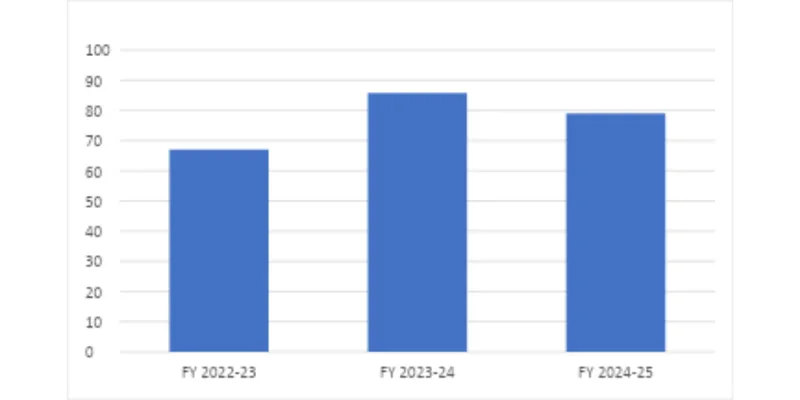
Revenue from Operations | 78.98 | 85.78 | 67.00 |
Net Profit / (Loss) | (9.29) | (4.77) | (20.00) |
Earnings Per Share (EPS) | (0.14) | (0.07) | (0.31) |
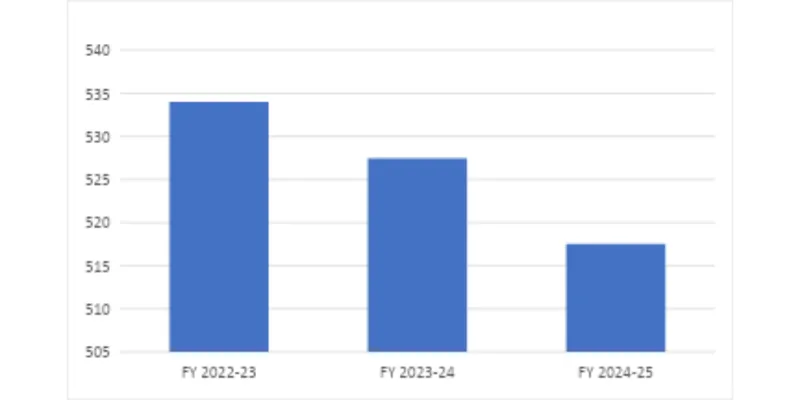
Total Assets | 517.54 | 527.44 | 534.00 |
Total Liabilities | 517.54 | 527.44 | 534.00 |
Total Equity (Net Worth) | (14.35) | (5.06) | (0.29) |
ROCE % | -2.85% | -1.51% | -4.21% |
Inventory Days | 3,506 | 3,454 | 4,618 |
Trend Interpretation
The data reveals a revenue contraction of 7.9% year-over-year. The widening loss suggests that rising operational costs are outpacing sales, a trend that appears to be accelerating. Post-report data from December 2025 shows an interim loss of INR 22.18 Lakhs, indicating that the fiscal situation is worsening. Furthermore, the Inventory Days metric remains alarmingly high at 3,506 days. Critically, Note 6 of the financial statements shows that this inventory is almost entirely Raw Materials (266.02 Lakhs) rather than finished goods, suggesting significant production inefficiencies or a major over-purchasing of Turkish yarn that isn't being converted into sales.
5. Insights
A SWOT assessment of GCL reveals a firm struggling with insolvency:
- Strengths: Bank-debt-free status and Belgian CRM loom technology. Its status as a customized weaver remains a rare market differentiator.
- Weaknesses: Balance sheet insolvency and Negative Net Worth. High inventory days (3,500 and above) caused by raw material stocks represent a capital tied up in unproductive assets.
- Risks: Accelerating losses (22.18 Lakhs in Q3 Dec 2025). India’s lower protectionist barriers expose GCL to machine-made imports, while markets like Turkey impose 46% import duties on Indian carpets.
- Future Outlook: While PM MITRA parks and the $100 billion national export target offer a long-term runway, GCL’s "sick unit" status makes it difficult to modernize without significant fresh capital infusion beyond promoter loans.
6. Conclusion
Golden Carpets Limited represents a technologically sound but balance-sheet insolvent entity. Its 31-year legacy is defined by technical excellence, yet the current financial data paints a sobering picture of a firm that has eroded its entire capital base. While the promoters have waived remuneration and infused unsecured loans, the widening losses in late 2025 suggest that the current model is unsustainable without a radical marketing or production overhaul.
From an investment perspective, GCL is a "wait-and-watch" case—with a heavy emphasis on "watch." The firm possesses the technical "moat" and the "shield" of being bank-debt free, but it currently lacks the "engine" (working capital and production efficiency) to turn its raw material stockpile into profit. Future survival depends entirely on management's ability to stop the equity erosion and leverage government export incentives before internal accruals and promoter support are completely exhausted.
7. Data Sources
- Golden Carpets Ltd Annual Report 2024-25, Screener.in