Go Fashion (India) Ltd.

Introduction
Introduction of the Company
Go Colors is a women’s bottom-wear focused apparel company in India, known for its wide range of leggings, palazzos, churidars, and jeggings. The Indian apparel industry is highly fragmented but evolving toward branded, organized retail driven by rising disposable incomes and fashion consciousness.
Industry Overview
The Indian apparel industry is one of the largest consumer-driven sectors, shaped by rising incomes, urbanization, and increasing fashion awareness. It is broadly divided into organized (branded retail) and unorganized (local, unbranded players) segments, with the former steadily gaining market share.
Purpose of the Analysis
This report evaluates Go Colors from an investor’s perspective—focusing on financial health, scalability, and long-term sustainability rather than just surface-level growth.
Company Overview
Background & History
Go Colors started in 2010. They made a name for themselves by selling women’s bottom wear. At that time not many people were selling this kind of clothing so it was an area for Go Colors to focus on. The company decided it was better to do one thing well instead of trying to do a lot of things. Go Colors chose to be good at selling women’s wear, rather, than selling all kinds of clothes.
Business Model
Its business model is retail-heavy, with a strong Exclusive Brand Outlet (EBO) network complemented by large-format stores (LFS) and online channels. This hybrid approach ensures both brand visibility and distribution efficiency.
Product Offerings
Ethnic Wear, Western Wear, Denims, Lounge Wear, Girls Wear, Athleisure.
Market Position
GFIL is the first and largest company to launch a brand exclusively dedicated to women’s bottom-wear category, with an 8% market share in the branded women’s bottom-wear market as of 9MFY26
Promoter Introduction
Professional Background:
Indian entrepreneur and business leader best known as the founder, Chief Executive Officer, and Executive Director of Go Colors.
Role in Company Growth:
With a background in retail and distribution, Gautam focused on:
- Standardization of products
- Aggressive store expansion
- Building a brand around “choice and convenience”
His strategic clarity of sticking to a niche instead of diversifying too early has been central to the company’s growth.
Gautam Saraogi

Financial Statement Analysis
Income Statement
- Revenue: Strong growth from ₹665 Cr (FY23) to ₹848 Cr (FY25).
- Profit: Flat at ₹83 Cr in FY23–24, then up to ₹94 Cr in FY25.
- EPS: Mirrors profit, steady at 15.33, rising to 17.31 in FY25.
- Margins: OPM steady at 32%, showing consistent cost control.
- Gap: Revenue grew faster than profit, signalling efficiency challenges.
Year | Revenue (₹ Cr) | Net Profit (₹ Cr) | EPS | OPM % |
FY23 | 665 | 83 | 15.33 | 32 |
FY24 | 763 | 83 | 15.33 | 32 |
FY25 | 848 | 94 | 17.31 | 32 |
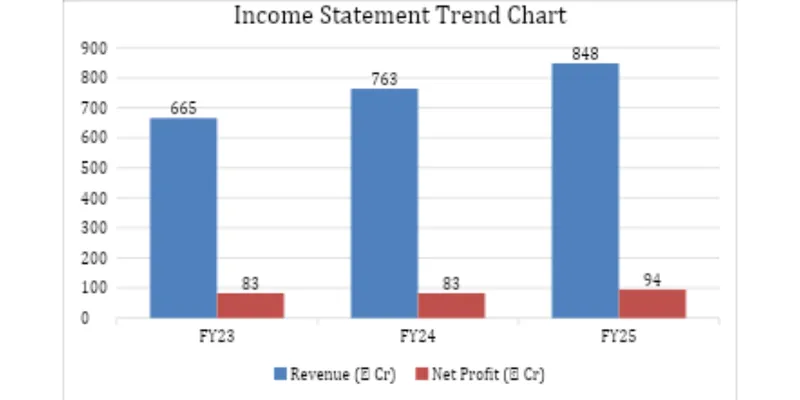
Trend: Revenue is rising steadily, margins remain stable, but profit growth is slower than revenue growth, showing efficiency challenges with improvement only in FY25.
Balance Sheet
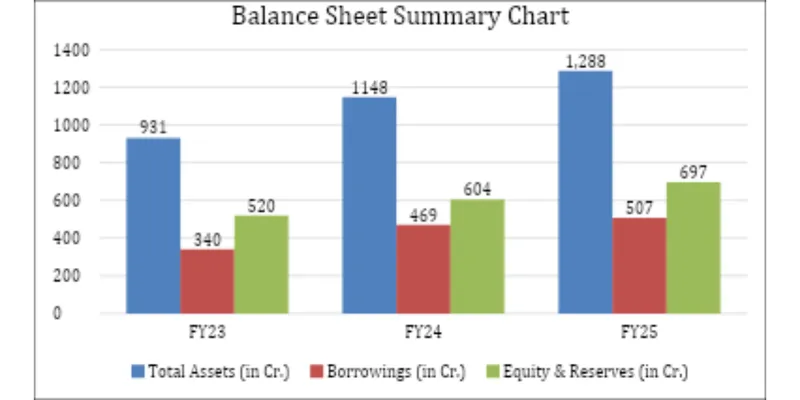
- Assets grew steadily from ₹931 Cr in FY23 to ₹1288 Cr in FY25 because they opened new stores.
- Borrowings went up from ₹340 Cr to ₹507 Cr, which means the company is using debt to fund expansion.
- Equity got stronger from ₹520 Cr to ₹697 Cr, which is good for shareholders.
- The capital mix changed, with both debt and equity growing. Equity grew more than debt in FY25.
Cash Flow Statement
- Operating Cash Flow: Heavy cash generated from daily operations. This is because profits are stable and EBITDA is strong.
- Investing Cash Flow: Company is spending a lot on expansion and capital expenditures.
- Financing Cash Flow: Company is borrowing money over time. This shows that they are relying on debt to fund activities.
Key Financial Ratios
Ratio | FY23 | FY24 | FY25 | Trend |
PE Ratio | 78.64 | 38.87 | 27.93 | Valuation multiples declining as earnings improve. |
Price-to-Sales | 8.53 | 4.29 | 2.34 | Revenue growth & lower stock price reduced PS ratio. |
Price-to-Book | 10.78 | 5.21 | 2.68 | Equity base strengthened, lowering PB ratio. |
Net Profit Margin | 12.5% | 10.9% | 11.0% | Profitability stable, slight recovery in FY25. |
Debt-to-Equity | 0.65 | 0.78 | 0.73 | Borrowings rose, but equity growth in FY25 improved balance. |
Year-on-Year Performance
- Profit: Revenue increased from 665 Cr to 848 Cr. The profit was the same in FY24. Got better in FY25, which was 94 Cr.
- Balance Sheet: Assets increased and borrowings increased, along with equity in FY25 which made debt and equity balanced.
- Valuation: price-to-earnings, price-to-book, and price-to-sales ratios all decreased and by FY25 valuations are more reasonable.
Key Insights & Interpretation
Strengths:
- Focused niche strategy: Dominance in bottom wear creates strong brand recall.
- Scalable retail model: EBO-led expansion ensures control over customer experience.
- High repeat purchases: Basic wardrobe products drive consistent demand.
- Low leverage: Financial discipline reduces downside risk.
Weakness:
- Category concentration risk: Over-dependence on bottom wear limits diversification.
- High inventory dependency: Risk of unsold stock and working capital strain.
- Retail-heavy model: Fixed costs increase vulnerability during demand slowdowns.
Risk Factors
- Fashion trends shifting away from core products.
- Increasing competition from larger apparel brands expanding into bottom wear.
- Execution risk in aggressive store expansion.
- Margin pressure due to rising input and rental costs.
Future Outlook:
The company’s growth depends on three levers:
- Store expansion in Tier 2 & Tier 3 cities.
- Product diversification without diluting brand identity.
- Strengthening online and omnichannel presence.
If executed well, Go Colors can evolve into a broader women’s apparel brand. If not, it risks stagnation within a niche.
Conclusion
Go Colors has a business plan and a strong brand that people know. They are also good at managing their money. But for Go Colors to keep doing in the long term they need to make sure they are growing at a good pace and being efficient with how they operate.
From the point of view of someone who wants to invest in Go Colors:
- Go Colors is a choice for people who want to see their money grow slowly and steadily and who do not mind taking a few risks. Go Colors is not the choice for people who want to make a lot of money quickly.
- The main thing to pay attention to with Go Colors is how well the stores that are already open are doing compared to how they are opening new stores.
Data Sources
https://www.screener.in/company/GOCOLORS/
https://www.bseindia.com/stock-share-price/go-fashion-india-ltd/GOCOLORS/543401/