Global textile market projected to reach USD 2.6 trillion by 2030
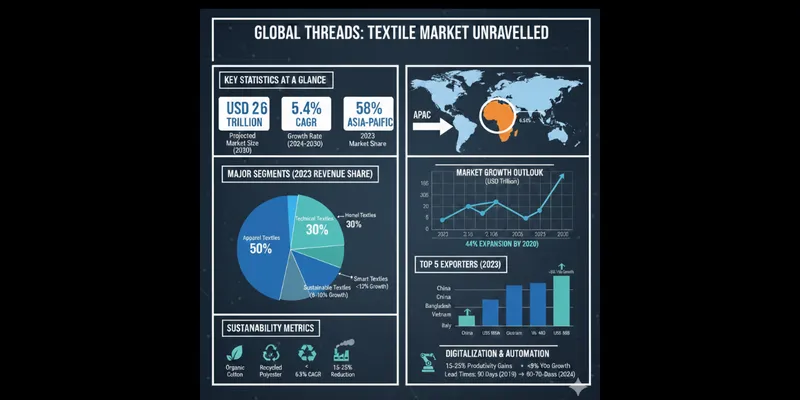
The global textile market was valued at approximately USD 1.8 trillion in 2023 and represented nearly 2% of global GDP, employing more than 300 million people worldwide. According to projections from Dataintelo, the market is expected to expand to USD 2.6 trillion by 2030, growing at a compound annual growth rate (CAGR) of 5.4% from 2024 to 2030. The sector has recovered from a contraction of nearly 12% in 2020 and continues to show steady growth despite recent economic and supply chain challenges.
Key Statistics at a Glance
Metric | Value | Year / Period |
Global Market Size | USD 1.8 trillion | 2023 |
Projected Market Size | USD 2.6 trillion | 2030 (Forecast) |
Compound Annual Growth Rate (CAGR) | 5.4% | 2024–2030 |
Asia-Pacific Market Share | 58% | 2023 |
Global Textile Exports | USD 940 billion | 2023 |
Top Exporter | China – USD 303 billion (textile & apparel exports) | 2023 |
Sustainable Textiles Growth Rate | 8–10% annually | Ongoing (Recent Years) |
Technical Textiles Share of Total Market | 30% | 2023 |
Global Apparel Production Volume | ~100 billion garments per year | Recent Estimate |
Recycled Fiber Market Growth | 6.8% CAGR | 2024–2028 |
1. 2024 Market Size & 7-Year Growth Outlook (2023–2030)
The textile market reached approximately USD 1.8 trillion in 2023, recovering from a pandemic-driven dip of nearly –12% in 2020. Since 2021, annual growth has averaged 4.6%, supported by:
• Resurgence in apparel demand (+7.2% in 2022)
• Increased home furnishing sales (+5.1% in 2023)
• Technical textile expansion (+6.5% YoY in 2023)
Forecast Through 2030
Year | Market Size (USD Trillion) | YoY Growth |
2023 | 1.8 | — |
2024 | 1.89 | 5.0% |
2025 | 1.99 | 5.3% |
2026 | 2.10 | 5.5% |
2027 | 2.22 | 5.6% |
2028 | 2.35 | 5.7% |
2029 | 2.48 | 5.5% |
2030 | 2.60 | 5.4% |
By 2030, the market is projected to add USD 800 billion in incremental value, representing a 44% increase over 2023 levels.
2. Regional Breakdown: 58% Dominated by Asia-Pacific
Asia-Pacific (APAC)
• Market share (2023): 58%
• CAGR (2024–2030): 6.2%
• Largest producers: China, India, Bangladesh
• China textile & apparel exports (2023): USD 303 billion
• India textile market size (2023): USD 165 billion
• Bangladesh garment exports (2023): USD 47 billion
APAC’s cost advantage remains significant:
• Average garment manufacturing cost: 20–30% lower than Europe
• Labor cost per hour: China (~USD 6), India (~USD 2), U.S. (~USD 23) North America
• Market share: 18%
• U.S. textile exports (2023): USD 28 billion
• Technical textiles account for 45% of regional output
• Automation investment grew 12% YoY in 2023
Europe
• Market share: 16%
• Focus on sustainable textiles
• EU textile recycling target: 55% by 2025
• Italy textile exports (2023): USD 36 billion
3. 5 Major Textile Segments by Revenue Share (2023)
Segment | Market Share | Growth Rate |
Apparel textiles | 50% | 4.8% |
Home textiles | 20% | 5.1% |
Technical textiles | 30% | 6.5% |
Sustainable textiles | ~12% (overlaps) | 8–10% |
Smart textiles | <3% | 12% |
Technical Textiles: Fastest-Growing Segment
Technical textiles, used in automotive, healthcare, and construction, represent 30% of total revenue and are projected to reach USD 950 billion by 2030.
Growth drivers:
• Automotive lightweight materials (+7.4% demand in 2023)
• Medical textiles (+9% post-pandemic increase)
• Infrastructure geotextiles (+6% annually)
4. Sustainability Metrics: 8–10% Growth in Eco-Textiles
Sustainability is reshaping the textile industry with measurable impact: • Textile industry contributes 8–10% of global carbon emissions
• Water consumption: 93 billion cubic meters annually
• Polyester accounts for 52% of total fiber production
• Recycled polyester growth: 6.8% CAGR (2024–2028)
• Organic cotton production increased 20% between 2021–2023
Brands investing in recycled fibers report:
• 15–25% reduction in carbon footprint
• 10–18% energy savings
• 8–12% higher production costs, offset by 20–30% premium pricing 5. Trade & Export Data: 2023 Performance Snapshot
Global textile and apparel exports reached approximately USD 940 billion in 2023, compared to:
• USD 820 billion (2020)
• USD 890 billion (2021)
• USD 910 billion (2022)
Top 5 Exporters (2023)
Rank | Country | Export Value (USD Billion) |
1 | China | 303 |
2 | Bangladesh | 47 |
3 | Vietnam | 44 |
4 | Germany | 40 |
5 | Italy | 36 |
China’s export volume declined 2.8% YoY in 2023, while Vietnam grew +9% YoY, signaling supply chain diversification.
6. Cost Structure Breakdown (Per Garment Example)
Average production cost of a $20 retail T-shirt:
• Raw materials: $4.50 (22.5%)
• Labor: $3.20 (16%)
• Transportation: $1.80 (9%)
• Overheads: $2.50 (12.5%)
• Marketing & retail margin: $8.00 (40%)
Manufacturers typically operate at 5–12% net margins, while retailers achieve 30–50% gross margins.
7. Digitalization & Automation: Productivity Gains of 15–25%
Between 2021 and 2024:
• Smart factory adoption increased 18% globally
• AI-based quality inspection reduced defects by 30–40%
• Automated cutting systems improved fabric utilization by 12–15%
• Lead times reduced from 90 days (2019 average) to 60–70 days (2024 average) Factories implementing Industry 4.0 technologies report:
• 20% productivity gains
• 15% reduction in operational costs
• ROI within 2–3 years
8. Risks & Volatility Metrics
Key measurable risks include:
• Cotton price volatility: ±25% fluctuations (2022–2023)
• Freight cost spike: +300% during 2021 peak
• Inventory surplus in 2022: +18% compared to 2021
• Labor shortages impacting 35% of global manufacturers (2023 survey data) Inflation increased production costs by 8–12% in 2022, moderating to 3–5% in 2024. 2030 Forecast: 44% Market Expansion
By 2030:
• Global market size: USD 2.6 trillion
• Sustainable textiles share: 20% of total production
• Technical textiles approaching 35% of total revenue
• Digitalized factories projected to exceed 50% of global production facilities Emerging markets in Africa are expected to grow at 7–9% CAGR, outpacing global averages. Conclusion: Data-Driven Outlook for the Textile Market
The textile market, valued at USD 1.8 trillion in 2023, is on track to reach USD 2.6 trillion by 2030, growing at a steady 5.4% CAGR. Asia-Pacific controls 58% of global production, while technical textiles and sustainable materials lead growth at 6–10% annually. Global exports reached USD 940 billion in 2023, and automation investments are delivering 15–25% productivity gains.
Despite risks such as raw material volatility (±25%) and cost inflation (8–12% peak in 2022), the industry remains resilient. Measurable shifts toward sustainability, digitalization, and regional diversification indicate that the next 5–7 years will be defined by efficiency gains, eco-innovation, and supply chain transformation.
In quantitative terms, the textile industry is not just growing — it is evolving, optimizing, and scaling toward a 44% larger global footprint by 2030.
Read A Full Research Report: https://dataintelo.com/report/global-textile-market