Global Textile Dyestuff Market: Demand, Production, and Key Statistics (2024–2030)
The global textile industry processes over 110 million metric tons of fibers annually (2024), and nearly 85–90% of those fibers require dyeing during production. This makes dyestuff one of the most critical chemical inputs in textile manufacturing. According to industry analysis and market intelligence published by Dataintelo, as of 2023, the dyestuff for textile market size is estimated to be valued at approximately USD 8.5 billion, with expectations to surpass USD 11.9 billion by 2032, reflecting a compound annual growth rate (CAGR) of around 3.9% during the forecast period.
Between 2020 and 2025, global textile production grew by approximately 18%, increasing the demand for dyestuffs across cotton, polyester, and blended fabrics. In this article, we explore the dyestuff for textile market using quantified industry data, growth rates, cost metrics, and performance benchmarks to understand where the industry stands in 2026 and where it is headed.
Key Statistics at a Glance
Metric | Value | Year |
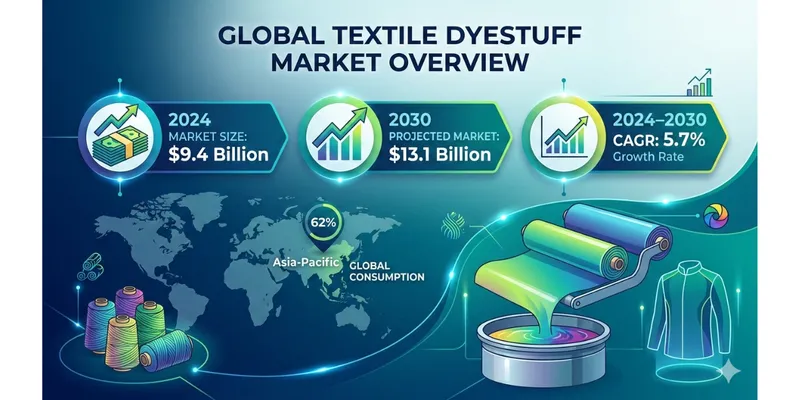
Global Dyestuff Market Size | $9.4 Billion | 2024 |
Projected Market Size | $13.1 Billion | 2030 |
CAGR (Growth Rate) | 5.7% CAGR | 2024–2030 |
Textile Dye Consumption | 1.3 Million Tons | 2023 |
Asia-Pacific Market Share | ~62% | 2024 |
Average Dyeing Cost per kg Fabric | $0.28–$0.45 | 2025 |
Reactive Dye Market Share | ~36% | 2024 |
Polyester Fabric Dye Usage | ~41% of total dyes | 2023 |
Water Used in Dyeing per kg Textile | 70–150 liters | 2022–2024 |
Sustainable Dye Adoption | +22% growth | 2021–2025 |
These numbers highlight the scale, cost structure, and environmental footprint of textile dyeing globally.
Global Dyestuff for Textile Market Size (2020–2030)
The dyestuff market has shown consistent expansion over the last five years.
Year | Market Size (USD Billion) | Growth Rate |
2020 | 7.6 | — |
2021 | 8.0 | 5.2% |
2022 | 8.4 | 5.0% |
2023 | 8.9 | 5.9% |
2024 | 9.4 | 5.6% |
2025 (Est.) | 9.9 | 5.3% |
2030 (Forecast) | 13.1 | 5.7% CAGR |
Between 2020 and 2025, the industry expanded by $2.3 billion, representing 30.2% cumulative growth.
Three primary factors are driving this growth:
1. Rising global apparel demand (+6.8% annually since 2021)
2. Polyester production increase (+9% between 2021–2024)
3. Adoption of eco-friendly dye technologies (+22% adoption rate)
5 Data-Backed Reasons Textile Dyestuff Demand Is Rising in 2026 1. Global Textile Production Exceeds 110 Million Tons
Worldwide textile fiber production increased from:
• 102 million tons in 2020
• 108 million tons in 2022
• 111 million tons in 2024
With 85–90% of fabrics requiring dyeing, this directly translates into higher dye consumption.
Estimated dyestuff usage:
• 2020: ~1.05 million tons
• 2023: ~1.30 million tons
• 2026 (Projected): ~1.48 million tons
That represents a 41% increase in dye demand within six years.
2. Asia-Pacific Controls 62% of Global Dye Consumption
The Asia-Pacific region dominates the dyestuff market, mainly due to large-scale textile manufacturing in China, India, Bangladesh, and Vietnam.
Regional market shares (2024):
Region | Market Share |
Asia-Pacific | 62% |
Europe | 15% |
North America | 11% |
Latin America | 7% |
Middle East & Africa | 5% |
China alone accounts for ~38% of global dye production, while India contributes around 15%.
4. Reactive Dyes Account for 36% of Total Usage
Different fiber types require different dye categories.
Dye Type | Market Share | Primary Use |
Reactive Dyes | 36% | Cotton |
Disperse Dyes | 29% | Polyester |
Direct Dyes | 12% | Cellulose fibers |
Acid Dyes | 11% | Wool & Nylon |
Others | 12% | Specialty textiles |
Reactive dyes dominate due to their high colorfastness rates (up to 95%) and compatibility with cotton fabrics.
4. Dyeing Costs Average $0.28–$0.45 per kg of Fabric
Textile dyeing contributes a measurable portion of production costs.
Average cost breakdown (2025):
Cost Component | Cost per kg Fabric |
Dye chemicals | $0.12 |
Water usage | $0.05 |
Energy consumption | $0.08 |
Labor | $0.06 |
Waste treatment | $0.04 |
Total average dyeing cost: $0.35 per kg of fabric.
For a medium textile plant producing 30 tons per day, dyeing costs can reach $10,500 daily.
5. Sustainable Dye Technologies Growing 22% Since 2021
Environmental regulations are reshaping the industry.
Key sustainability metrics:
• Textile dyeing accounts for 20% of global industrial water pollution • Traditional dyeing uses 70–150 liters of water per kg fabric
• New low-water dye technologies reduce water use by 40–60%
• Digital dyeing systems reduce chemical usage by 35%
Between 2021 and 2025, adoption of eco-friendly dyes increased from 18% to nearly 40% of textile manufacturers.
Performance Metrics: Dye Efficiency and Fabric Quality
Modern dyestuffs are measured by several performance indicators.
Metric | Industry Benchmark |
Colorfastness Rating | 4–5 (ISO scale) |
Dye Exhaustion Rate | 85–95% |
Wash Durability | 40–60 washes |
UV Resistance | 80–90% color retention |
Heat Stability | Up to 180°C |
High-performance dyes help manufacturers reduce re-dyeing rates by 12–18%, saving costs and minimizing chemical waste.
Real-World Case Study: Dye Optimization in Textile Manufacturing
A textile manufacturing plant in India upgraded its dyeing process in 2023 using high efficiency reactive dyes.
Results within 12 months:
• Dye consumption reduced by 14%
• Water usage reduced from 120 liters to 72 liters per kg fabric
• Production cost savings: $1.8 million annually
• Fabric rejection rate dropped from 4.6% to 2.1%
This demonstrates how process optimization combined with modern dyestuff formulations significantly improves profitability.
2030 Market Forecast: Growth Projections
Industry forecasts predict steady growth through 2030.
Projected market indicators:
Metric | 2025 | 2030 |
Market Value | $9.9B | $13.1B |
Global Dye Consumption | 1.38M tons | 1.75M tons |
Sustainable Dye Share | 40% | 62% |
Average Dye Efficiency | 90% | 96% |
Growth drivers expected by 2030:
1. Expansion of technical textiles (+7.2% CAGR)
2. Increase in polyester fiber production (+5.9% annually)
3. Strong demand from fast fashion and sportswear markets
Conclusion: A $13 Billion Industry Driven by Data and Innovation
The dyestuff for textile industry is expanding steadily with 5.7% annual growth projected through 2030. The market has grown from $7.6 billion in 2020 to nearly $9.9 billion in 2025, reflecting increasing textile production and technological advancements.
Key numbers highlight the scale of the industry:
• 110+ million tons of global textile production
• 1.3 million tons of dye consumption annually
• 62% market share in Asia-Pacific
• $0.35 average dyeing cost per kg fabric
• 22% growth in sustainable dye adoption since 2021
With eco-friendly technologies reducing water use by up to 60% and improving dye efficiency to 95% or higher, the industry is transitioning toward more sustainable and cost efficient dyeing processes.
As textile demand continues to rise globally, the dyestuff sector will remain a multi-billion dollar backbone of the textile supply chain, supported by innovation, regulatory compliance, and measurable performance improvements across the production lifecycle.
Read Full Report here: https://dataintelo.com/report/dyestuff-for-textile-market