Global Sodium-ion Battery Market to Reach USD 12.30 Billion by 2034, Says Polaris Market Research
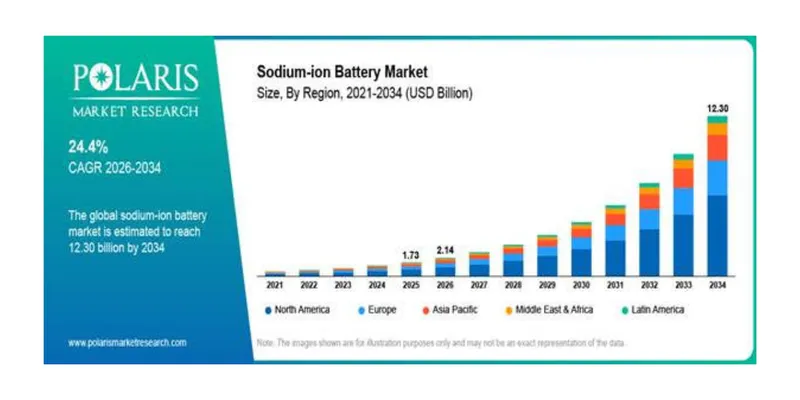
Market projected to grow at a CAGR of 24.4% between 2026 and 2034, supported by renewable energy expansion, grid modernization and battery manufacturing investments.
The global sodium-ion battery market is expected to expand significantly over the next decade, driven by increasing investments in energy storage, renewable energy infrastructure, and alternative battery technologies. According to Polaris Market Research, the market is projected to grow from USD 2.14 billion in 2026 to USD 12.30 billion by 2034, registering a CAGR of 24.4% during the forecast period.
According to the Sodium-ion Battery Market report by Polaris Market Research, the global market was valued at USD 1.73 billion in 2025 and is estimated to reach USD 2.14 billion in 2026. The report projects the market to expand to USD 12.30 billion by 2034, reflecting continued investment in cost-effective energy storage technologies.
Growing Interest in Sodium-ion Batteries
Sodium-ion batteries are gaining attention as an alternative to lithium-ion technology amid concerns over lithium, cobalt and nickel supply constraints, geopolitical sourcing risks and rising raw material costs. Sodium is widely available, comparatively inexpensive to extract and suitable for applications where affordability and material availability are priorities.
The technology operates on the movement of sodium ions between the cathode and anode during charging and discharging. While sodium-ion batteries typically offer lower energy density than lithium-ion batteries, they provide advantages in thermal stability, raw material availability and cost, making them suitable for stationary energy storage, grid infrastructure and selected electric mobility applications.
Regional Market Performance
Asia Pacific accounted for approximately 47.8% of global sodium-ion battery market revenue in 2025, supported by established battery manufacturing capacity, clean-energy initiatives and investments in next-generation storage technologies. China remains a major manufacturing hub for battery production.
North America is projected to record the fastest growth, supported by investments in electrical grid modernization, domestic battery manufacturing incentives and infrastructure development. Europe is also expected to see increasing demand through clean energy transition initiatives across Germany, France and the UK.
Market Segmentation
By Type
- Sodium layered oxide batteries accounted for approximately 52.4% of the market in 2025, supported by commercial adoption and suitability for large-scale energy storage.
- Sodium polyanionic batteries are expected to register the fastest growth, supported by research focused on improving safety, battery life and thermal stability.
By Application
- Stationary energy storage represented around 58.6% of the market in 2025, driven by renewable energy integration and grid modernization.
- Electric vehicles are expected to become the fastest-growing application segment as manufacturers evaluate sodium-ion technology for cost-sensitive vehicle categories.
By End User
- Utilities accounted for approximately 49.3% of the market share in 2025, reflecting increasing use of battery storage for grid reliability and renewable integration.
- The automotive sector is projected to register the highest CAGR among end users.
Industry Developments
Several commercial developments highlighted in the report indicate increasing industry activity:
- February 2026: CATL and CHANGAN introduced what is described as the world's first commercial sodium-ion passenger vehicle.
- June 2026: CATL launched what it describes as the first commercially operational sodium-ion battery energy storage system.
- Early 2026: Nuvve Japan announced a 2 MW/8 MWh grid-scale battery storage project.
- June 2026: Changhong Sanjie New Energy received approval for an approximately USD 1.3 billion battery manufacturing facility in Malaysia.
Market Challenges
The report notes several factors that could influence market expansion, including:
- Lower energy density compared to advanced lithium-ion batteries.
- High capital investment required for manufacturing facilities.
- Continued need for research and development.
- Certification requirements.
- Competition from the established lithium-ion battery industry.
Competitive Landscape
Key companies identified in the Polaris Market Research report include:
- Altris AB
- AMTE Power plc
- Aquion Energy
- CATL
- Faradion Limited
- HiNa Battery Technology Co., Ltd.
- Li-FUN Technology Corporation Limited
- Natron Energy Inc.
- Northvolt AB
- Peak Energy
- TIAMAT SAS
- Zhejiang Natrium Energy Co., Ltd.
The report notes that competition is based on manufacturing capacity, battery performance, production costs and supply chain partnerships.