Global Smart Textile Recycling Industry Surges as Textile Waste Crosses 134 Million Tons
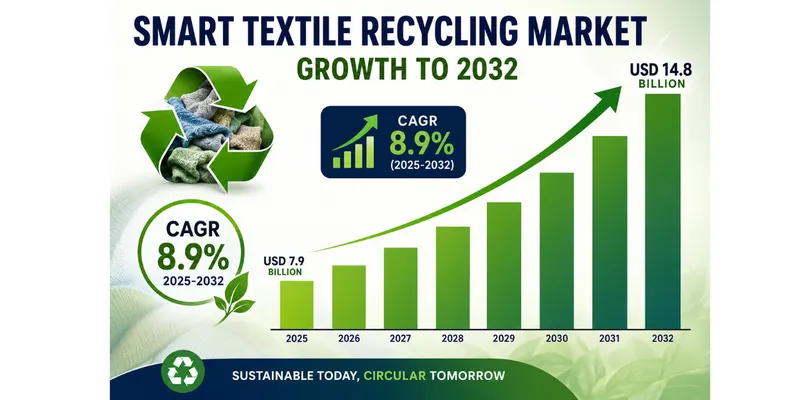
The global Smart Textile Recycling market is witnessing accelerated growth as textile waste volumes exceeded 134 million tons globally in 2025. Increasing environmental regulations, AI-enabled sorting technologies, and rising investments in circular economy infrastructure are transforming the industry. According to recent industry estimates by Marketintelo, the Smart Textile Recycling market was valued at approximately USD 7.2 billion in 2024 and is projected to reach USD 14.8 billion by 2032, expanding at a CAGR of 8.9%.
In the introduction of its latest sustainability-focused analysis, highlights that over 87% of discarded textiles still end up in landfills or incineration facilities annually. Smart Textile Recycling technologies are emerging as a critical solution to reduce waste while recovering high-value fibers through automated sorting, blockchain traceability, and AI-powered recycling systems.
Key Numerical Highlights
• Global textile waste generation crossed 134 million tons in 2025. • Only 12% of textile waste is currently recycled worldwide. • Europe accounted for 31.4% of Smart Textile Recycling revenue in 2025.
• AI-enabled textile sorting efficiency improved from 62% in 2018 to 91% in 2025.
• The Asia-Pacific region generated over USD 2.4 billion in market revenue in 2025.
• Chemical textile recycling investments increased by 41% YoY between 2023 and 2025.
• The recycled polyester segment represented 46% of recycled textile output in 2025.
• Smart sensors and RFID-based textile tracking adoption rose by 38% during 2024.
• North America processed approximately 19.6 million tons of textile waste in 2025.
• Global government sustainability funding for textile recycling exceeded USD 5.7 billion between 2022 and 2025.
Historical Market Performance (2016–2025)
The Smart Textile Recycling market has evolved significantly over the past decade. In 2016, the market size stood near USD 3.1 billion, primarily driven by mechanical recycling systems. By 2020, market valuation reached USD 4.9 billion, supported by increased ESG mandates and circular fashion initiatives.
Between 2021 and 2025, the industry experienced strong momentum:
Year | Market Value (USD Billion) | YoY Growth |
2021 | 5.4 | 7.1% |
2022 | 5.9 | 9.3% |
2023 | 6.4 | 8.5% |
2024 | 7.2 | 12.5% |
2025 | 7.9 | 9.7% |
The rise in digital textile identification technologies helped reduce sorting errors by nearly 34% between 2019 and 2025. Automated robotic recycling facilities also reduced operational costs by approximately 22%.
AI and Automation Driving Smart Textile Recycling
Artificial intelligence has become central to Smart Textile Recycling systems. AI powered optical sorting machines can now identify textile blends with more than 95% accuracy. In 2025, over 2,800 smart recycling facilities globally integrated machine-learning-based fiber recognition systems.
Blockchain integration in Smart Textile Recycling improved textile traceability rates from 18% in 2020 to 49% in 2025. RFID-enabled garments increased recycling efficiency by nearly 27%, especially across premium apparel supply chains.
The chemical recycling segment is growing particularly fast. Industry investments in enzymatic and depolymerization technologies reached USD 1.9 billion in 2025, compared to USD 940 million in 2021.
Regional Analysis and Market Share
Europe
Europe dominates the Smart Textile Recycling market with approximately 31.4% market share in 2025. The European Union allocated over USD 2.1 billion toward textile circularity programs between 2022 and 2025. Germany, France, and the Netherlands collectively processed over 8.7 million tons of recyclable textiles in 2025.
North America
North America accounted for nearly USD 2 billion in Smart Textile Recycling revenue during 2025. The United States alone generated more than 17 million tons of textile waste annually. Smart sorting infrastructure investments in the region grew by 29% YoY.
Asia-Pacific
Asia-Pacific remains the fastest-growing regional market with projected CAGR of 10.8% through 2032. China, India, Japan, and South Korea are investing heavily in automated recycling facilities. China processed nearly 26 million tons of textile waste in 2025, while India’s recycled textile exports exceeded USD 1.4 billion.
Middle East & Africa
The Middle East & Africa market reached USD 620 million in 2025. UAE sustainability initiatives and African circular fashion startups are expected to increase regional recycling capacity by 35% before 2030.
Industry Trends and Corporate Investments
Major fashion brands increased recycled textile utilization from 18% in 2020 to 37% in 2025. Smart Textile Recycling adoption among apparel manufacturers rose significantly due to stricter carbon reduction targets.
Key industry trends include:
• AI-enabled robotic textile sorting
• Waterless chemical recycling technologies
• RFID and QR-based garment tracking
• Closed-loop fashion manufacturing
• Blockchain-enabled recycling certification
Global venture capital investment in Smart Textile Recycling startups surpassed USD 3.3 billion between 2021 and 2025. More than 420 textile recycling startups were actively operating worldwide in 2025, compared to 180 companies in 2018.
Future Outlook Through 2032
The Smart Textile Recycling market is expected to maintain strong growth due to increasing landfill restrictions, ESG compliance requirements, and rising consumer demand for sustainable fashion. By 2032:
• Global market value is forecast to exceed USD 14.8 billion • Recycled textile processing volume may surpass 62 million tons annually • AI-powered sorting systems could achieve 98% accuracy
• Chemical recycling may account for 44% of total recycled textile output • Asia-Pacific could represent nearly 36% of global market demand
Smart Textile Recycling is becoming a strategic pillar of the global circular economy. Rapid advances in automation, digital traceability, and sustainable material recovery are expected to reshape the textile industry over the next
decade. With investments rising, regulations tightening, and recycling efficiency improving yearly, the sector is positioned for long-term, data-driven expansion.
Read A Full Report: https://marketintelo.com/report/smart-textile-recycling market