Global Robotic Textile Sorting Market Projected to Reach USD 1.12 Billion by 2034
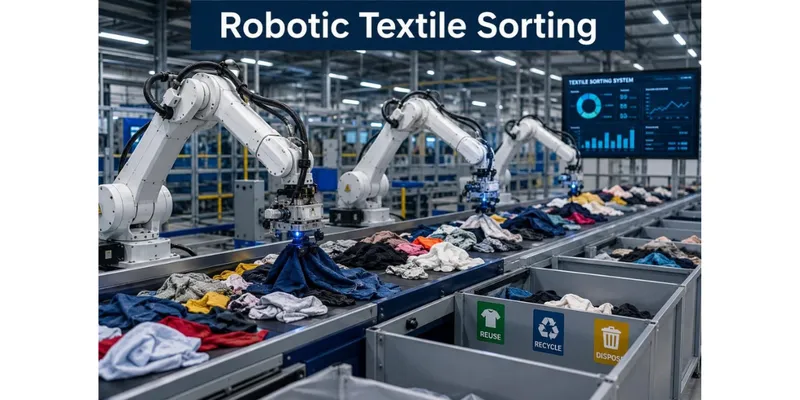
AI-powered textile sorting technologies gain momentum as recycling, automation and circular economy initiatives drive market expansion worldwide.
According to Growth Market Report, the global Robotic Textile Sorting market reached USD 400.1 million in 2025 and is forecast to attain approximately USD 1.12 billion by 2034, registering a compound annual growth rate (CAGR) of 12.1% between 2026 and 2034.
The report attributes market growth to the increasing adoption of automation across textile recycling, manufacturing and waste management. Additional factors include stricter sustainability regulations, growing demand for efficient textile sorting processes, and continued advances in artificial intelligence (AI), robotics and sensor technologies.
Automation Addresses Growing Textile Waste
Rising global fashion production has contributed to increasing volumes of discarded garments, industrial textile waste and post-consumer fabrics. Traditional manual sorting systems face challenges in processing these volumes while maintaining the quality required for textile recycling.
Robotic textile sorting systems combine artificial intelligence, computer vision, machine learning and material recognition technologies to automate the identification and classification of textile materials. Unlike manual sorting methods, these systems can identify fabric composition, colours, fibre blends, contaminants and garment types within seconds, helping recycling facilities improve material recovery and operational efficiency.
The report notes that governments' circular economy initiatives and growing consumer demand for sustainable products are contributing to wider adoption of automated textile sorting technologies.
Technology Behind Robotic Textile Sorting
Robotic textile sorting involves the automated identification, classification and separation of textile materials using advanced robotic systems equipped with technologies including near-infrared spectroscopy (NIR), hyperspectral imaging, AI-powered vision systems and robotic arms.
These systems are designed to distinguish reusable garments from recyclable fibres, identify blended fabrics and detect damaged or contaminated materials. The report states that this improves the recovery of reusable textiles while producing higher-quality recycled fibres for manufacturing applications.
Key Technologies Supporting Market Growth
The report identifies several technologies driving market development:
- Artificial intelligence enables continuous learning to recognise diverse textile compositions and improve sorting accuracy.
- Computer vision systems analyse garment shape, texture, stitching, labels, colours and visible defects in real time.
- Near-infrared spectroscopy identifies fibre composition through unique spectral signatures for materials including cotton, polyester, wool, nylon, viscose, acrylic and blended textiles.
- Advanced robotic arms equipped with adaptive gripping systems process garments of different sizes while maintaining handling precision.
- Cloud-based data analytics allow facilities to monitor equipment performance, optimise workflows and improve operational efficiency.
Applications Across the Textile Value Chain
According to the report, robotic textile sorting is increasingly being adopted across multiple industry segments, including:
- Textile recycling facilities
- Fashion brands operating garment take-back programmes
- Industrial textile manufacturers
- Charity organisations handling donated clothing
- Municipal waste management companies
Market Drivers
The report identifies several factors supporting continued market growth, including:
- Increasing textile waste generation
- Rising demand for recycled fibres
- Expansion of circular economy initiatives
- Investment in smart recycling infrastructure
- Labour shortages in waste processing
- Higher recycling quality standards
- Advances in AI and robotics
- Sustainability commitments from global fashion brands
- Government regulations promoting textile recycling
- Growing consumer awareness of environmental sustainability
Circular Economy Supports Adoption
The report highlights the transition from a linear production model to a circular economy as a significant market driver.
Rather than disposing of used garments, circular systems prioritise reuse, repair, remanufacturing and fibre-to-fibre recycling. Robotic textile sorting provides the initial step by separating valuable materials that can be reintroduced into manufacturing supply chains.
Challenges Remain
Despite technological progress, the report notes several challenges affecting market adoption.
Mixed-fibre garments remain difficult to identify because of complex material compositions, while older garments often lack accurate labels. High initial investment costs may also limit adoption among smaller recycling facilities. Integration with existing infrastructure and handling contaminated textiles continue to present operational challenges.
The report states that ongoing improvements in AI algorithms and sensor technologies are addressing many of these issues.
Future Developments
According to the report, future innovations may include:
- AI capable of recognising thousands of blended fabric combinations
- Digital garment passports for automated identification
- Autonomous mobile robots for material transport
- Blockchain integration for material traceability
- Self-learning robotic systems
- Advanced hyperspectral imaging
- Edge computing for faster processing
- Fully autonomous recycling facilities
Competitive Landscape
The report lists the following companies among key participants in the market:
Tomra Systems ASA, Valvan Baling Systems, Andritz AG, Siemens AG, ABB Ltd., Rockwell Automation, Schneider Electric, SoftWear Automation, Worn Again Technologies, Renewlogy, Fibersort (a Valvan initiative), Bollegraaf Recycling Solutions, PICVISA Machine Vision Systems, Pellenc ST, and Stadler Anlagenbau GmbH.
The report also identifies opportunities for investment in AI-powered material recognition software, robotic handling systems, recycling automation platforms, cloud-based recycling management software, digital traceability solutions, fibre detection sensors and autonomous recycling technologies.
Source: Growth market Reports