Global Recycled Plastics Market Projected to Reach USD 145.26 Billion by 2034
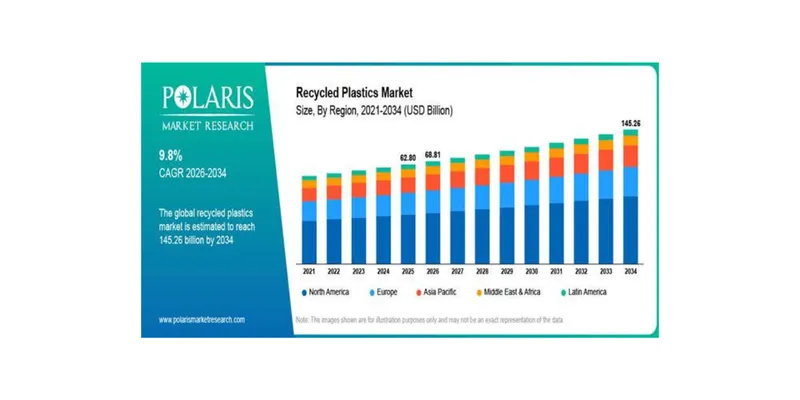
The global recycled plastics market is expected to expand significantly over the coming decade, with its value projected to increase from USD 68.81 billion in 2026 to USD 145.26 billion by 2034, reflecting a CAGR of 9.8% during the forecast period.
The report attributes market growth to stricter government regulations on plastic waste, increasing use of recycled materials across industries and advances in plastic sorting, decontamination and recycling technologies.
Regulatory Measures Supporting Market Growth
Government policies continue to influence the adoption of recycled plastics across global markets.
The European Union introduced a plastic tax on non-recycled plastic packaging in January 2021, while the United Kingdom implemented a levy on plastic packaging containing less than 30% recycled content in April 2022. In the United States, California introduced a requirement in 2022 mandating a minimum of 15% recycled PET content in plastic bottles.
According to the report, these regulatory initiatives are encouraging manufacturers to incorporate post-consumer recycled (PCR) and post-industrial recycled (PIR) materials into their production processes.
Corporate Sustainability Initiatives
Corporate sustainability programmes are also contributing to market demand.
The report highlights a partnership announced in May 2022, under which Trioworld and Lidl Sweden introduced post-consumer recycled (PCR) plastic film for frozen food packaging, demonstrating the growing use of recycled plastics in food-contact applications.
Market Segmentation
PET Expected to Record Strong Growth
Among recycled polymer types, including polyethylene (PE), polyvinyl chloride (PVC), polypropylene (PP) and polystyrene (PS), polyethylene terephthalate (PET) is projected to record the highest growth during the forecast period.
The report attributes this to PET's widespread use in food and beverage packaging, bottles and FMCG applications, supported by bottle-to-bottle recycling systems and developments in food-grade decontamination technologies.
Plastic Bottles Remain the Largest Source
Plastic bottles accounted for the largest source segment in 2025, supported by established collection systems and standardized PET and HDPE feedstocks.
Plastic films are identified as an emerging opportunity, although further investment in collection and sorting infrastructure will be required to expand recycling capacity.
Mechanical and Chemical Recycling
Mechanical recycling remains the dominant processing method, particularly for clean and high-volume plastic waste streams.
Chemical recycling is also expanding through technologies including pyrolysis and solvent-based recycling. In June 2025, INEOS Olefins & Polymers Europe began recycled plastic production at its Lavera site using pyrolysis oil derived from plastic waste to manufacture recycled polymers that meet European packaging standards.
End-Use Industries
Packaging continues to represent the largest end-use sector for recycled plastics, covering food and beverage packaging, consumer goods and e-commerce applications.
The report also identifies growing adoption within the automotive sector for lightweight vehicle components. Construction and textiles are additional industries contributing to market demand.
Regional Outlook
Asia Pacific accounted for the largest share of the global recycled plastics market in 2025, supported by industrial activity, urbanisation, recycling capacity expansion and government initiatives across China, India, South Korea and Southeast Asia.
The report projects India to record the highest country-level CAGR during 2026–2034, supported by urbanisation, demand for packaged products, recycling infrastructure investments and initiatives such as the 2021 Plastics Pact.
North America is also expected to register notable growth, driven by Extended Producer Responsibility (EPR) legislation across several U.S. states and continued investment in domestic recycling infrastructure.
Industry Developments
The report identifies several recent developments within the recycled plastics industry.
- In February 2025, LyondellBasell completed the acquisition of APK and its mechanical recycling assets in California.
- AZEK Company acquired Northwest Polymers to expand PVC recycling capacity in the Pacific Northwest.
- In January 2025, Loop Industries signed a USD 20.8 million technology licensing agreement with Reed Société Générale Group for the European deployment of its Infinite Loop depolymerization platform.
- In March 2025, Versalis opened a new recycling facility in Porto Marghera to produce plastics from mechanically recycled materials as part of Eni's circular economy strategy.
Market Challenges
The report notes that mixed plastic waste, contamination and inconsistent feedstock quality continue to present challenges for the recycling industry. Expanding recycling infrastructure for plastic films, foams and composite materials will require continued investment from both public and private sectors.
Read More: Polaris Market Research