Global Plastic Compounding Market Projected to Reach $149.64 Billion by 2034
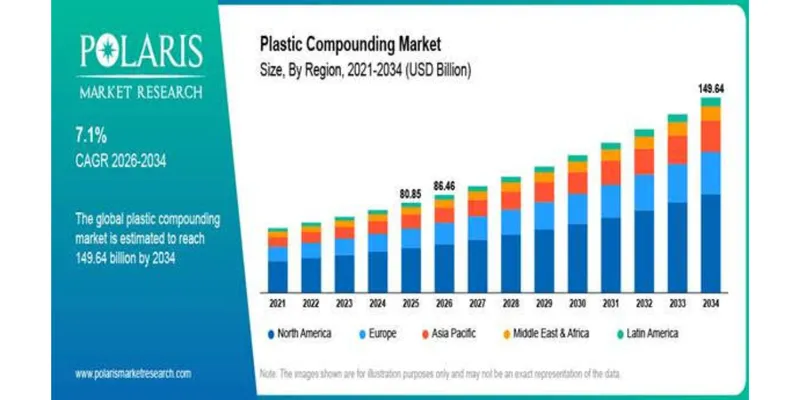
Market expected to grow at a CAGR of 7.1% as demand rises for lightweight, sustainable and high-performance polymer materials
According to industry analysis, the global Plastic Compounding Market was valued at USD 86.46 billion in 2026 and is forecast to reach USD 149.64 billion by 2034, growing at a CAGR of 7.1% during the forecast period.
The market is expanding as manufacturers across the automotive, packaging, electrical & electronics, construction and consumer goods industries increasingly adopt customised polymer formulations to meet evolving performance, sustainability and regulatory requirements.
Plastic compounding involves blending base polymers with additives, fillers, reinforcements, colourants, impact modifiers, stabilisers and specialty materials to create formulations with specific performance characteristics. The process enables manufacturers to improve material properties, optimise processing efficiency and reduce production costs.
Automotive Sector Remains a Key Growth Driver
The report identifies the automotive industry's transition toward lightweight and fuel-efficient vehicles as one of the major drivers of market growth.
Vehicle manufacturers are replacing conventional metal components with advanced plastic compounds to reduce weight, improve fuel efficiency, lower emissions and enhance vehicle performance. The growing production of electric vehicles (EVs) is also increasing demand for plastic compounds used in battery systems, electrical insulation, charging infrastructure, interior components and structural applications.
Engineering plastics including polypropylene, polyamide, acrylonitrile butadiene styrene (ABS), polycarbonate and thermoplastic elastomers are increasingly being used in automotive applications that require strength, heat resistance, dimensional stability and chemical resistance.
Packaging Industry Supports Market Expansion
The packaging industry continues to contribute significantly to market growth.
Flexible packaging, rigid containers, food packaging, pharmaceutical packaging and e-commerce packaging increasingly rely on advanced plastic compounds to improve durability, product protection, shelf life and product appearance.
The report notes that growing demand for sustainable packaging is encouraging manufacturers to develop compounds incorporating recycled materials, bio-based polymers and environmentally friendly additives.
Focus on Sustainability and Circular Economy
Sustainability continues to influence developments across the plastics value chain.
According to the report, manufacturers are investing in recycled polymers, biodegradable materials and advanced recycling technologies in response to increasing regulatory requirements and consumer demand for improved circular economy practices.
The use of post-consumer recycled (PCR) content is becoming more common across automotive, packaging, consumer goods and industrial applications. Advances in compounding technology are also improving the quality and consistency of recycled materials for applications that previously depended on virgin resins.
Electronics and Construction Create Additional Demand
The electrical and electronics industry is generating demand for plastic compounds that provide electrical insulation, flame retardancy, thermal management and dimensional stability.
Compounded plastics are widely used in connectors, switches, sensors, battery housings, electrical enclosures and electronic assemblies.
The construction industry also remains an important end-use sector, with plastic compounds used in pipes, fittings, insulation systems, roofing materials, flooring products, window profiles and structural applications. The report attributes continued demand to rapid urbanisation and infrastructure development across emerging economies.
Technological Advancements
The report highlights continued innovation in plastic compounding, including the development of nanocomposites, conductive compounds, reinforced polymers, flame-retardant materials and high-temperature engineering plastics.
Digital manufacturing technologies, including automation systems, real-time process monitoring, artificial intelligence-driven quality control and advanced analytics, are also being adopted to improve operational efficiency and maintain consistent material quality.
Material and Regional Trends
From a material perspective, polypropylene continues to account for the largest share of the market due to its versatility, affordability and wide range of applications.
Other major materials include polyethylene, PVC, polystyrene, engineering thermoplastics and specialty polymers, with engineering plastics expected to record strong growth across automotive, electronics and industrial applications.
Regionally, Asia-Pacific remains the largest and fastest-growing market, supported by manufacturing expansion, automotive production and demand from the packaging and electronics industries.
China continues to serve as a major production and consumption hub, while India is emerging as a high-growth market driven by infrastructure development, industrial expansion and government initiatives.
The report also identifies North America as a market characterised by demand for sustainable materials and advanced manufacturing technologies, while Europe continues to focus on environmental sustainability, circular economy initiatives and automotive manufacturing.
Read More On: Polaris Market Research