Global Metal Cans Market Projected to Reach USD 113.76 Billion by 2034, Report Finds
Demand for recyclable packaging, beverage applications and circular economy initiatives continues to support market growth
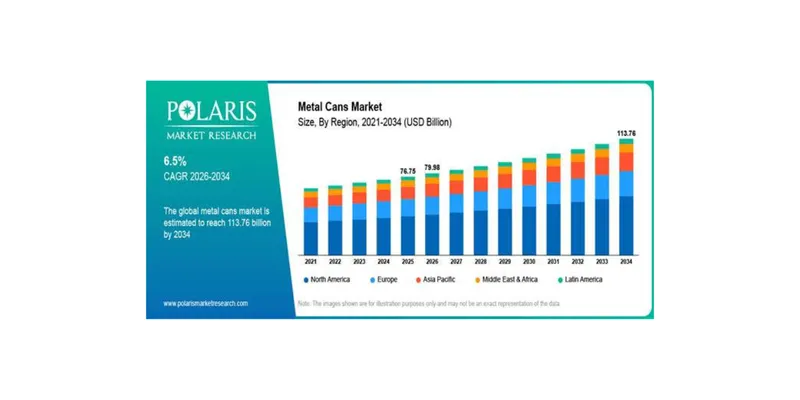
According to Polaris Market Research, the global metal cans market is forecast to expand from USD 79.98 billion in 2026 to USD 113.76 billion by 2034, following a valuation of USD 76.75 billion in 2025. The report attributes growth to increasing demand for recyclable packaging formats and the continued expansion of beverage and food packaging applications.
Metal cans remain widely used across industries due to their durability, recyclability and suitability for large-scale packaging operations. Aluminum and steel cans can be recycled repeatedly without degradation in material quality, supporting circular economy objectives and sustainability initiatives across multiple markets.
The report notes that rising consumption of ready-to-drink (RTD) beverages, including energy drinks, craft beers, carbonated soft drinks and wellness beverages, continues to support demand for metal packaging. Their portability, leak resistance and shelf-life advantages have contributed to broader adoption across consumer markets.
Material Segment Analysis
The aluminum cans segment accounted for 48% of the global market share in 2025. The segment's position is supported by aluminum’s lightweight properties, corrosion resistance and recyclability. Aluminum continues to be extensively used in beverage packaging applications.
Steel cans maintained a significant presence in food packaging, particularly in applications requiring strength and heat resistance.
Product Type Overview
Among product categories, 2-piece cans held a 42% market share in 2025. The format is widely used in beverage packaging due to its manufacturing efficiency and design characteristics.
Drawn & Redrawn (DRD) cans are increasingly being used in premium food packaging applications, including processed and ready-to-eat food products.
Application Trends
The beverage cans segment represented 55% of total market share in 2025, making it the largest application category. Metal cans continue to be used extensively for beverage packaging due to their ability to protect contents from UV exposure, preserve carbonation and extend shelf life.
Food cans remained another major application area, particularly for vegetables, fruits, soups and meat products.
Regional Market Insights
North America accounted for the largest regional share at 37%, supported by strong demand for packaged beverages and established recycling infrastructure.
Europe represented 29% of the global market, driven in part by packaging regulations and Extended Producer Responsibility (EPR) frameworks in countries including Germany, France and the United Kingdom.
Asia Pacific recorded the fastest regional growth rate at 6.1%. The report cites urbanisation, expanding middle-class populations and growing demand for packaged food and beverages in China and India as key growth factors. According to UN-Habitat, Asia’s urban population exceeds 2.2 billion and is projected to increase by an additional 1.2 billion by 2050.
Latin America and the Middle East & Africa are expected to grow at a combined CAGR of 4.2%, supported by industrial development and retail sector expansion.
Key Market Drivers
The report identifies sustainability requirements, growth in RTD beverage consumption and packaging innovation as major factors influencing market development.
In March 2026, Henkel introduced a tinplate can packaging solution using CO₂-reduced bluemint steel. According to the report, the packaging achieves up to 62% lower emissions compared to conventional tin cans.
The expansion of energy drinks, hard seltzers, cold-brew coffees and wellness beverages is also contributing to increased demand for metal cans. In addition, developments in digital printing, QR code integration, BPA-free coatings and lightweight can design continue to support product innovation.
Market Challenges
The report highlights aluminum price volatility as a key challenge for manufacturers. Fluctuating raw material costs can affect margins across the supply chain, prompting companies to explore hedging strategies, long-term supply agreements and greater use of recycled content.
Competitive Landscape
Major companies operating in the market include Ball Corporation, Crown Holdings, Ardagh Group S.A., Silgan Holdings Inc., Can-Pack S.A., CCL Industries Inc., Oricon Enterprises Limited and Hindustan Tin Works Ltd.
Industry participants continue to focus on lightweight packaging, circular economy initiatives, coating technologies and expansion into growth markets.
In December 2024, Ball Corporation partnered with Dabur to introduce Réal Bites juice in aluminum cans as part of efforts to reduce plastic packaging use in India’s juice segment.
Market Outlook
According to the report, the metal cans industry is expected to continue benefiting from demand for recyclable packaging, growth in beverage consumption and advancements in packaging technologies through the forecast period ending in 2034.
Read Full Report here: https://www.polarismarketresearch.com/press-releases/metal-cans-market