Global Membranes Market Projected to Reach $11.70 Billion by 2030
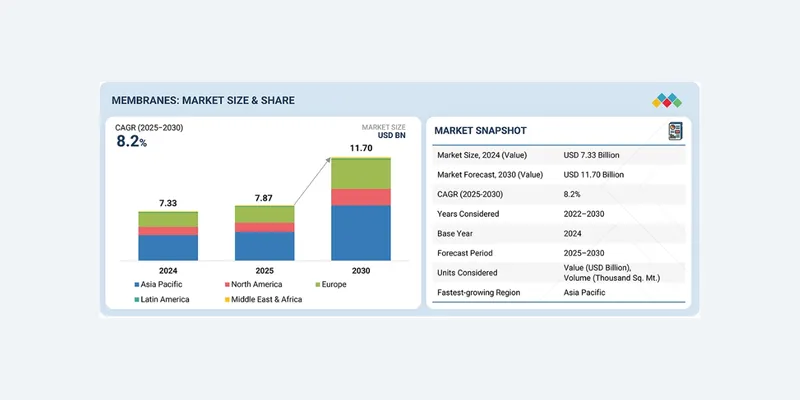
According to the report titled “Membranes Market by Material (Polymeric, Ceramic), Technology (Reverse Osmosis, Ultrafiltration, Microfiltration, Nanofiltration), Application (Water & Wastewater Treatment, Industrial Processing), and Region - Global Forecast to 2030”, the global membranes market is expected to reach USD 11.70 billion by 2030 from USD 7.87 billion in 2025, growing at a CAGR of 8.2%.
The report stated that market growth is being driven by rapid industrialization and urbanization, which are increasing wastewater generation and pollution levels globally. This has led to higher demand for advanced treatment technologies such as membrane filtration to support sustainable water management and resource recovery.
North America is projected to account for the second-largest share of the membranes market during the forecast period. The report attributed this to established water treatment infrastructure, rising industrial activity, and stringent environmental regulations supporting adoption of membrane technologies.
The region is also witnessing increasing use of membrane systems across pharmaceutical and food & beverage industries, alongside growing investments in municipal wastewater treatment projects. Ongoing technological advancements and the presence of major market participants are expected to further support regional growth.
The report identified emerging economies as a key opportunity area for membrane manufacturers. Rising urban populations, industrial expansion, and growing concerns around water availability and pollution in regions including Asia Pacific, Latin America, the Middle East, and Africa are increasing demand for advanced water treatment solutions.
According to the study, pressure on water infrastructure in developing economies has encouraged municipalities and industries to invest in membrane filtration technologies to support potable water production, wastewater treatment, and water reuse systems.
The report noted that membrane technologies offer high efficiency in removing contaminants, pathogens, and trace industrial chemicals while supporting compliance with water quality standards and sustainable development objectives.