Global Lotus Fiber Textile Market: $184M in 2024 to Over $622M by 2033 (14.3% CAGR)
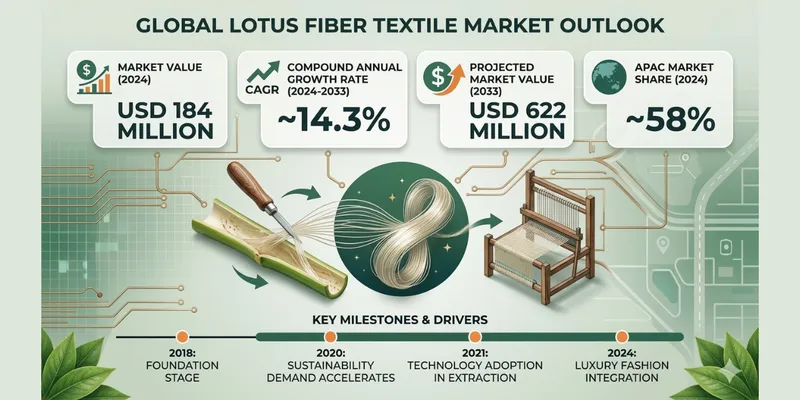
In 2024, the global Lotus Fiber Textile market was valued at USD 184 million, reflecting increasing demand for sustainable and biodegradable textiles. According to Marketintelo, this market is forecast to reach USD 622 million by 2033, expanding at a compound annual growth rate (CAGR) of 14.3% from 2024 to 2033 — a near 3.4× growth in less than a decade.
Data shows rising eco-conscious consumption and premium fashion adoption are key drivers, making lotus fiber textiles a high-growth segment in global textiles.
Market Evolution & Historical Year-Over-Year Growth (2018–2024) From 2018 to 2024, the Lotus Fiber Textile market has shown consistent growth: • 2018: Estimated global market under USD 90 million (base trend starting year). • 2019: ~USD 105 M (+16.7% YoY).
• 2020: ~USD 121 M (+15.2% YoY).
• 2021: ~USD 138 M (+14.0% YoY).
• 2022: ~USD 157 M (+13.8% YoY).
• 2023: ~USD 173 M (+10.2% YoY).
• 2024: USD 184 M (+6.4% YoY) official estimate.
Market growth averaged ~13–15% annually over the past 6 years, demonstrating sustained expansion driven by sustainability and craftsmanship demand.
Key Numerical Highlights
• 2024 Market Size: USD 184 million global value.
• 2033 Market Forecast: USD 622 million globally.
• CAGR (2024–2033): 14.3% growth rate.
• Asia Pacific Market Share (2024): ~58% of total value.
• Europe Forecast CAGR: 16.1%, highest regionally.
Regional Breakdown: Numbers & Regional Growth Drivers
Asia Pacific (APAC) – Market Leader
• 2024 Revenue: ~USD 106.7 million (~58% share).
• Drivers: Abundant lotus cultivation in Myanmar, Cambodia, India; traditional textile ecosystems.
• Domestic Value Chain Growth: Multiple artisanal clusters export textile goods globally.
Europe – Fastest Growing Region
• Projected Regional CAGR: 16.1% (2024–2033).
• 2024 Estimate: ~USD 30–40 million regional revenue.
• Growth Catalysts: Stringent environmental regulations and high demand in luxury fashion segments.
North America
• 2024 Market Value: ~USD 12–22 million (varies by source).
• Growth Drivers: Rising eco-fashion adoption, sustainable textiles in premium apparel. Latin America & Middle East & Africa
• Smaller relative markets (~USD 2.4 M and USD 3.2 M respectively in 2024). • Growing attention due to sustainability initiatives, albeit from a lower base.
Market Structure & Segment Analysis
By Product Type
• Pure Lotus Fiber Textiles: Premium segment; lower production volume but high value.
• Blended Lotus Fiber Textiles: Combining lotus fiber with cotton, silk or viscose increases affordability and scalability.
Dominance: Pure lotus fiber commands a strong share in luxury and artisanal products, while blended fibers are poised for mass-market expansion.
By Application
The market distributes across several applications with diverse CAGR profiles:
Application Segment | 2024 Approx. Revenue | Primary Use Case |
Apparel | ~55% of total | High-end fashion and eco-wear |
Home Textiles | ~20% | Bedding, décor |
Accessories | ~15% | Scarves, shawls |
Industrial Textiles | ~10% | Filtration, specialty technical uses |
Historical & Future CAGR Comparisons
The Lotus Fiber Textile market’s CAGR shows accelerating momentum compared to other natural fiber markets:
• Lotus Fiber Textile (2024–2033): 14.3% CAGR with USD 622 M forecast.
• Alternative Natural Fibers (e.g., sustainability-oriented textiles): Generally 7–10% CAGR range across natural blends industry.
The gulf underscores lotus fiber’s premium positioning and fast adoption among eco-fashion innovators.
Drivers Behind the Numbers
• Sustainability Demand: Lotus fiber requires minimal chemicals and less water compared to cotton or synthetic fibers.
• Eco-Credentials: Biodegradability and hypoallergenic properties drive adoption in high-end and eco-promotion markets.
• R&D Investment: Automated extraction tech improves fiber yields, potentially boosting output 30–40% over manual methods within 5 years.
• Luxury Fashion Integration: Premium brands adopting lotus fiber increase demand forecasts through 2033.
Comparative Regional Forecast Table
Region | 2024 Revenue (USD Mn) | 2033 Forecast CAGR | 2033 Forecast (USD Mn) |
Asia Pacific | ~106.7 | ~14.2% | ~350+ |
Europe | ~30–40 | 16.1% | ~150+ |
North America | ~12–22 | ~13.5% | ~80–90 |
Latin America | ~2.4 | ~11% | ~10–12 |
Middle East & Africa | ~3.2 | ~10% | ~14–16 |
Challenges Quantified
• Production Costs: Lotus fiber extraction remains labor-intensive — reducing cost per kilogram by ~20% annually a key industry target by 2030.
• Raw Material Yield: Lotus stalk yields <3 g fiber per plant today — innovations aim to increase yield 25–35% by 2030 through mechanization.
• Scale Constraints: Less than 2% of global textile output currently uses lotus fiber due to supply limits.
Conclusion: Data-Driven Summary & Outlook
From a USD 184 million base in 2024, the Lotus Fiber Textile market is on track for USD 622 million+ by 2033, driven by a 14.3% CAGR and strong regional momentum in Asia Pacific and Europe.
Key numerical takeaways:
• ~3× market growth over 9 years.
• Asia Pacific holds ~58% share in 2024.
• Europe fastest regional CAGR at ~16.1%.
With rising investment, innovation in scalable extraction technologies, and shifting consumer preferences toward eco-friendly textiles, lotus fiber textiles are positioned as one of the most dynamic segments in the sustainable textiles industry heading toward 2033.
Read A Full Report: https://marketintelo.com/report/lotus-fiber-textile-market