Global Green Steel Market Projected to Reach USD 213.96 Billion by 2035, Growing at 12.4% CAGR
Verified Emissions, Reliable Deliveries and Regulatory Compliance Emerge as Key Factors Shaping the Green Steel Industry
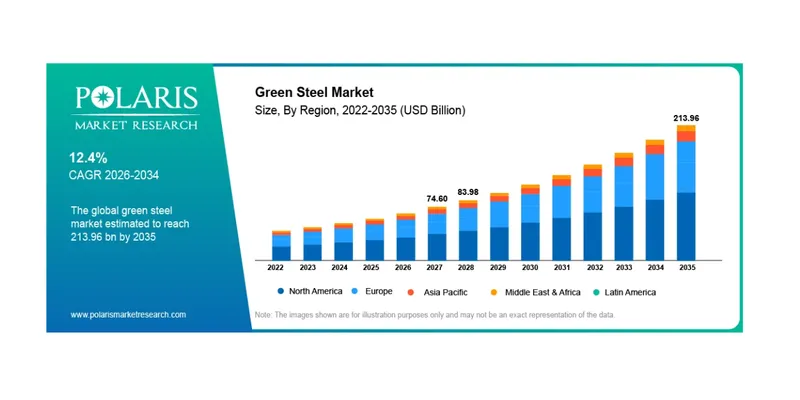
The global green steel market is projected to grow from USD 74.60 billion in 2026 to USD 213.96 billion by 2035, registering a compound annual growth rate (CAGR) of 12.4%, according to Polaris Market Research. As steelmakers advance decarbonisation plans, customers are increasingly looking for verified emissions data and reliable delivery timelines alongside lower-carbon production technologies.
Emissions Verification Becomes a Commercial Priority
Green steel cannot be distinguished from conventional steel through physical strength alone. Its market premium increasingly depends on documented emissions performance and regulatory frameworks that recognise lower-carbon production.
The European Union's Carbon Border Adjustment Mechanism (CBAM) entered its definitive period in 2026. European Commission guidance issued in August outlines the calculation of embedded emissions across six product categories. Under this guidance, post-consumer scrap carries zero embedded emissions, creating an advantage for producers using recycled metal.
Customer requirements vary across industries. Automotive manufacturers seek facility-level emissions data and audit rights, while construction companies look for recognised labels for tenders. Machinery manufacturers require certificates that can be incorporated into their own reporting systems.
Commercial agreements are also evolving, with some contracts linking price premiums to verified emissions levels and allowing certificates to be traded separately from physical steel.
As a result, emissions measurement, verification and certification at batch level are becoming important commercial capabilities for steel producers.
Scrap and Natural Gas Routes Support Near-Term Transition
Scrap-based electric arc furnaces (EAF) accounted for 49.8% of technology revenue in 2027. These systems can reduce emissions by using recycled metal and clean electricity, while requiring significantly lower capital investment than new ironmaking facilities.
Natural gas-based direct reduction with carbon capture is another transition pathway, generating approximately USD 26.2 billion in 2027. It allows producers to reduce emissions before green hydrogen becomes commercially available at scale.
Hydrogen remains an important long-term technology, although its commercial deployment faces cost and infrastructure challenges. Thyssenkrupp's 2.5-million-tonne Duisburg project received revised funding terms in November 2026 after the company reported higher-than-expected green hydrogen costs. The project may initially operate on natural gas, which can reduce CO₂ emissions by more than 50% compared with the blast furnace route.
Despite these constraints, hydrogen-based direct reduced iron (DRI) is forecast to grow at an annual rate of 19.9%, while electrolysis-based routes are projected to expand by 21.0% from a relatively small base.
Project Timelines and Financing Remain Key Risks
Securing finance does not necessarily ensure that a green steel project will meet its planned schedule. Stegra raised EUR 1.4 billion for its Boden plant, with backing from Scania, Schaeffler and Kobe Steel. However, its overall timeline remains under review.
Delays can affect customers that have planned their sourcing strategies around certified hydrogen-based steel becoming available in the late 2020s. Phased production strategies, beginning with scrap or natural gas and transitioning to hydrogen as costs and supply conditions improve, can help reduce delivery risks.
Regional Market Outlook
Europe
Europe is projected to account for 35.5% of green steel market revenue in 2027. Its annual growth rate of 10.6% is the slowest among the five regions, reflecting its comparatively large existing market base. Germany is the region's largest national market.
Salzgitter expects to produce its first SALCOS steel in the second half of 2027. The project includes direct reduction technology, a 100 MW electrolysis plant and an electric arc furnace.
Asia Pacific
Asia Pacific is expected to record the fastest regional growth at 14.5% annually. China represents the largest market base in the region, while India is projected to lead all countries with a growth rate of 21.0%.
India's green steel taxonomy, which establishes a threshold of 2.2 tonnes of CO₂ per tonne of steel, is among the factors supporting market development. In September 2026, POSCO and BHP signed an agreement to test hydrogen-based steelmaking using real iron ore through the HyREX process.
North America
North America is expected to account for 22.2% of market revenue and grow at 11.5%. Its established electric arc furnace capacity, scrap availability and natural gas resources support the region's position.
Cleveland-Cliffs' Middletown project, supported by a USD 500 million federal grant, illustrates the role of public funding in directing investment towards lower-emission steel production.
Latin America and the Middle East & Africa
Although these regions account for smaller market shares, their iron ore resources, solar power potential and natural gas-based assets provide opportunities for green steel production and exports.
Saudi Arabia is projected to lead its region with annual growth of 16.1%. Access to financing and greater policy certainty will influence how many announced projects progress to construction and production.
Competitive Landscape: Three Industry Strategies
The market's competitive landscape reflects three broad approaches to the transition.
1. Existing Steelmakers Modernising Production
ArcelorMittal, SSAB, Salzgitter and voestalpine are replacing conventional blast furnace capacity within their existing production networks.
voestalpine's Donawitz electric arc furnace, targeting annual production of approximately 850,000 tonnes from the first half of 2027, represents a scrap-first transition strategy.
ArcelorMittal's third-quarter net loss, partly associated with delays in passing on higher energy and carbon costs, highlights the financial pressures facing established producers as they fund industrial conversion.
2. Specialist Green Steel Producers
Stegra represents a project-led approach supported by customer equity and strategic investors. Its financing demonstrates the role of long-term commercial partnerships in supporting capital-intensive developments, although execution and delivery risks remain.
3. State-Supported Producers in Asia and the Gulf
Companies such as POSCO and Emirates Steel Arkan are pursuing lower-carbon production strategies supported by public-sector backing and access to resources such as iron ore, natural gas and power.
Measuring market share remains difficult because relatively few companies separately disclose green steel sales. Customer agreements, production facility start-ups and certification activity therefore provide useful indicators of market progress.
Long-term automotive supply agreements can also improve access to project financing. The automotive segment is expected to represent 40.2% of market revenue in 2027.
Market Outlook Through 2035
Several developments are expected to influence the green steel industry's growth over the coming years:
- Scrap-based capacity to support early supply: New electric arc furnace installations in Europe and North America are expected to add production capacity during 2027 and 2028, ahead of many hydrogen-based projects.
- Gradual hydrogen adoption: The transition from natural gas to hydrogen-based production is likely to depend on hydrogen prices and availability rather than occur through a single industry-wide shift.
- Policy to influence investment locations: Carbon border measures, green steel taxonomies and government grants are expected to direct investment towards regions offering regulatory clarity and affordable clean energy.
- Potential industry consolidation: Producers with established customers but limited financial capacity may seek strategic partners. Suppliers of iron ore, electricity and hydrogen may also invest in steel projects to secure future demand.
Building and construction is projected to grow at 14.1% annually, while stainless and specialty steel is expected to expand at 14.8%. These segments are among the fastest-growing areas of the market, supported by the increasing use of sustainability labels in public procurement and the commercial value of recycled content.
Conclusion: Emissions Data and Delivery Will Shape Market Competitiveness
The green steel market is projected to expand significantly by 2035, but investment opportunities will depend on more than the selection of production technology.
Steelmakers will need to demonstrate emissions performance through recognised verification systems, maintain project timelines despite fluctuations in hydrogen costs and secure access to customers, electricity and scrap.
Companies able to address these requirements with measurable data and commercially viable production strategies will be better positioned to compete as regulations and customer sourcing requirements evolve.