Global Fire Resistant Fabrics Market Projected to Reach USD 6.63 Billion by 2034, Says Polaris Market Research
Market growth is supported by workplace safety regulations, industrial demand and advancements in flame-resistant textile technologies.
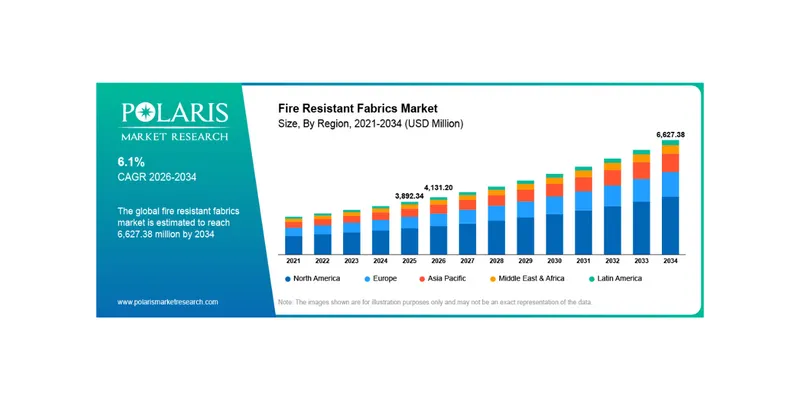
According to the Fire Resistant Fabrics Market report published by Polaris Market Research, the global fire resistant fabrics market is forecast to expand from USD 3,673.18 million in 2024 to USD 6,627.38 million by 2034, at a CAGR of 6.1% during the 2025–2034 period. The market is projected to reach USD 3,892.34 million in 2025.
Workplace Safety Regulations Drive Demand
Fire resistant fabrics are designed to protect users from flames, heat and molten splash. The report states that demand is increasing across industries including construction, chemicals, oil and gas, and manufacturing, supported by workplace safety regulations and the adoption of certified flame-resistant protective clothing.
Treated Fabrics Accounted for the Largest Share
The market is segmented into inherent fire resistant fabrics and treated fire resistant fabrics.
According to the report, treated fire resistant fabrics held the largest market share in 2024, supported by demand from the automotive, defence, and oil and gas sectors. Inherent fire resistant fabrics are also expanding their presence in applications where long-term flame protection is required.
Among end-use industries, the industrial safety segment—including oil and gas, utilities and manufacturing—is expected to record the fastest growth through 2034, driven by the increasing use of flame-resistant coatings and protective garments to comply with workplace safety requirements.
Asia Pacific Leads the Market
The report states that Asia Pacific accounted for 37.2% of global market revenue in 2024. Growth in the region is supported by industrial development, expansion of the healthcare, mining and chemicals sectors, and stricter testing and compliance requirements. China, India, Japan and South Korea remain key markets in the region.
North America is projected to register the fastest growth during the forecast period, supported by expanding chemical and oil and gas industries and increased adoption of certified fire-resistant workwear.
Technology Developments in Fire Resistant Fabrics
The report highlights ongoing developments in textile technology, including the use of nanotechnology to incorporate clay minerals and metal nanoparticles into fabric structures to improve flame resistance.
It also notes increasing adoption of phase-change materials, which absorb and release body heat to improve wearer comfort in high-temperature environments.
Recent product developments mentioned in the report include:
- DuPont introduced Nomex® Nano Flex in March 2025, offering 25% higher thermal protection, 99% particulate blocking, and improved mobility.
- Teijin Limited developed Tenax, a carbon-fiber fabric coated with thermoplastic polymer for applications requiring heat, impact and fatigue resistance.
- Royal TenCate introduced Tecasafe 360, described as the first inherently flame-resistant fabric combining stretch with flame protection.
Competitive Landscape
The report identifies the following companies as key participants in the market:
- Huntsman International LLC
- PBI Fibers International
- Teijin Limited
- DuPont
- Royal TenCate N.V.
- Gun Ei Chemical Industry Co., Ltd.
- Solvay S.A.
- Kaneka Corporation
- Lenzing AG
- Newtex Industries, Inc.
According to the report, these companies continue to invest in research and development while expanding product portfolios and developing sustainable flame-retardant technologies.
Market Outlook
The report states that demand for fire resistant fabrics is expected to remain supported by investments in occupational safety and increasing use of flame-resistant textiles across industries including defence, industrial safety and home furnishings. It also notes that high production costs remain a challenge, while continued advances in treatment technologies and fibre science are expected to improve cost efficiency over time.
Source: Polaris Market Research