Global Fashion at Financial Risk: Why Climate Action Can No Longer Wait
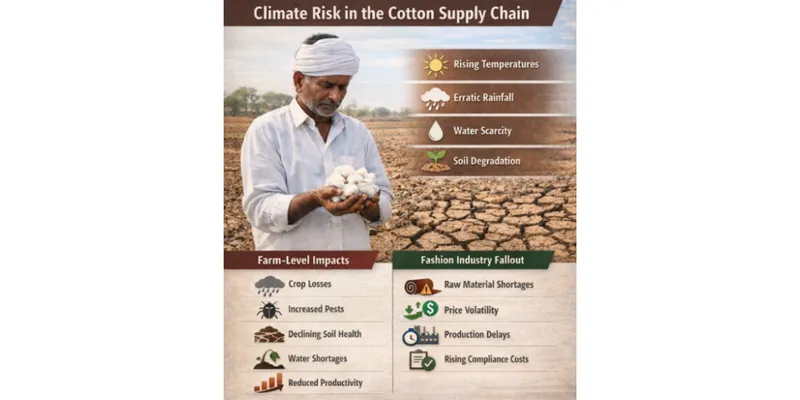
Climate change is increasingly affecting the reliability of cotton and other natural fibre supply chains. This article examines how climate volatility is becoming a financial risk for fashion brands and why farm-level climate action is now critical for long-term stability.
The global fashion industry is entering a new era of risk, one shaped less by trends and more by temperature, rainfall, and soil health. Climate change is no longer a distant sustainability concern. It is a present-day business threat disrupting the reliability of raw materials, timelines, and costs across the value chain.
For an industry deeply dependent on natural fibres like cotton, climate volatility becomes business volatility. Rising heat, erratic monsoons, water stress, and degrading soils are already reshaping sourcing regions. What appears as a procurement problem in headquarters often begins as a shock at the farm gate.
At CottonGuru®, we witness this reality on the ground. In India’s cotton belt, including districts such as Yavatmal in Maharashtra, tribal and smallholder farmers are facing unseasonal rains, extended dry spells, and rising pest pressure. When a farmer’s yield drops or fibre quality becomes inconsistent, the consequences ripple upward: shortages, price swings, production delays, and heightened compliance burdens for brands.
Climate risk is now supply chain risk
Cotton is among the most climate-sensitive crops. Yield and quality depend on stable weather patterns, adequate water, and living soils. Increasingly, cotton-growing regions are seeing:
- Unseasonal and extreme rainfall
- Heat stress and prolonged dry spells
- Declining soil organic matter
- Higher pest and disease incidence
- Lower productivity and inconsistent quality
These are not isolated agronomic issues. They translate into higher input costs, reduced output, and greater uncertainty, exactly the kind of volatility that becomes financial risk for fashion brands.
In a world where consumer expectations, disclosure standards, and investor scrutiny are rising, brands face a double exposure: operational disruption and reputational risk. The old approach, publishing targets without changing conditions on the ground, no longer holds.
From risk to resilience: insetting and high-integrity offsetting
There is a practical path forward. Leading brands are moving from reporting to intervention through two complementary strategies.
1) Carbon insetting: decarbonising within the supply chain
Insetting means investing inside a company’s own sourcing landscape to reduce emissions and increase carbon sequestration. This strengthens the supply chain rather than outsourcing responsibility. In cotton systems, insetting can include:
- Regenerative agricultural practices
- Improved residue management
- Water-efficient farming
- Reduced synthetic input dependency
- Soil carbon enhancement through durable interventions such as biochar
These measures do more than cut emissions. They rebuild soil structure, improve water retention, support nutrient cycling, and stabilise yields. The result is a more resilient cotton supply base under climate stress.
2) Carbon offsetting: financing verified climate solutions
Offsetting can complement insetting by supporting verified projects that avoid or remove greenhouse gas emissions elsewhere. But credibility matters. Brands increasingly require transparent measurement, traceability, and on-ground validation. High-integrity carbon outcomes depend on execution, meaning what is implemented, how it is measured, and whether it stands up to scrutiny.
Why field execution partners matter
Many fashion brands have ambitious net-zero or science-based targets. The toughest gap is operational: translating climate investment into measurable farm-level outcomes across thousands of small farms.
Key questions remain:
- How will carbon claims be validated?
- How will farmer participation be sustained?
- How will resilience be built without reducing productivity?
- How will progress be measured with transparency?
This is where execution capability becomes the differentiator.
CottonGuru® bridges corporate climate ambition and grassroots agricultural transformation. Our work focuses on practical, scalable interventions with measurable field outcomes. We collaborate directly with cotton-growing communities, train farmers in regenerative practices, and support soil health improvements, while building traceable, climate-linked cotton value chains.
Biochar is one example of a durable soil-based intervention. When produced and applied responsibly, it can lock carbon into soils for long-term storage while improving water retention, nutrient efficiency, and soil structure. This helps crops withstand erratic weather and reduces long-term dependence on chemical inputs. The result is a dual benefit: stronger farmer livelihoods and credible climate progress.
Climate action as strategic risk management
For fashion, climate action is no longer only about compliance or corporate responsibility. It is strategic risk management. Building resilience at the farm level can reduce raw material volatility, stabilise sourcing regions, strengthen brand trust, and mitigate long-term financial exposure.
As climate extremes intensify, the brands that invest now in adaptive supply systems will outperform those that wait. The future of fashion will belong to companies that invest not just in style, but in soil.
CottonGuru® remains committed to building that future from the ground up.
Author: CottonGuru®