Global Digital Textile Printing Market to Reach $18.22B by 2034
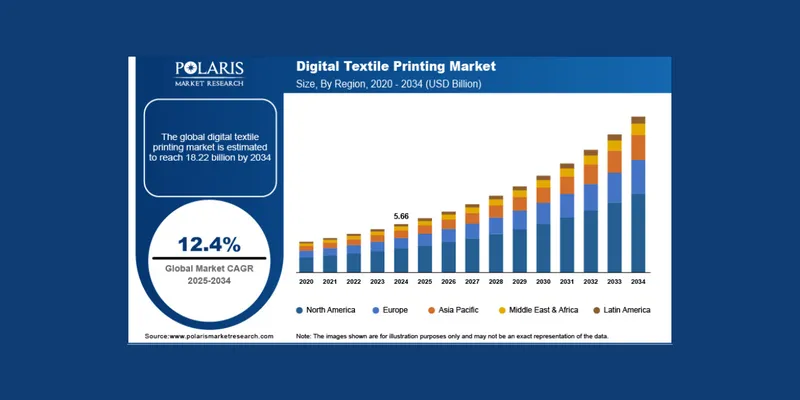
The Global Digital Textile Printing Market is undergoing notable growth as manufacturers in fashion, home décor, and technical textiles adopt digital printing solutions. A report from Polaris Market Research forecasts the market will increase from USD 6.35 billion in 2025 to USD 18.22 billion by 2034, representing a CAGR of 12.4% during the forecast period.
Digital textile printing involves applying colorants directly to fabrics using digital inkjet technology. This process offers precise design capabilities, reduced production cycles, and environmentally efficient workflows compared to traditional screen and rotary printing methods. The technique enables on-demand production of multicolor designs with minimal setup costs.
Environmental considerations are a significant factor in the adoption of digital textile printing. Unlike conventional printing processes that consume large volumes of water and generate chemical waste, digital printing reduces water use and effluent output, supporting sustainability objectives. Its capacity to produce short-run garments and décor with minimal waste is influencing supply chains and operational efficiency.
Market Dynamics:
- On-Demand Production & Customization: Digital textile printing allows the creation of customized, small-batch products, meeting the needs of direct-to-consumer retail and reducing inventory risks.
- Technological Advancements: Improvements in printing hardware, ink formulations, and design software have enhanced production speed, resolution, and material compatibility, supporting broader adoption.
- Eco-Friendly Ink Systems: Sublimation inks held the largest market share in 2024 due to their suitability for polyester fabrics and strong color performance. These inks reduce waste and enhance wash durability.
Market Segmentation:
- Printing Process: Direct to Garment (D2G), Dye Sublimation, Direct to Fabric (D2F)
- Ink Type: Sublimation, Reactive, Acid, Direct Disperse, Pigment
- Substrate: Cotton, Silk, Rayon, Linen, Polyester, and others
- End Use: Clothing, Households, Displays, Technical Textiles
The preference for sublimation inks is linked to the demand for polyester textiles in apparel, sportswear, and home products. Dye Sublimation printing enables production of lightweight, wrinkle-resistant fabrics with complex designs.
Regional Outlook:
North America led the market in revenue share in 2024, supported by advanced manufacturing infrastructure, established fashion brands, and e-commerce growth enabling flexible production schedules. The Asia Pacific region is projected to record the fastest growth through 2034, driven by expanding textile manufacturing, automation investment, and increased demand for high-quality fashion exports from countries such as China, India, and Bangladesh.
Competitive Landscape:
Key market players, including Durst, Epson, Kornit Digital, and Brother Industries, are developing advanced hardware, integrated ink systems, and software platforms to improve efficiency and color accuracy. Emerging firms are introducing scalable, cost-effective solutions for small and medium enterprises, expanding market reach. Single-pass printing technologies and end-to-end workflow solutions are among current innovation focuses.
Outlook:
The Digital Textile Printing Market is expected to continue expanding as manufacturers adopt digital processes for more sustainable, agile, and cost-efficient production. Advancements in inks, machine efficiency, and digital design tools are likely to shape industry practices and support market growth.
Source: Polaris Market Research