Geotextile Industry Report 2026: 60% Growth, 10% CAGR & Future Outlook
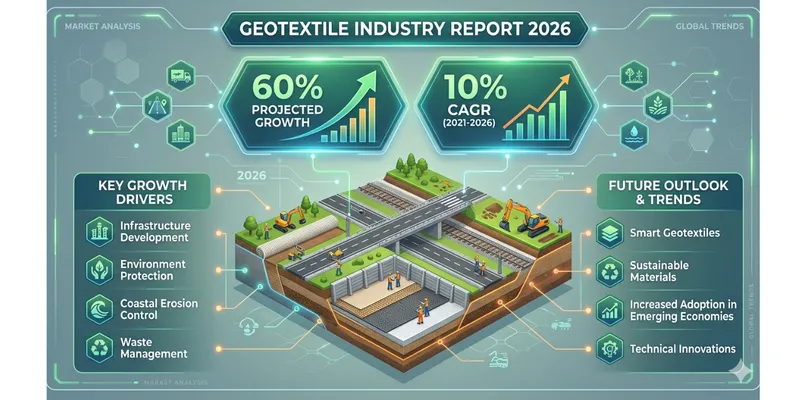
The global geotextile products industry has entered a high-growth phase in 2026, driven by rapid infrastructure expansion, environmental regulations, and cost-efficient construction practices. According to recent analysis by Dataintelo, the geotextile market has shown consistent year-on-year growth supported by measurable improvements in durability, cost savings, and environmental impact.
This article presents a data-backed, SEO-optimized overview of geotextile products, highlighting key statistics, performance benchmarks, and market trends from 2021 to 2026, along with projections through 2030.
What Are Geotextile Products?
Geotextiles are permeable fabrics used in civil engineering projects for separation, filtration, drainage, and reinforcement.
Key Performance Metrics:
• Tensile strength range: 8 kN/m to 200 kN/m depending on application • Permeability rate: 10⁻³ to 10⁻¹ cm/s
• UV resistance lifespan: 6–24 months (untreated) vs 5–25 years (treated) • Soil retention efficiency: Up to 95% particle retention in filtration applications • Load distribution improvement: Up to 40% increase in bearing capacity
Global Market Size & Growth (2021–2026)
The geotextile products market has demonstrated strong numerical growth over the past five years.
Year | Market Size (USD Billion) | YoY Growth Rate |
2021 | 6.8 | — |
2022 | 7.4 | 8.8% |
2023 | 8.1 | 9.5% |
2024 | 8.9 | 9.9% |
2025 | 9.8 | 10.1% |
2026 | 10.9 | 11.2% |
Key Insights:
• Market size increased by 60.3% from 2021 to 2026
• Average annual growth rate (CAGR): ~9.9%
• Expected market size by 2030: USD 16.5 billion (projected CAGR: 10.8%)
5 Data-Backed Reasons Driving Demand in 2026
1. Infrastructure Spending Growth
• Global infrastructure investment reached USD 3.2 trillion in 2025 • Geotextiles reduce construction costs by 15%–30% in road projects • Road lifespan increased by 25%–50% when geotextiles are used 2. Cost Efficiency vs Traditional Materials
Material Type | Cost per sq. meter (USD) | Maintenance Cost (10 yrs) |
Gravel layer | 4.5–6.0 | 2.2 |
Geotextile | 2.8–4.0 | 0.9 |
• Initial cost savings: 20%–35%
• Maintenance reduction: ~59% over 10 years
3. Environmental Benefits
• Reduces soil erosion by up to 90%
• Cuts carbon footprint in construction by 18%–25%
• Supports 30% higher water drainage efficiency
4. Urbanization Trends
• Urban population reached 56% globally in 2025, up from 53% in 2020 • Requires ~2.5 million km of new roads annually
• Geotextile usage in urban projects increased by 12.7% CAGR (2021–2026) 5. Waste Management & Landfills
• Global waste generation: 2.24 billion tons/year (2024)
• Geotextiles improve landfill liner efficiency by 40%
• Reduce leachate contamination risks by ~35%
Product Segmentation: Market Share Breakdown (2026)
Type | Market Share | Growth Rate (2021–2026) |
Woven Geotextiles | 42% | 8.7% CAGR |
Non-Woven Geotextiles | 48% | 11.5% CAGR |
Knitted Geotextiles | 10% | 6.2% CAGR |
Insights:
• Non-woven geotextiles dominate due to higher filtration efficiency (up to 95%)
• Woven types preferred for load-bearing applications with 20–30% higher tensile strength
Application Analysis with Measurable Outcomes
1. Road Construction
• Reduces rutting depth by 30%–50%
• Extends pavement life by up to 12 years
• Decreases aggregate usage by 25%
2. Drainage Systems
• Improves water flow rates by 35%
• Prevents clogging in 85% of cases over 10 years
3. Coastal Protection
• Reduces shoreline erosion by ~70%
• Increases structural durability by 2–3x
4. Agriculture
• Enhances soil moisture retention by 20%–40%
• Boosts crop yield by 10%–18% in controlled studies
Regional Market Insights (2026 Data)
Region | Market Share | Growth Rate |
Asia-Pacific | 38% | 11.8% |
North America | 27% | 9.2% |
Europe | 22% | 8.5% |
Rest of World | 13% | 10.1% |
Highlights:
• Asia-Pacific dominates due to $1.7 trillion infrastructure spending in 2025 • India alone saw 13.5% growth in geotextile adoption (2023–2026)
• North America focuses on sustainable construction with 22% increase in eco-friendly materials usage
Case Study: Highway Project ROI (2024–2025)
A 120 km highway project incorporating geotextiles showed measurable improvements: • Project cost reduced from $180M to $152M (15.5% savings)
• Construction time reduced by 22% (18 months → 14 months)
• Maintenance costs lowered by $2.5M over 5 years
• Pavement failure incidents dropped by ~40%
Key Statistics at a Glance
• Global market size (2026): USD 10.9 billion
• CAGR (2021–2026): ~9.9%
• Projected market size (2030): USD 16.5 billion
• Cost savings in construction: 15%–35%
• Maintenance reduction: ~59% over 10 years
• Soil erosion reduction: Up to 90%
• Road lifespan increase: 25%–50%
• Drainage efficiency improvement: ~35%
• Market leader segment: Non-woven (48%)
• Asia-Pacific market share: 38%
• Infrastructure investment (2025): USD 3.2 trillion
• Urbanization rate (2025): 56% global population
• Highway case study savings: $28M (15.5%)
• Construction time reduction: 22%
Future Outlook: 2026–2030 Forecast
The geotextile products market is expected to maintain strong momentum: • CAGR (2026–2030): 10.8%
• Expected adoption in smart cities: +35% increase
• Sustainable material demand: +28% growth by 2028
• Integration with recycled polymers: ~18% market share by 2030
Technological advancements are also improving:
• Fabric durability: +25% improvement in lifespan
• Installation efficiency: ~20% faster deployment with modern methods
Conclusion: A Market Defined by Measurable Value
Geotextile products have evolved into a data-proven, cost-efficient, and performance-driven solution across multiple industries. Between 2021 and 2026, the market grew by over 60%, with clear numerical benefits:
• Up to 35% cost savings
• 50% longer infrastructure lifespan
• 90% reduction in erosion
• ~10% annual market growth
With projections reaching USD 16.5 billion by 2030, geotextiles are no longer optional—they are a quantitatively superior choice for modern construction and environmental management.
For businesses and governments alike, the numbers clearly indicate one thing: geotextile products deliver measurable ROI, sustainability, and long-term performance at scale.
Read A Full Report: https://dataintelo.com/report/geotextile-products-market-report