Geotextile Encapsulation Systems Market to Surpass USD 10.5 Billion by 2033 at 8.2% CAGR
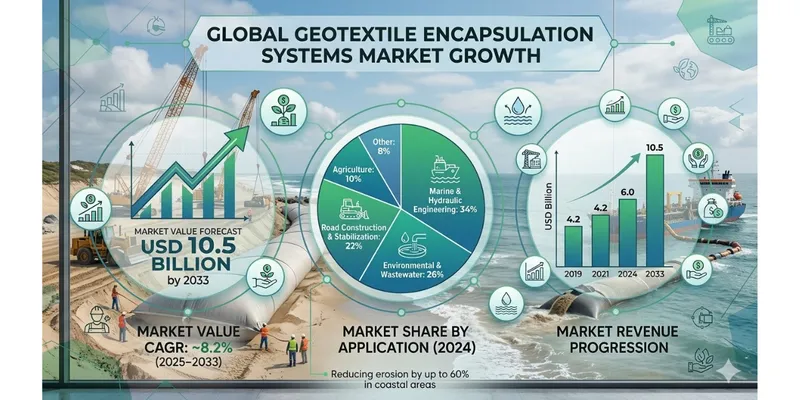
The Geotextile Encapsulation Systems market is witnessing significant growth as global infrastructure investment and environmental engineering projects accelerate. According to industry analysis highlighted by Marketintelo, the global market is projected to reach USD 10.5 billion by 2033, expanding at a compound annual growth rate (CAGR) of approximately 8.2% between 2025 and 2033.
In 2024, the industry generated an estimated USD 5.8–6.2 billion in revenue, supported by rising adoption in coastal protection, road stabilization, wastewater treatment, and landfill engineering. Increasing global infrastructure budgets—estimated at USD 3.7 trillion annually—are further accelerating the demand for geosynthetic materials.
Geotextile encapsulation systems, often used as geotextile tubes or containers, are engineered fabrics filled with sand or slurry to stabilize soil and prevent erosion. These systems can reduce construction costs by 30–40% compared to traditional rock or concrete structures, making them increasingly popular in sustainable civil engineering projects.
Key Numerical Highlights of the Global Market
• Global Geotextile Encapsulation Systems market forecast: USD 10.5 billion by 2033. • Expected CAGR: 8.2% during 2025–2033.
• Asia-Pacific market share in 2024: 42–46% of global revenue.
• North America market size in 2024: ~USD 1.35–1.4 billion.
• Global geotextile tubes segment valuation in 2024: USD 3.5 billion. • Forecast value for geotextile tubes by 2033: USD 5.9 billion.
• Infrastructure-driven geotextile industry growth expected to exceed 9% CAGR in Asia Pacific.
These statistics highlight the growing importance of geotextile encapsulation systems in modern construction and environmental engineering.
Historical Market Performance (2016–2024)
Over the past decade, the Geotextile Encapsulation Systems market has experienced steady expansion due to increasing coastal protection projects and stricter environmental regulations.
Between 2016 and 2020, the market grew from approximately USD 3.1 billion to USD 4.4 billion, representing an average annual growth rate of 7.1%.
The COVID-19 pandemic slowed infrastructure spending in 2020, reducing growth to 4.8%, but recovery began in 2021 as construction activity resumed.
From 2021 to 2024, global revenue expanded from USD 4.9 billion to nearly USD 6 billion, reflecting stronger demand from wastewater treatment, shoreline stabilization, and dredging projects.
Year-Wise Market Progression
Year | Market Size (USD Billion) | YoY Growth |
2019 | 4.2 | 6.8% |
2020 | 4.4 | 4.8% |
2021 | 4.9 | 11.3% |
2022 | 5.3 | 8.1% |
2023 | 5.6 | 5.7% |
2024 | 6.0 | 7.1% |
The data demonstrates a consistent growth trajectory for geotextile encapsulation systems, supported by infrastructure modernization programs worldwide.
Regional Market Breakdown with Numerical Insights
Asia-Pacific
Asia-Pacific dominates the Geotextile Encapsulation Systems market, accounting for 42–46% of global revenue in 2024, equivalent to roughly USD 2.7 billion.
China, India, and Japan collectively represent over 65% of the regional demand due to large scale highway, railway, and coastal protection projects.
Key regional statistics:
• Expected CAGR: 9.3% through 2033.
• Infrastructure spending in China alone exceeded USD 1.8 trillion in 2023.
• India’s geotextile tube market estimated at ₹61 crore in 2019-20, projected to reach ₹98.24 crore by 2024-25.
North America
North America is the second-largest regional market, generating approximately USD 1.35– 1.4 billion in revenue in 2024.
Key growth drivers include:
• U.S. Infrastructure Investment and Jobs Act allocating USD 1.2 trillion for infrastructure upgrades.
• Growing adoption of geotextile encapsulation systems for landfills, shoreline protection, and flood control.
The region is expected to expand at a CAGR of around 8.3% through 2033.
Europe
Europe represents approximately 25% of global demand, equivalent to about USD 1.4–1.5 billion in 2024.
Key statistics:
• EU environmental engineering projects exceeded EUR 300 billion between 2020 and 2024.
• Coastal protection projects in the Netherlands and Germany increased geotextile use by 18% between 2019 and 2023.
European markets are expected to grow at a CAGR of 7.5–8% through 2032.
Middle East, Africa, and Latin America
Emerging regions are witnessing growing adoption of geotextile encapsulation systems due to coastal erosion, mining, and wastewater management projects.
Combined regional statistics:
• Market share: ~12–15% of global revenue in 2024
• Growth rate: 8.5–9% CAGR expected between 2025 and 2033
• Major projects include coastal protection programs in Brazil, UAE desalination infrastructure, and South African mining waste containment.
Application Insights and Industry Usage
The Geotextile Encapsulation Systems market is segmented by application, with construction and environmental engineering dominating.
Market Share by Application (2024)
• Marine & hydraulic engineering: 34%
• Environmental engineering & wastewater treatment: 26%
• Road construction & infrastructure stabilization: 22%
• Agriculture & aquaculture: 10%
• Other applications: 8%
Geotextile tubes used in wastewater treatment help reduce sludge volume by 70–90%, significantly lowering disposal costs.
Similarly, in coastal protection projects, geotextile encapsulation systems can reduce erosion by up to 60% compared to conventional embankments.
Competitive Landscape and Company Statistics
The Geotextile Encapsulation Systems market includes several global geosynthetic manufacturers competing on innovation, durability, and cost efficiency.
Major industry players include:
• TenCate Geosynthetics
• Officine Maccaferri
• NAUE GmbH & Co. KG
• Fibertex Nonwovens
• Ace Geosynthetics
• HUESKER Synthetic GmbH
• TechFab India Industries
These companies collectively account for over 45% of global market share.
Production capacities among leading manufacturers exceed 200 million square meters of geosynthetic fabrics annually, with R&D investments increasing by 12–15% annually since 2020.
Future Market Projections (2025–2035)
The next decade will likely see accelerated adoption of geotextile encapsulation systems driven by climate change mitigation, urbanization, and sustainable construction practices.
Key forecasts include:
• Global market value projected to reach USD 10.5 billion by 2033.
• Geotextile tubes segment expected to reach USD 13.53 billion by 2035 at 9.6% CAGR.
• Infrastructure and coastal protection projects expected to account for over 55% of total demand by 2030.
• Asia-Pacific likely to maintain >45% market share through 2033.
Governments worldwide are also increasing funding for climate resilience and coastal protection, which could boost demand for geotextile encapsulation systems by 35–40% over the next decade.
Conclusion: Strong Growth Outlook for Geotextile Encapsulation Systems
The global Geotextile Encapsulation Systems market is positioned for robust expansion as infrastructure modernization, environmental protection, and climate resilience initiatives gain momentum.
From USD ~6 billion in 2024, the market is expected to grow to USD 10.5 billion by 2033, reflecting a CAGR of over 8%.
Asia-Pacific remains the dominant region with over 40% global share, while North America and Europe continue investing heavily in sustainable infrastructure.
With increasing government infrastructure budgets, rising coastal protection projects, and expanding wastewater treatment applications, geotextile encapsulation systems are becoming essential components of modern civil engineering solutions.
By 2035, industry analysts expect global demand to exceed USD 13 billion, confirming the sector’s long-term growth trajectory and strategic importance in sustainable construction and environmental engineering.
Read A Full Report: https://marketintelo.com/report/geotextile-encapsulation-systems-market