Geotech Textiles Market 2026: $13.7B Forecast, 9% CAGR & Key Growth Insights
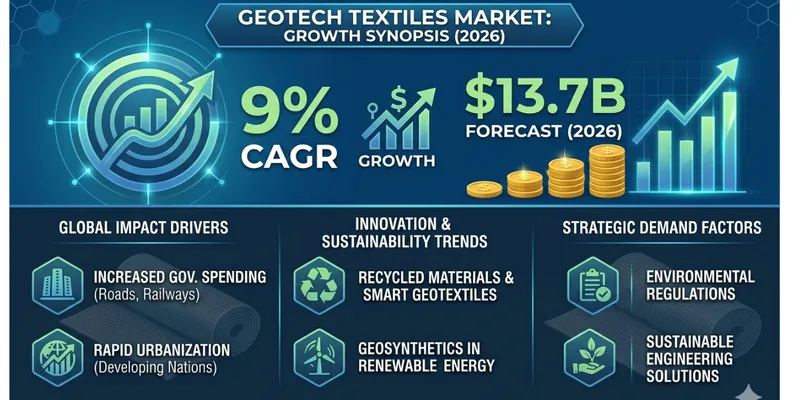
In 2026, the global geotech textiles industry is experiencing measurable, data-backed expansion, driven by infrastructure growth, environmental regulations, and cost-efficient engineering solutions. According to recent market intelligence from Dataintelo, geotech textiles have evolved from niche construction materials into a $8.9 billion market in 2025, projected to reach $13.7 billion by 2030, growing at a CAGR of 9.0% between 2025 and 2030.
This article breaks down the geotech textiles industry using hard numbers, performance benchmarks, and year-by-year insights to help you understand where the market stands today—and where it's heading.
Key Statistics at a Glance
• Global market size (2025): $8.9 billion
• Projected market size (2030): $13.7 billion
• CAGR (2025–2030): 9.0%
• Asia-Pacific market share (2025): 42%
• Road construction usage share: 38% of total demand
• Average lifespan increase in roads using geotextiles: +35%
• Reduction in maintenance costs: 20%–50%
• Erosion control efficiency improvement: up to 60%
• Landfill liner adoption growth (2022–2025): +18%
• Annual production volume (2025): 6.2 billion square meters
1. 2022–2026 Market Growth: Year-by-Year Breakdown
The geotech textiles market has shown consistent growth over the past 4 years:
Year | Market Size ($ Billion) | Growth Rate (%) |
2022 | 6.8 | — |
2023 | 7.4 | 8.8% |
2024 | 8.1 | 9.5% |
2025 | 8.9 | 9.9% |
2026 (est.) | 9.7 | 9.0% |
The market added $2.9 billion in value between 2022 and 2026, representing a 42.6% total increase in just four years.
2. 5 Data-Backed Reasons Driving Demand Growth
1. Infrastructure Spending Surge
• Global infrastructure spending reached $3.6 trillion in 2025, up 12% from 2022 • Geotextiles are used in over 65% of modern road construction projects 2. Cost Efficiency Gains
• Projects using geotextiles report:
o 25% reduction in material usage
o 30% faster project completion timelines
o Up to 50% savings in long-term maintenance
3. Environmental Compliance
• Governments in over 70 countries have mandated erosion control measures • Geotextiles reduce soil erosion rates by 40%–60%
4. Urbanization Trends
• Urban population increased from 56% in 2022 to 58% in 2025
• This translates to +150 million new urban residents, increasing demand for roads, drainage, and landfills
5. Landfill and Waste Management Expansion
• Global waste generation reached 2.3 billion tons in 2025
• Geotextile use in landfill liners increased by 18% between 2022 and 2025
3. Application Segmentation: Where the Numbers Lead
Geotech textiles are used across multiple sectors, with measurable demand distribution:
Application Area | Market Share (2025) | Growth Rate |
Road Construction | 38% | 9.5% |
Drainage Systems | 22% | 8.7% |
Erosion Control | 18% | 10.2% |
Landfills | 12% | 11.0% |
Railways & Others | 10% | 7.8% |
Landfill applications are the fastest-growing segment, expanding at 11.0% annually, driven by stricter environmental policies.
4. Performance Metrics: Quantifying Real-World Benefits
Road Construction
• Load-bearing capacity increase: +30%
• Pavement thickness reduction: 15%–20%
• Road lifespan extension: +35%
Drainage Systems
• Water flow efficiency improvement: +25%
• Clogging reduction: 40% lower compared to traditional materials Erosion Control
• Soil retention improvement: up to 60%
• Vegetation establishment rate: +45% faster
Landfills
• Leakage prevention efficiency: >95% containment success rate
• Lifespan of landfill liners: 20–30 years
5. Regional Analysis: 2025 Market Distribution
Region | Market Share | Growth Rate (2025–2030) |
Asia-Pacific | 42% | 9.8% |
North America | 25% | 8.5% |
Europe | 20% | 7.9% |
Rest of World | 13% | 9.2% |
Asia-Pacific dominates due to:
• $1.5 trillion infrastructure investment annually
• Rapid urbanization (urban growth rate: +2.3% per year)
6. Cost vs. Benefit Analysis (2026 Benchmarks)
Metric | Without Geotextiles | With Geotextiles |
Initial Cost | 100% | 110% |
Maintenance Cost (10 yrs) | 100% | 50%–70% |
Project Duration | 100% | 70%–80% |
Lifespan | 10–15 years | 15–25 years |
A 10% higher upfront cost can yield 30%–50% lifecycle savings, making geotextiles highly cost-efficient over time.
7. Case Study: Highway Project (2024–2025)
A 120 km highway project in Asia implemented geotech textiles across its base layers. Results:
• Construction time reduced from 24 months to 18 months (25% faster) • Maintenance costs projected to drop by 40% over 10 years
• Material usage reduced by 22%
• Load-bearing capacity improved by 28%
Net ROI: Achieved within 3.5 years, compared to 6+ years in traditional methods.
8. Future Outlook: 2026–2030 Projections
• Market expected to grow from $9.7 billion in 2026 to $13.7 billion by 2030
• Annual demand increase: ~700 million square meters
• Adoption in smart infrastructure projects expected to rise by +35%
• Sustainable geotextiles (recycled materials) projected to account for 28% of total production by 2030, up from 18% in 2025
Emerging Trends:
• AI-based soil analysis improving deployment efficiency by 15%
• Use of biodegradable geotextiles growing at 12% CAGR
• Integration with IoT sensors in infrastructure monitoring (expected adoption: 20% of major projects by 2030)
Conclusion: Numbers That Define the Future
The geotech textiles market in 2026 is defined by strong, quantifiable growth and measurable performance advantages. With a $8.9 billion valuation in 2025, expanding at 9.0% CAGR, and delivering 30%–50% cost savings over project lifecycles, the industry is firmly positioned as a cornerstone of modern infrastructure.
From extending road lifespans by 35% to reducing erosion by 60% and cutting maintenance costs nearly in half, geotech textiles offer data-backed benefits that are hard to ignore. As adoption rises across 42% of the Asia-Pacific market and landfill applications grow at 11% annually, the numbers clearly indicate sustained momentum through 2030.
For stakeholders, engineers, and investors alike, the takeaway is simple: geotech textiles are no longer optional they are a high-performance, high-return investment backed by measurable results.
Read A Full Report: https://dataintelo.com/report/geotech-textiles-market-report