Generative AI Beyond the Hype: A Fashion Educator's Perspective on Creativity, Textiles, and Responsible Innovation

Sidhanta Das
Fashion Educator/Freelance Stylist/AI Visual Designer/Corporate Trainer
There was a time when Artificial Intelligence was spoken of as the future. Today, it has quietly become a part of our present. From healthcare and education to finance, retail, manufacturing, and the creative industries, Generative AI is steadily transforming the way we work, create, and solve problems. Yet, despite its growing adoption, much of the public conversation still revolves around one narrow perception—that AI is merely a tool for generating attractive images by typing a few prompts.
As someone who has spent nearly a decade in the fashion industry and the last few years actively working as a Generative AI design practitioner, educator, and corporate trainer, I believe this perception barely scratches the surface. In my experience, Generative AI is not simply another software or creative trend. It represents a fundamental shift in how ideas are conceived, developed, visualized, communicated, and eventually transformed into products.
More importantly, it is not replacing creativity—it is redefining the way creativity is expressed.
Understanding the Human Side of Generative AI
One of the biggest misconceptions surrounding Generative AI is that it effortlessly produces perfect results within seconds. While the technology has undoubtedly made creative workflows faster, meaningful outputs still depend on one irreplaceable element: human thinking.
Generative AI is largely a prompt-driven technology. Every design, concept, illustration, visualization, or campaign begins with language. The quality of the outcome depends on how effectively we communicate our ideas using structured prompts, descriptive keywords, and contextual information.
However, prompting is rarely a one-time activity.
In most professional workflows, the process involves what is commonly known as iterative prompting—continuously refining instructions, experimenting with different approaches, and making thoughtful adjustments until the output aligns with the original creative vision. Much like traditional design development, the process demands patience, observation, experimentation, and critical thinking.
This is precisely why I often tell my students that working with Generative AI is not significantly different from working with conventional design software. The interface may be simpler, but the creative thinking remains equally important. The technology has removed much of the technical complexity associated with software such as Adobe Illustrator, Photoshop, CorelDRAW, or Procreate, allowing designers to spend less time executing repetitive tasks and more time refining ideas.
In other words, AI has simplified the process—but it has not eliminated the need for creativity.
Moving Beyond Beautiful Pictures
Whenever Generative AI is discussed, the internet is flooded with glamorous fashion editorials, fantasy campaigns, cinematic portraits, and visually striking concept art. While these examples certainly demonstrate the creative potential of AI, they also create an incomplete understanding of what the technology can actually accomplish.
Its real strength lies not in producing beautiful images but in improving creative workflows.
Across the fashion and textile industry, Generative AI is increasingly helping professionals accelerate ideation, shorten product development cycles, reduce repetitive manual work, optimize resources, improve communication between teams, and make better-informed decisions long before production begins.
This is where its contribution becomes far more meaningful.
Rather than viewing AI as an image-generation tool, I prefer to see it as a creative productivity and innovation partner.
Sustainability Begins Before Production
One of the most overlooked contributions of Generative AI is its role in supporting more sustainable design practices.
Traditionally, product development often involves multiple rounds of sketching, sampling, revisions, physical prototypes, fabric testing, embroidery trials, photoshoots, and client approvals. Each iteration consumes time, materials, energy, financial resources, and human effort.
Generative AI enables many of these creative decisions to be explored digitally before any physical execution begins.
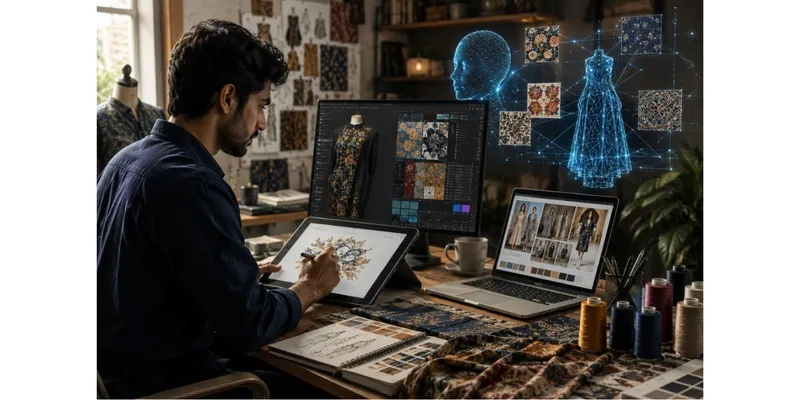
Designers can now visualize garments, textile prints, embroideries, colorways, styling concepts, product variations, and campaign imagery in advance. By identifying potential improvements early in the development process, unnecessary sampling and material wastage can often be reduced significantly.
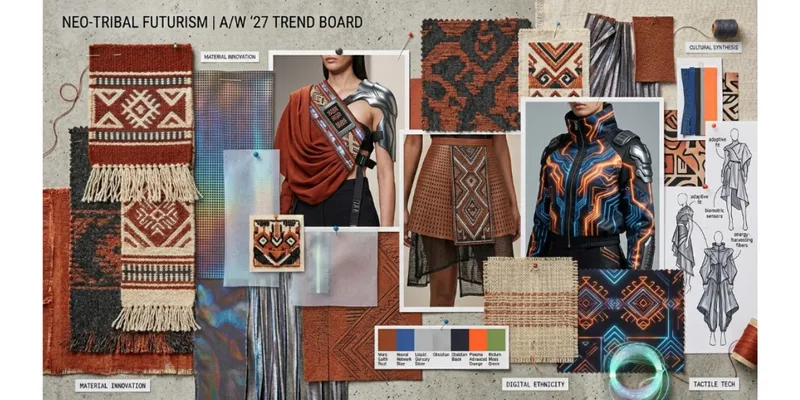
While AI is certainly not a replacement for physical craftsmanship or production expertise, it serves as a powerful decision-making tool that allows designers and brands to move forward with greater confidence.
For me, this is one of the most valuable contributions of Generative AI—not because it replaces human effort, but because it helps us use our resources more intelligently.
A Personal Exploration into Textile and Embroidery Design
A recent self-initiated project reinforced my belief in how transformative Generative AI can be for textile development.
I began with a digitally generated khaka artwork composed of stylized floral and geometric motifs. Instead of limiting the design to a single application, I explored how AI could support multiple stages of the creative process.
The same artwork was first visualized as thread-work embroidery on the neckline of a garment. Later, it was transformed into a digital textile print for a shirt, demonstrating how one original concept could evolve into entirely different product applications without losing its design identity.
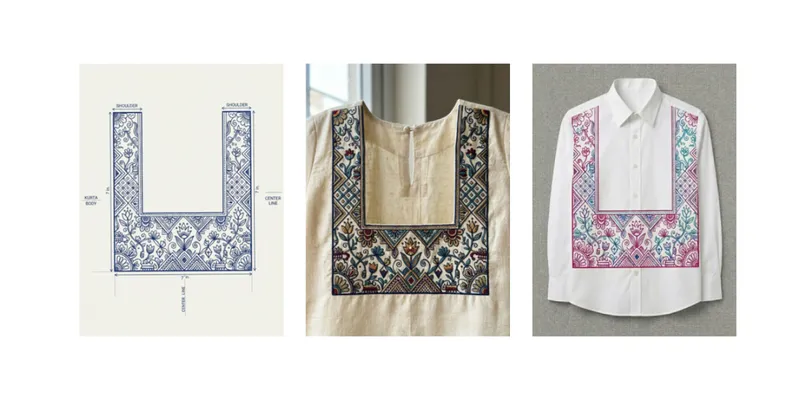
This simple experiment reminded me that AI is capable of much more than generating conceptual fashion imagery.
It can actively support textile design development, surface ornamentation, embroidery visualization, product communication, and commercial product planning.
Not long ago, I also came across a fascinating project on Instagram where a designer combined Generative AI with 3D printing to develop biomaterial-based fashion concepts. Although the project itself was outside my area of work, it reinforced an important idea: the true strength of AI lies in its ability to collaborate with other technologies, opening possibilities that extend far beyond digital artwork.
Fashion Through the Gen AI Lens
Today, AI can assist with analyzing historical fashion movements and identifying emerging trends. It can support forecasting future color palettes, silhouettes, materials, textures, prints, and consumer preferences. Tasks that once required extensive manual research can now be initiated within minutes, allowing designers to spend more time interpreting insights rather than collecting them.
Similarly, AI has begun streamlining the entire design journey—from mood board creation and concept development to fashion illustrations, collection planning, product visualization, and digital storytelling.
Marketing has also witnessed a remarkable transformation. Brands can now create high-quality campaign visuals using AI-generated models, locations, styling concepts, lighting, and environments, dramatically reducing the logistical challenges associated with traditional photoshoots. This not only lowers production costs but also enables faster experimentation and creative flexibility.
Beyond design and marketing, Generative AI is also supporting portfolio development, branding, content creation, visual merchandising concepts, retail presentations, flat sketches, technical documentation, and numerous other functions across the fashion value chain.
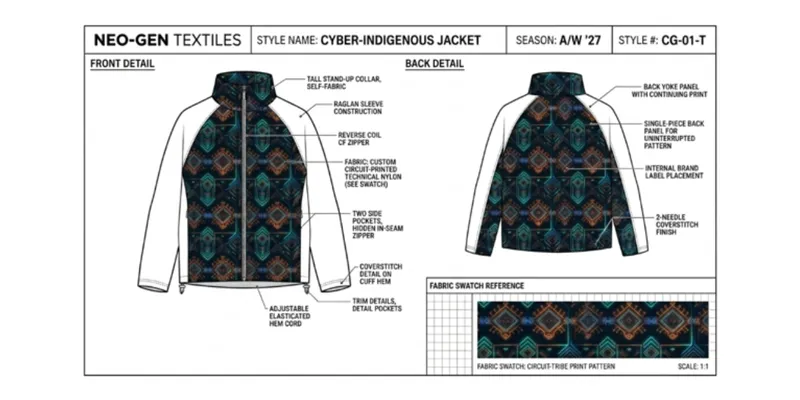
When viewed collectively, these applications reveal something much larger than image generation.
They demonstrate how AI is gradually evolving into a comprehensive creative ecosystem—one that supports designers, educators, businesses, and brands in working more efficiently while preserving space for human imagination.
This, in my view, is where the real conversation around Generative AI should begin.
Reimagining Textile Design Through Generative AI
Among all the creative domains that I work with, I believe textile design is one of the areas where the practical capabilities of Generative AI remain significantly underappreciated. Most discussions focus on AI-generated fashion campaigns or conceptual imagery, while its technical and commercial applications within textile development receive comparatively little attention.
In my experience, this is precisely where some of the most meaningful opportunities exist.
Today, Generative AI can assist designers in creating multiple commercial-ready textile print concepts within minutes. Instead of spending hours manually developing numerous design options, professionals can rapidly explore diverse creative directions while retaining complete control over the final decision-making process.
The possibilities extend much further than initial ideation.
AI can support the creation of seamless repeat patterns, generate multiple colorways for client presentations, upscale artwork into high-resolution production-ready files, and assist in color matching with remarkable efficiency. It can help extract motifs from existing compositions, organize elements into well-balanced repeat layouts, extend patterns into larger coordinated designs, and simplify tasks such as background removal, color layering, object layering, and raster-to-vector conversion for further refinement using conventional software.
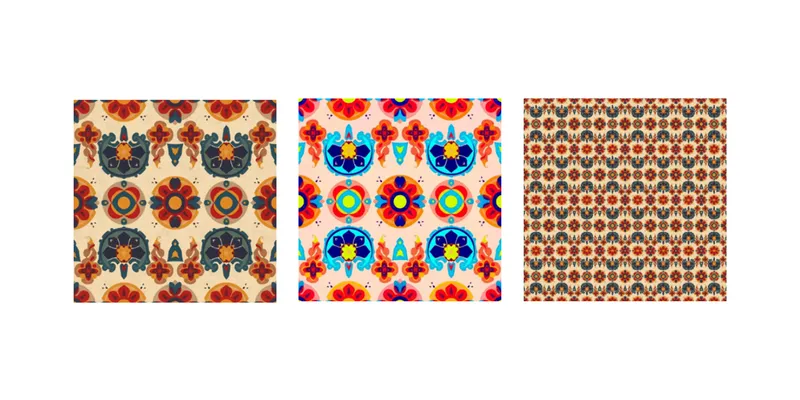
Another capability that fascinates me is the ability to digitize physical inspiration. A simple photograph of a fabric texture, embroidered swatch, curtain, cushion cover, or printed textile can become the starting point for developing new digital textile surfaces. Similarly, rough hand sketches or digital illustrations can be transformed into highly realistic textile visualizations, enabling designers to evaluate ideas long before physical sampling begins.
Embroidery development also benefits enormously from this workflow.
Designers can generate khaka concepts and then visualize how different embroidery/surface techniques—including thread work, sequins, quilting, tucks, and other ornamentation methods—may appear on the final garment. Instead of relying solely on imagination or investing immediately in physical samples, these possibilities can be explored digitally, making creative decision-making faster, more informed, and considerably more economical.
Even product visualization has evolved significantly. A simple printed, embroidered, or textured fabric swatch can now be digitally applied onto garments and accessories, allowing designers and clients to understand the look and feel of the finished product before production begins.
For me, this represents one of the most exciting intersections between creativity and technology. AI is not replacing textile design—it is expanding the designer's ability to experiment, iterate, communicate, and innovate.
Looking Beyond Design: AI Across the Fashion Value Chain
The influence of Generative AI extends well beyond design development.
Today, it supports branding, marketing, retail, business strategy, and customer engagement. AI-generated campaigns, product visualizations, fashion films, social media content, packaging concepts, logo development, and brand identity creation have become increasingly accessible, enabling businesses of every scale to communicate ideas more effectively.
Visual merchandising is another area where AI offers remarkable possibilities. Store layouts, window displays, signage, graphics, planograms, and retail environments can all be conceptualized digitally before implementation, allowing brands to evaluate multiple creative directions with significantly reduced cost and effort.
Similarly, AI-assisted virtual try-ons and realistic product visualizations are transforming how customers interact with fashion products, creating more engaging and personalized shopping experiences.
Viewed collectively, these developments demonstrate that Generative AI is not simply changing how products look—it is changing how fashion businesses think, plan, communicate, and operate.
Responsible Innovation Begins with Responsible Creativity
With every emerging technology comes an equally important conversation around ethics.
In my view, the discussion should move beyond whether AI is inherently "good" or "bad" and instead focus on how we choose to use it.
Throughout my journey with Generative AI, I have consistently believed that originality should remain the foundation of every creative project.
AI should begin with your ideas, your concepts, your observations, and your creative thinking—not someone else's work.
While copyright regulations surrounding AI-generated content continue to evolve across different countries and platforms, one principle remains timeless: respecting originality and intellectual property.
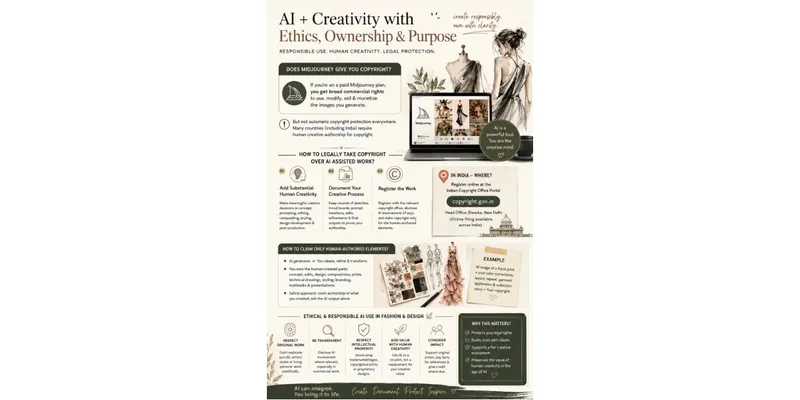
Rather than attempting to imitate another designer's signature style or reproduce existing creative work, professionals should use AI as a collaborative partner to strengthen their own imagination.
When human creativity leads and AI supports, the outcome becomes far more meaningful, authentic, and professionally rewarding.
Exploring the AI Ecosystem
For professionals beginning their AI journey, there is now an impressive ecosystem of platforms designed for different creative needs. Tools such as Imagine Art, Leonardo AI, Midjourney, Ideogram, Runway, Google Flow, ChatGPT, Google Gemini, Hugging Face, New Arc, The New Black, Lovart, Weaver AI, and several others continue to expand what is possible across fashion, textiles, design communication, visualization, content creation, and business strategy.
However, these platforms should never be viewed as destinations in themselves.
They are creative instruments.
Their true value depends entirely on how thoughtfully we choose to use them.
A Balanced Conversation Around AI and Sustainability
As AI adoption has accelerated, another important discussion has emerged around data centers and their environmental impact.
I believe this conversation deserves both attention and balance.
Data centers did not suddenly appear with the arrival of ChatGPT or Generative AI. They have quietly powered our digital lives for decades through search engines, email, online banking, digital payments, cloud computing, social media, e-commerce, GPS navigation, streaming platforms, healthcare systems, government services, and online education.
AI has certainly increased computational demand, and concerns surrounding electricity consumption, water usage, infrastructure, and local community resources are legitimate. These issues deserve continued research, transparent discussion, and responsible policy decisions.
At the same time, it is important to place AI within the broader environmental context.
Agriculture, transportation, aviation, manufacturing, construction, and several other industries continue to contribute significantly to global environmental challenges. AI is one part of a much larger conversation—not the entire conversation itself.
Rather than asking whether AI should exist, I believe the more meaningful question is this:
How do we build AI responsibly?
The future lies in smarter infrastructure, renewable-powered data centers, efficient cooling technologies, recycled water systems, improved chip efficiency, and continued innovation that balances technological progress with environmental responsibility.
As someone who actively teaches and works with AI, I do not support unchecked technological growth.
If AI infrastructure negatively affects communities or places unnecessary pressure on critical resources, those concerns should absolutely be questioned.
Equally, rejecting AI altogether without understanding its broader benefits is neither realistic nor productive.
Responsible innovation requires thoughtful decisions—not extreme positions.
Generating Value, Not Just Visuals
Perhaps the greatest misunderstanding surrounding Generative AI is that its purpose is to generate images.
I see it very differently.
Its real contribution lies in generating value.
Whether it is reducing development time, lowering production costs, improving communication between stakeholders, accelerating design iterations, supporting sustainability, enhancing business decisions, or enabling entirely new creative workflows, AI is fundamentally a productivity and innovation tool.
This is why I believe the conversation around Generative AI needs to become more balanced.
Yes, discussions around copyright, ethics, and creative ownership are important.
But they represent only one part of a much larger picture.
The practical, commercial, technical, and collaborative applications of AI deserve equal attention because these are the areas where lasting transformation is already taking place.
As designers, educators, artists, entrepreneurs, and creative professionals, our responsibility extends beyond demonstrating what AI can create.
We must also demonstrate what AI can improve.
The future of fashion and textile design will not be defined by algorithms alone.
It will be shaped by people who combine technological capability with human imagination, empathy, cultural understanding, craftsmanship, and original thinking.
Technology may continue to evolve at an extraordinary pace, but creativity will always begin with people.
In the end, AI should never dominate the creative process.
Our ideas should remain our own.
Our experiences should continue to inspire our work.
Our emotions should still shape the stories we tell through fashion, textiles, and design.
AI's role is not to replace those qualities—it is to amplify them.
Because the future of Generative AI is not simply about creating better images.
It is about helping us create better ideas, better products, better businesses, and ultimately, a better and more responsible creative ecosystem.