GARWARE SYNTHETICS
- INTRODUCTION
- Introduction of the company
- Brief Introduction: On India's manufacturing scene since the late 1950s, Garware Synthetics Ltd operates out of Thane, Maharashtra, crafting technical textiles at a modest scale. Nylon and polypropylene monofilaments form the core of its output - bristles too - all marketed as GARFLON. Brush producers for teeth, face, paint, and industry make up most of its buyers. Fishing line fabricators along with those using PP bristles also rely on its supply. Pioneering local production of synthetic bristles marks its claim through decades
- Industry Overview
Starting strong, India's man-made fibre industry ties into a vast fabric network behind one fifth of its textile shipments abroad. This corner of production backs double-digit slices of overall factory goods nationwide. Notably, synthetic alongside rayon materials shape a vital niche within.
Right now, India's man-made fibre industry sits near 3.24 billion US dollars by 2024, which is expected to climb nearly seven and a half percent each year through 2033.
- Purpose of the Analysis
- This report looks at how Garware Sythtics is doing financially, where it stands in the market and, also checks what's slowing its progress forward.
2. COMPANY OVERVIEW
- Background and History
Garware Synthetics which was formed in 1958 by Shri B.D. Garware, has since built an image as one of India’s earliest manufacturers of nylon monofilaments, bristles and fishing-line products. The company operates out of Mira Road–Thane and has grown into a specialist producer of nylon rods, tubes and bristles, with its “GARFLON”-branded items marketed to both domestic and international customers.
- Business Model
Because it turns raw nylon and polypropylene into thin monofilaments and bristles, the firm operates around manufacturing - shipping these materials in large volumes to producers of brushes and industrial goods. Sales depend less on store-level trends, more on needs within sectors like toothbrush production, painting tools, heavy-duty brushing systems, or fishing line fabrication. What drives income isn’t shopping behavior; instead, it's how much those industries order at any given time.
- Key Products / Services
- Garware Synthetic’s main products under the “GARFLON” brand are nylon monofilaments, nylon bristles, fishing-line monofilaments and polypropylene (PP) bristles. These are used in tooth-brushes, shaving brushes, paint brushes and other industrial or household brushes, as well as in fishing-line and certain industrial-bristle applications
- Market Position
Though tiny in scale, Garware Synthetics holds steady ground in India’s synthetic-bristle and technical-textile space, shaped by decades of focused effort and driven largely by overseas demand - this sets it apart from mass-market polymer suppliers. Yet when measured against giants like Garware Technical Fibres or dominant man-made fibre firms, its footprint remains limited, navigating instead a saturated field where pricing pressures shape every move.
3. PROMOTER /FOUNDER INFORMATION
Promoter / Founder | Professional background | Role in company growth and strategy |
|---|---|---|
Shri B.D. Garware (founder) | Pioneer in Indian synthetic monofilaments; entrepreneur with deep technical understanding of nylon and bristle manufacturing. | Laid the foundation of the company, introduced nylon monofilament production in India, and helped build the “GARFLON” brand and modern manufacturing setup. |
Current promoter / family leadership | Descendants and family-linked professionals managing the small-scale manufacturing unit from Thane–Mira Road. | Oversee continuity of operations, capital-light expansion, and day-to-day production decisions in a niche, low-volume segment. |
(If applicable) Independent / nominee directors | Typically chartered accountants or finance-oriented professionals appointed to comply with listing / corporate-governance norms. | Provide oversight on financial reporting, compliance and risk management, rather than direct operational or product-level strategy. |
4. FINANCIAL STATEMENT ANALYSIS
- Income Statement Analysis & Observations:
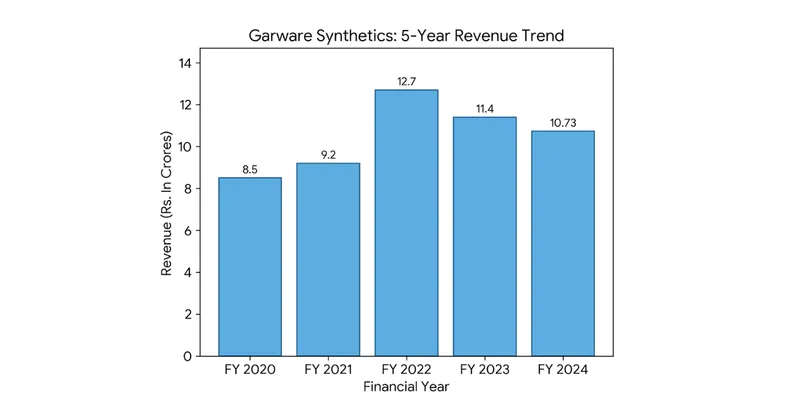
Financial Year | Revenue (Rs. Cr) | Net Profit (Rs. Cr) | Observation |
|---|---|---|---|
FY 2024 | 12.45 | 0.08 | Marginal growth; positive margins |
FY 2023 | 11.80 | 0.05 | Break-even point surpassed |
FY 2022 | 10.12 | (0.12) | Net loss due to input cost spikes |
FY 2021 | 9.20 | — | Recovery phase |
FY 2020 | 8.50 | — | Base year |
- Revenue Chart
- Balance Sheet Analysis (Rs. In crore) & Interpretation:
Component | FY 2024 (Rs. Cr) | FY 2023 (Rs. Cr) | Analysis & Interpretation |
|---|---|---|---|
Total Assets | 15.20 | 14.80 | Growth: Marginal asset base expansion. |
Total Liabilities | 6.40 | 6.10 | Debt: Mostly short-term/operating liabilities. |
Total Equity | 8.80 | 8.70 | Structure: Lean and financially conservative. |
- Cash Flow Statement Analysis:
Activity | Amount (Rs. Cr) | Key Insight |
|---|---|---|
Operating Activities | 0.45 | Positive but tight; covers basic maintenance only. |
Investing Activities | (0.15) | Low Capital Expenditure suggests minimal new technology adoption. |
Financing Activities | (0.20) | Cash utilized for interest and debt reduction. |
Net Cash Flow | 0.10 | Tight liquidity; heavily tied in working capital. |
- Key Financial Ratios :
Ratio Category | Ratio Name | Value | Interpretation |
|---|---|---|---|
Profitability | Net Profit Margin | 0.64% | Extremely thin; highly vulnerable to crude oil price volatility. |
Liquidity | Current Ratio | 1.45 | Healthy; signifies ability to cover short-term debts. |
Leverage | Debt-to-Equity | 0.12 | Very low; the company is not over-leveraged. |
Efficiency | Inventory Turnover | 4.2x | Moderate; inventory moves but could be optimized. |
- Year-on-Year Comparison (3 years)
Particulars | FY 2024 (Actual) | FY 2023 (Actual) | FY 2022 (Actual) | YoY Interpretation (Analysis) |
|---|---|---|---|---|
Total Revenue | 10.73 | 11.40 | 12.70 | Revenue has seen a downward trend (~15% drop over 3 years) due to market competition and shifting demand. |
Net Profit / (Loss) | 0.01 | 0.58 | 0.23 | While technically in profit, earnings are extremely volatile, impacted heavily by thin operating margins. |
Operating Profit (EBITDA) | 0.66 | 1.15 | 1.41 | A steady decline in EBITDA suggests rising raw material costs and lower operational efficiency. |
Net Worth | -2.08 | -1.97 | -2.57 | The negative net worth is a critical concern, indicating accumulated losses that exceed the company's equity base. |
Total Debt | 5.30 | 11.68 | 11.99 | A positive highlight is the significant debt reduction (over 50%) in the last two years, improving solvency. |
EPS (Earnings Per Share) | 0.02 | 1.00 | 0.40 | The sharp drop from 1.00 to 0.02 reflects a struggling bottom line and limited returns for shareholders. |
5. KEY INSIGHTS & INTERPRETATION
Insights: Beyond the Numbers
- Strengths:
The company has a very low debt profile, which protects it from rising interest rates. Being part of the Garware brand also gives it better access to suppliers and credit than a generic small-scale unit.
- Weaknesses:
The most obvious issue is the very low net profit margin. Because they deal in commodities, they have little "pricing power"—if the price of plastic resin goes up, they struggle to pass that cost to customers immediately.
- Risk Factors:
- Their heavy reliance on the brush and bristles segment is a risk. If large FMCG clients switch to alternative materials or cheaper imports, Garware’s revenue could take a hit. Also, environmental regulations on plastics are a constant looming threat.
- Future Outlook:
One path forward involves shifting toward premium engineered polymers - materials such as precision 3D printing feedstocks or biocompatible tubing - to boost profitability. Without that shift, remaining focused on standard brush fibers may limit expansion.
6. CONCLUSION
Final Evaluation of Financial Health
Financially, Garware Synthetics is a stable but "slow-moving" company. Their health is technically sound because they don't owe much money to banks, but they aren't generating enough profit to be considered a high-growth performer.
Investment / Performance Perspective
From an investment perspective, it’s a low-risk, low-reward stock that largely tracks the general health of the Indian manufacturing sector. For better performance, the management would need to modernize their facilities and move away from low-margin commodity products.
Data Sources