FUTURE RETAIL LIMITED FINANCIAL AND BUSINESS ANALYSIS REPORT

- INTRODUCTION
A) Brief Introduction of the Company
One of India’s big names in retail was Future Retail Limited - it ran familiar storebrands such as Big Bazaar, Easyday, and fbb. Instead of just groceries, shoppers found clothes, gadgets, and home goods under single roofs. Its model relied on spacious outlets offering many everyday things. These stores aimed to stock nearly everything a person might need regularly
B) Industry Overview
India's retail scene is expanding quickly due to increased consumer spending, urbanization, and income levels. Big store brands began to gain popularity because consumers prefer having a variety of options in one location. With fierce competition, the industry responds swiftly to household financial concerns. Changes in spending patterns have the potential to cause just as much disruption as growing costs in the background. Tough times spread quickly, particularly when all budgets become more constrained.
C) Purpose of the Analysis
This report looks into how Future Retail Limited has been doing financially, examining its standing in the market while exploring what led to its present situation instead of just stating outcomes.
- COMPANY OVERVIEW
A) Background and History
Fresh off the launchpad within the Future Group, Future Retail Limited quickly grew into a dominant name among Indian retailers. With more than 1300 outlets spread through 397 urban centers, its footprint stretched wide across the national landscape. Expansion unfolded at speed, stitching together locations from coast to heartland. This scale positioned it firmly at the core of structured retail activity in the country
B)Business Model
The enterprise operated on a large-scale retail format, earning income via
- Hypermarkets (Big Bazaar)
- Supermarkets (Easyday)
- Fashion retail (fbb)
Emphasis shifted toward large-scale transactions where price played a key role. Still, volume took priority over margins in shaping strategy.
C)Key Products / Services
The company offered:
- Grocery and FMCG products
- Apparel and fashion
- Electronics
- Household goods
D)Market Position
Facing heavy debt loads alongside ongoing management troubles, Future Retail saw its position weaken despite earlier dominance across India's shopping landscape. Though it led the market at one point, problems piling up behind the scenes shifted momentum away steadily.
- PROMOTER / FOUNDER INTRODUCTION
A) Name of Promoter(s) / Founder(s)
Biyani Kishore started the business - recognized widely for his role in shaping modern retail across India.
B)Professional Background
Frequently called the "Retail King of India," he helped shape structured retail across the nation through sustained influence. While others hesitated, his initiatives laid early groundwork for modern shopping formats. Though recognition came later, his impact emerged quietly over years of consistent effort. Where systems lacked, new models took root under his guidance - transforming how people bought goods.
C)Role in Company Growth and Strategic Decisions
Under his guidance, Big Bazaar grew alongside other retail ventures, turning Future Retail into a familiar presence across Indian households.
- FINANCIAL STATEMENT ANALYSIS
A) Income statement analysis
A sharp fall in income followed the fiscal year 2020, pointing to weakening performance across core activities. Despite earlier stability, financial statements reveal substantial deficits piling up through consecutive reporting periods.
Year | Revenue (₹ Cr) | Net Profit (₹ Cr) |
FY19 | 20,332 | 21 |
FY20 | 20,332 | -3,770 |
FY21 | 6,304 | -5,944 |
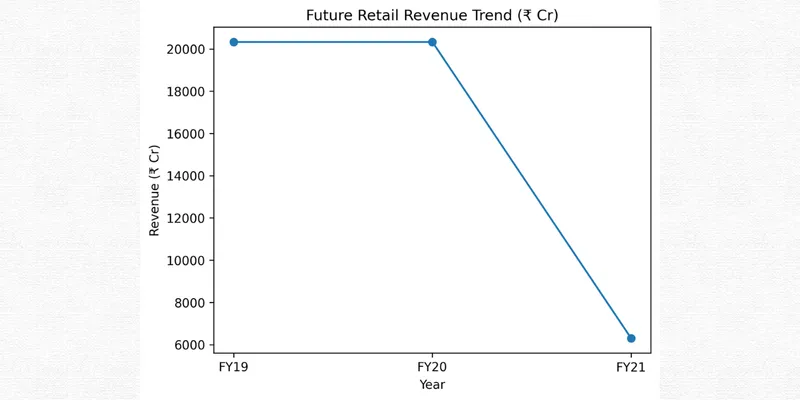
Figure: Revenue trend of Future Retail Limited
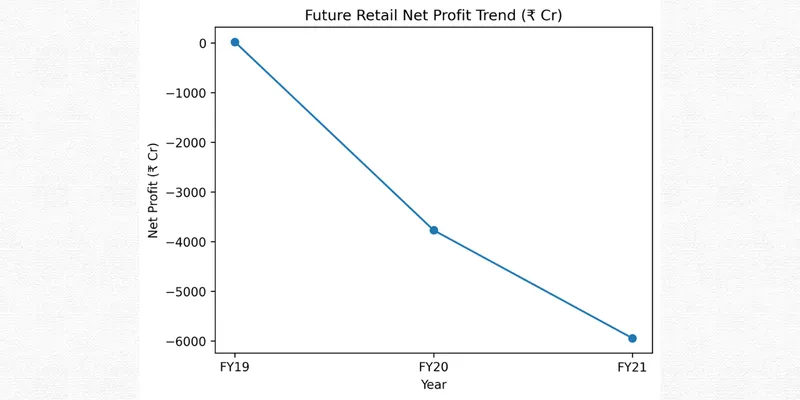
.Figure: Net loss trend of Future Retail Limited.
B) Balance sheet analysis
Indicator | Value |
Total Debt | ₹13,000+ Cr |
Total Liabilities | ₹17,000+ Cr |
Book Value | Negative |
Future Retail has a highly leveraged balance sheet.
The company’s high debt and liabilities indicate financial stress and weak solvency.
C) Cash Flow Statement analysis
Falling revenues combined with rising costs led to negative cash flow. Despite efforts, the business could not produce enough cash through daily activities.
D) Key Financial Ratios
Ratio | Value |
ROE | -116% |
ROCE | -13% |
Profit Margin | Negative |
Debt-to-Equity | Extremely high |
Ratio | Value |
A closer look at these figures reveals signs of weak results along with operational struggles. Despite expectations, the numbers fail to show strength, instead pointing toward ongoing issues within management practices
Year on Year Comparison Minimum Three Years
A downward trend in earnings and profit margins marks recent years for the firm. Clearly, growing deficits point toward mounting fiscal strain.
5) KEY INSIGHTS AND INTERPRETATION
Strengths
- Strong brand recognition (Big Bazaar)
- Wide retail network
- Large customer base
Weaknesses
- High debt levels
- Continuous losses
- Poor financial management
Risk Factors
- Bankruptcy risk
- Competition from Reliance Retail and D-Mart
- Legal and financial issues
Future Outlook
Despite rising liabilities, operational performance continues to weaken across divisions. Whether it lasts another five years hinges on major internal changes - or a takeover from better-positioned firms.
6. CONCLUSION
Facing serious money troubles lately, Future Retail Limited had earlier led India's retail market. Its shrinking income, growing deficits, alongside mounting borrowings reveal weak finances.
Despite appearing unstable to investors, the firm carries residual strength through its established name and store reach. Should reorganization take effect, these elements could regain relevance over time.
7) REFERENCES
- Future Retail Limited. (n.d.). Company website. https://www.futureretail.in
- Screener. (n.d.). Future Retail Ltd financial analysis. https://www.screener.in/company/FRETAIL/
- Moneycontrol. (n.d.). Future Retail financial statements. https://www.moneycontrol.com