Furniture Plastic Market Projected to Reach USD 21.55 Billion by 2030
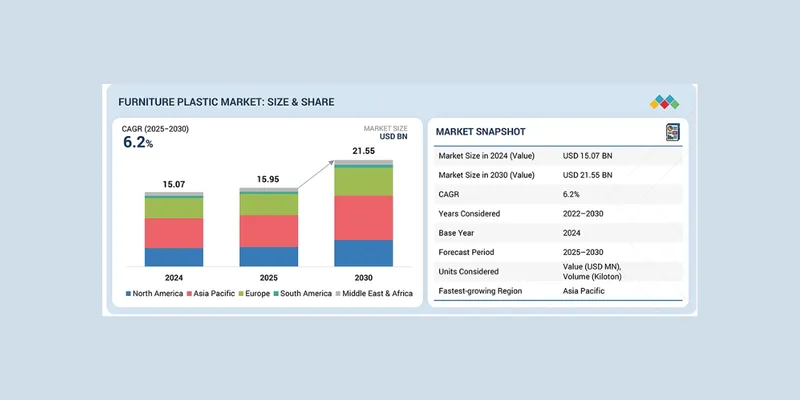
According to a report by MarketsandMarkets titled “Furniture Plastic Market by Plastic Type (Virgin Grade, Compounded Grade), Composition (Unfilled, Mineral Filled, Glass Fiber Reinforced, Other Compositions), Furniture Type, Application, End-use Industry, and Region – Global Forecast to 2030,” the global market is projected to grow from USD 15.95 billion in 2025 to USD 21.55 billion by 2030. The market is expected to register a compound annual growth rate (CAGR) of 6.2 during the forecast period.
A report by MarketsandMarkets estimates that the furniture plastic market will expand from USD 15.95 billion in 2025 to USD 21.55 billion by 2030, recording a CAGR of 6.2 over the forecast period. Furniture plastics are used in residential, commercial, and institutional furniture to support cost-efficient, durable, and technically functional designs. These materials are widely applied in the mass production of furniture components, enabling large-scale manufacturing at reduced cost.
Plastics have facilitated high-volume furniture production and contributed to improved affordability in urban markets. Their resistance to moisture, termites, and corrosion has supported their adoption in apartments and compact living environments. Advanced materials such as reinforced polypropylene, ABS, and mineral-filled compounds are used to enhance load-bearing performance, dimensional stability, and design flexibility.
Key companies identified in the report include Keter Group (Israel), Nilkamal (India), Supreme Industries Limited (India), Tramontina (Brazil), Cello (India), and Inter IKEA Systems B.V. (Netherlands), among others.
Asia Pacific is projected to be the fastest-growing region in the furniture plastic market. Growth in this region is associated with rapid urbanization, rising disposable incomes, and expansion in residential and commercial construction. Demand for lightweight, affordable, and durable furniture in China, India, Southeast Asia, and Australia has supported the development of plastic-based furniture products.
The report notes increased adoption of modular, ready-to-assemble, and space-efficient furniture suited to urban housing, leading to higher use of plastics such as polypropylene, polyethylene, and engineered polymers. The expansion of e-commerce furniture sales, along with the need for greater logistics efficiency, has also contributed to market growth.
According to MarketsandMarkets, market expansion is driven by rapid urbanization and growth in affordable housing. Environmental concerns and negative perceptions related to plastic waste are identified as restraints. The adoption of recycled and bio-based plastics is cited as a challenge, while opportunities exist in developing products that balance durability, aesthetics, and sustainability.