Functional Textile Finishing Agents Market: 2026 Data-Driven Trends, Growth Metrics, and Industry Insights
The global textile industry is undergoing a rapid transformation, with advanced finishing technologies becoming critical for performance, durability, sustainability, and consumer safety. According to recent industry analysis by Dataintelo, the demand for Functional Textile Finishing Agents is projected to witness strong expansion between 2024 and 2032, driven by rising consumption of technical textiles, smart fabrics, and eco-friendly apparel solutions.
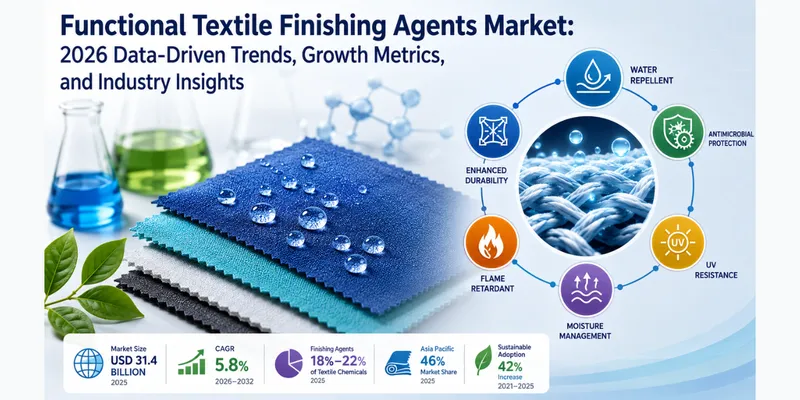
In 2025, the global textile chemicals market surpassed USD 31.4 billion, with finishing agents accounting for nearly 18%–22% of total chemical consumption in textile processing. Functional finishing agents are increasingly used to improve water resistance, antimicrobial protection, flame retardancy, UV resistance, wrinkle recovery, and moisture management properties across textiles.
Key Statistics at a Glance
Metric | Value | Year |
Global textile chemicals market size | USD 31.4 Billion | 2025 |
Share of finishing agents in textile chemicals | 18%–22% | 2025 |
Expected CAGR of functional finishing agents market | 5.8% | 2026–2032 |
Technical textiles market value | USD 240 Billion | 2025 |
Antimicrobial textile demand growth | 9.1% CAGR | 2024–2030 |
Sustainable textile chemical adoption | 42% increase | 2021–2025 |
Asia Pacific market share | 46% | 2025 |
Average reduction in fabric shrinkage using finishing agents | 25%–40% | Industry Average |
Water-repellent textile demand increase | 31% | 2022–2025 |
Eco-friendly finishing agents adoption in Europe | 54% of manufacturers | 2025 |
What Are Functional Textile Finishing Agents?
Functional textile finishing agents are specialty chemicals applied during textile processing to enhance fabric performance and functionality. These chemicals can improve:
• Durability by 20%–35%
• Moisture absorption efficiency by up to 50%
• UV protection ratings above UPF 50+
• Flame resistance by reducing ignition spread by nearly 60%
• Antimicrobial effectiveness against bacteria by 99%
Between 2020 and 2025, the adoption of multifunctional finishing chemicals increased by approximately 37%, especially in sportswear, healthcare textiles, automotive fabrics, and military applications.
5 Data-Backed Reasons Driving Market Growth in 2026
1. Rising Technical Textile Consumption
The global technical textiles sector reached approximately USD 240 billion in 2025 and is expected to cross USD 320 billion by 2030. Functional finishing agents are essential in medical textiles, geotextiles, industrial fabrics, and protective clothing.
Healthcare textile demand alone grew by 14% between 2022 and 2025 due to infection control requirements and antimicrobial fabric usage.
2. Sustainability Regulations Are Accelerating Adoption
Governments worldwide are enforcing stricter environmental standards on textile processing chemicals.
• Europe reduced allowable hazardous textile chemical discharge limits by 28% between 2021 and 2024
• Nearly 54% of European textile manufacturers shifted toward bio-based finishing agents by 2025
• Water-saving finishing technologies lowered textile processing water usage by 18%– 25%
Low-VOC and fluorocarbon-free repellents are now becoming industry benchmarks. 3. Sportswear and Athleisure Expansion
The global sports apparel market exceeded USD 410 billion in 2025. Moisture-management and odor-control finishes are increasingly integrated into performance garments.
Key performance metrics include:
Functionality | Performance Improvement |
Sweat absorption | +45% |
Drying speed | +30% |
Odor reduction | Up to 99% bacterial control |
Fabric durability | +22% lifecycle increase |
Major apparel manufacturers are investing heavily in advanced finishing technologies to improve consumer comfort and product lifespan.
4. Smart Textile Innovation
Smart textiles incorporating conductive fibers and wearable technologies are expected to grow at a CAGR of 11.3% through 2030.
Functional finishing agents now support:
• Conductivity enhancement
• Temperature regulation
• Phase-change material integration
• Anti-static performance improvements by 70%
In 2025, smart textile integration in healthcare wearables increased by 26% year-over-year. 5. Asia Pacific Dominates Production
Asia Pacific accounted for nearly 46% of global textile finishing chemical demand in 2025 due to large-scale textile manufacturing hubs in China, India, Bangladesh, and Vietnam.
India’s textile exports crossed USD 44 billion in 2025, increasing the need for premium finishing solutions to meet international compliance standards.
Market Challenges Quantified
Despite strong growth, the industry faces several measurable challenges:
Challenge | Quantified Impact |
Raw material price volatility | 12%–18% annual fluctuations |
Energy-intensive processing | Up to 30% operational cost share |
Compliance costs | Increased by 15% since 2022 |
Wastewater treatment expenses | USD 0.40–0.80 per kg fabric |
Manufacturers are increasingly investing in nanotechnology-based finishes and biodegradable chemical formulations to offset regulatory pressure.
Emerging Trends and Forecasts Through 2032
Several emerging trends are expected to reshape the market:
• Bio-based finishing agents may capture 35% market share by 2032
• Nano-finishing technologies could improve fabric durability by 40% • AI-assisted textile processing may reduce chemical wastage by 20% • Waterless finishing technologies are projected to grow at 8.7% CAGR
Additionally, antimicrobial textile demand is forecast to rise by more than 9% annually as healthcare and hygiene awareness continue to increase globally.
Conclusion
The Functional Textile Finishing Agents market is becoming a crucial pillar of the modern textile industry. With the global textile chemicals sector exceeding USD 31.4 billion in 2025 and finishing agents contributing over 20% of total chemical usage, the market presents significant opportunities for innovation and investment.
From improving fabric durability by 35% to reducing bacterial growth by 99% and cutting water consumption by 25%, finishing technologies are delivering measurable value across industries.
Read A Full Report: https://dataintelo.com/report/functional-textile-finishing-agents-market