From Stubble Burning to Soil Wealth: Why Biochar Could Be India’s Most Practical Farming Revolution
 (1)-800x1120.webp?2026-06-16T06:45:11.026Z)
Manish Daga
Founder & MD,
Cotton Guru
India's fields are silently suffocating - depleted by decades of chemical overuse, scarred by stubble smoke, and burdened by farmers who cannot afford to lose a single season. Biochar is changing that, one handful of dark, fertile soil at a time.
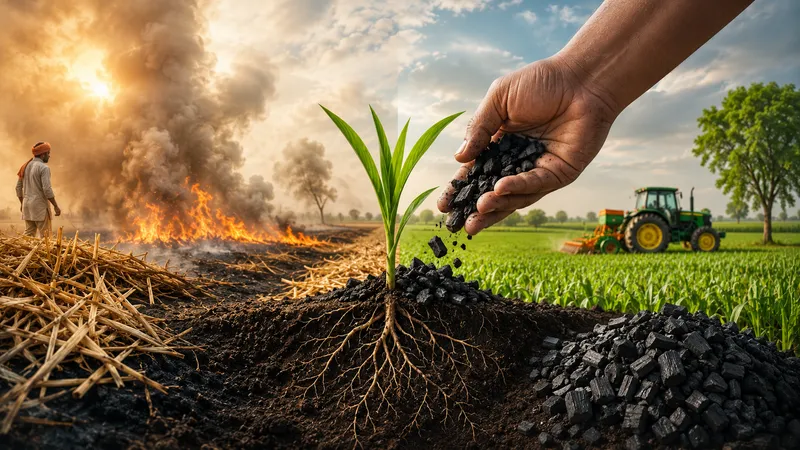
One solution gaining increasing attention is biochar - a carbon-rich soil amendment produced from agricultural waste through controlled low-oxygen heating, known as pyrolysis. Unlike open stubble burning, which destroys nutrients and pollutes the environment, biochar converts biomass into a valuable soil input that improves soil health and stores carbon for the long term.
01 | THE CHALLENGE India's Agriculture at a Crossroads |
India's agriculture is facing a critical convergence of challenges. Rising fertiliser prices, declining soil fertility, erratic monsoons, and ballooning cultivation costs are squeezing farmers across every agro-climatic zone. Meanwhile, the government spends lakhs of crores annually on fertiliser subsidies for urea and DAP, while millions of tonnes of agricultural residue are burnt openly every year - destroying nutrients, poisoning air, and degrading the very soil that India's food security depends upon.
Large swaths of India's farmland today suffer from low soil organic carbon, poor water retention, reduced microbial activity, compaction, and chronic nutrient imbalance. As soil quality declines, farmers need ever-larger quantities of chemical inputs just to maintain existing yields - a vicious cycle of rising costs and falling land health.
The cotton belt of Vidarbha, Maharashtra, and the dry-land farming regions of Adilabad, Telangana, are among the hardest hit. Cotton stalk burning is rampant after every harvest - convenient but deeply destructive, stripping carbon and releasing greenhouse gases while the biomass that could enrich the land goes up in smoke.
 (1)-800x450.webp?2026-06-16T06:47:35.467Z)
02 | THE SCIENCE What Makes Biochar Different |
What Is Biochar - and Why Is It Different?
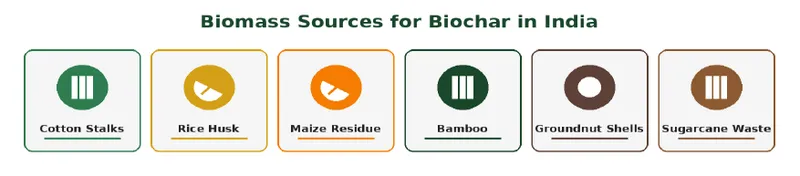
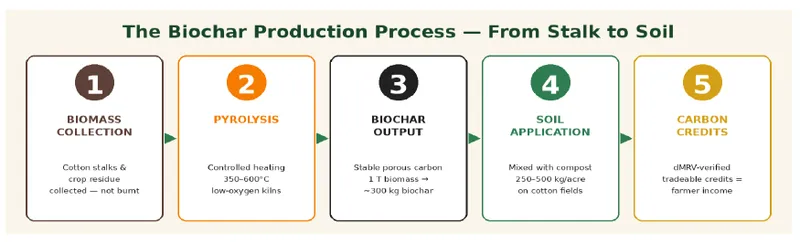
Biochar is a carbon-rich, porous soil amendment produced when agricultural biomass is heated in a low-oxygen environment - a process called pyrolysis. Unlike open burning, which releases stored carbon as CO₂, pyrolysis converts biomass into a stable charcoal-like material that persists in soil for hundreds to thousands of years. The result: waste is eliminated without pollution, and the soil gains a permanent carbon reservoir.
 (1)-1-800x657.webp?2026-06-16T06:50:48.218Z)
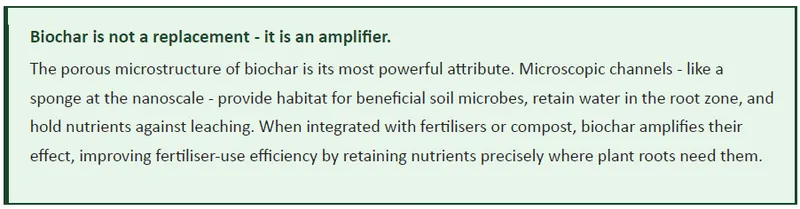
Biochar is not meant to completely replace fertilisers overnight.
Its biggest strength lies in improving efficiency.
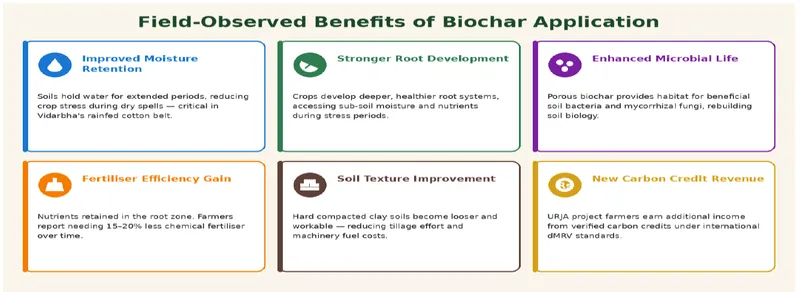
When integrated with fertilisers, compost, or microbial inputs, biochar helps in improving nutrient retention, reducing nutrient loss, improving microbial activity, enhancing water-use efficiency, and building long-term soil fertility.
This balanced approach makes biochar highly practical for Indian agriculture.
PM Modi’s Vision for Sustainable Agriculture
 (1)-800x498.webp?2026-06-16T06:51:36.992Z)
Hon’ble Prime Minister Shri Narendra Modi has repeatedly emphasised the need for:
- Soil health restoration
- Natural and regenerative farming
- Waste-to-wealth innovation
- Reduction in stubble burning
- Sustainable improvement in farmer incomes
Biochar directly aligns with this national vision.
India’s future agricultural resilience cannot depend only on increasing chemical fertiliser usage. Long-term sustainability requires improving soil biology, increasing organic carbon, and making farming systems more resource-efficient.
India’s Fertiliser Import and Subsidy Burden
- India remains heavily dependent on imported fertilisers and raw materials such as DAP, potash, phosphoric acid, and natural gas for urea production.
- Global disruptions, including wars, energy crises, and supply chain instability, have increased fertiliser market volatility.
Government Impact | Farmer Impact | Agricultural Economy |
Higher subsidy burden | Rising cultivation costs | Input uncertainty & dependency |
Declining Soil Health
- Low soil organic carbon
- Poor water retention
- Reduced microbial activity
- Soil compaction
- Nutrient imbalance
Result: Farmers require increasing quantities of fertilisers to maintain productivity.
The Hidden Cost of Stubble Burning
Every year, millions of tonnes of agricultural residue - including rice straw, cotton stalks, maize residue, and soybean waste - are burnt openly in fields.
While burning may appear to be the fastest disposal method, the long-term damage is enormous.
Open burning causes:
- Severe air pollution
- Greenhouse gas emissions
- Loss of valuable nutrients
- Destruction of beneficial soil microbes
- Decline in soil moisture retention
- Respiratory health problems
In cotton-growing regions, cotton stalk burning remains common despite the biomass containing significant carbon and soil value.
Instead of treating agricultural residue as waste, India must begin viewing it as a valuable farm resource.
03 | FIELD EVIDENCE What Farmers Are Actually Experiencing |
For three consecutive seasons, CottonGuru has run its flagship Pradarshan Khet™ Model Farms (Evidence Model Farms) - CottonGuru’s Experience with over 1000 smallholder cotton farmers in Maharashtra and Telangana, real-world demonstration sites in Yavatmal district, Maharashtra and Adilabad district, Telangana. These are live fields, farmed by the same smallholder growers, “Guru farmers,” who face every real challenge: erratic rainfall, heavy clay soils, limited capital, and chronic input price volatility.
Importantly, these are not laboratory simulations - these are real experiences from farmers cultivating under practical, challenging conditions in Vidarbha and Adilabad.
The Central Institute for Cotton Research (CICR), Nagpur - India's premier cotton science authority - has independently validated biochar's benefits in cotton systems. Their trials confirm improvements in soil organic carbon, better moisture retention, improved fertiliser-use efficiency, enhanced microbial activity, and measurably better drought resilience.
 (1)-800x276.webp?2026-06-16T06:53:37.441Z)
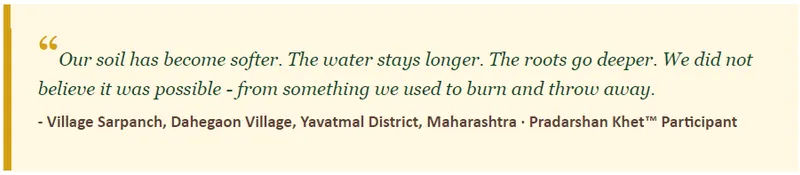
Figure 1 - Village Sarpanch from Dahegaon village, Yavatmal, Maharashtra
04 | ECOSYSTEM PARTNERS Institutions & Market Validation |
CottonGuru's biochar initiatives have attracted support from India's most respected agricultural research institutions and leading international bodies. Projects are implemented under strict Digital Measurement, Reporting and Verification (dMRV) frameworks aligned with international carbon standards - ensuring every tonne of sequestered carbon is traceable and credible in voluntary carbon markets globally.
Institutional & Market Partners
🔬 CICR, Nagpur | 🏭 CIRCOT, Maharashtra |
🏦 NABARD, Telangana | 🌐 ICAC, Washington |
♻️ Varaha | ⚖️ Equilibrium |
🔬 Scientific Validation Central Institute for Cotton Research (CICR), Nagpur, India's premier cotton science authority, has independently validated biochar's measurable benefits in cotton-cropping systems. | Farmer Organisation Network All India Cotton FPO Association unites smallholder cotton producers across India's cotton belt - providing scale, training, and last-mile delivery for biochar adoption. |
♻️Carbon Market Standards Projects are implemented under internationally recognised dMRV (Digital Measurement, Reporting & Verification) standards - making every tonne of sequestered carbon traceable and credible. | Industry Forums CottonGuru leadership engages at the IMC Agriculture Conclave 2026 and through the Cotton Association of India - keeping policy, industry, and farmer voices aligned. |
🏦 Institutional Support CottonGuru’s biochar initiatives have also received support and collaboration from reputed institutions and leading ecosystem stakeholders working in sustainable agriculture and carbon removal.CIRCOT (Central Institute for Research on Cotton Technology), Maharashtra, NABARD, Telangana | Scientists associated The initiatives are supported by technical guidance and training from renowned institutions such as ICAC, Washington, and CICR, Nagpur. Combined with scientific validation, digital monitoring, and farmer-centric implementation, these efforts are strengthening confidence in biochar as a scalable regenerative solution for Indian agriculture. |
05 | THE ROAD AHEAD India Has the Biomass. India Has the Farmers. |
What is now required is scale.
Biochar offers India an opportunity to:
- Improve soil health
- Reduce stubble burning
- Improve fertiliser efficiency
- Reduce environmental damage
- Increase farmer resilience
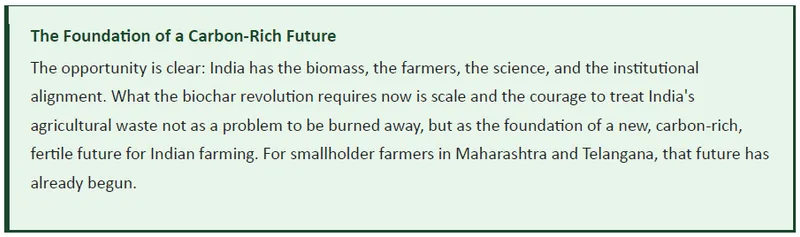
- Support regenerative agriculture