From Plant to Product: How Herbal Extracts Are Shaping the Future of Natural Ingredients

Dr Yawer Ali Shah
Co-Founder & CEO
AMA Herbal Group
Since history, Ayurveda and herbs have been playing an important role in diverse aspects of human activities, including food, medicinal, textile, dye, and wellness applications. Various herbs, shrubs, bark, roots, flowers, and other natural components have been used widely for the beneficial qualities they possess. As lifestyles changed, consumers started preferring convenient ready-to-use products; therefore, the traditional practice of using herbs was declining. The use of synthetic products has become more popular due to their simplicity and fast production. Increasing public concern about the possible health and ecological risks related to some synthetic substances has caused the comeback of natural products.
It has been influencing consumers' preferences and has caused an increasing need for herbal and botanical extracts. Consumers have become more interested in the ingredients used in products; therefore, they try to recognise natural components such as turmeric, ginger, aloe vera, green tea, ashwagandha, and rosemary. However, it is not always possible to use herbs themselves because consumers do not have enough time or knowledge to process herbs. This has led to the formation of an industry dealing with scientific extraction, purification, standardisation, and control of herbal products. The extraction of herbs is a difficult process since it involves boiling of the herbs or preparing a decoction. Such a procedure includes many compounds of the herbs, both active and non-active. The concentration of the compounds in the herbs may differ for various reasons.
For example: the type of plants used, cultivation, harvesting, storing and extraction itself. Curcuminoids are some of the compounds contained in turmeric. Curcumin, which is a curcuminoid, has anti-inflammatory properties and can be useful in treating osteoarthritis. Thus, it is vital to employ a proper method of extract extraction with the desired concentration. The modern methods of extraction will help in better purifying and stabilising the botanical extracts.
During the standardisation procedure, there are several factors to be controlled. Firstly, it is crucial to identify the components of the extracts. Quality control is also important in this case since the composition of the extracts will depend on the raw material and process involved.
The sustainability of production is also one of the factors that influence the future of herbal extracts. It can be quite resource-consuming to make water extractions because a lot of water is consumed in the process. However, modern technologies allow for collecting the water that is used in the process, thus making its reuse possible and reducing consumption. Cold extraction reduces energy consumption in the processing because of limited usage of heat. If the extraction requires solvents, it is especially important to use more sustainable and environmentally friendly solvents. One more promising technology of extraction is supercritical fluid extraction with CO2 being a solvent because it can be collected after the extraction.
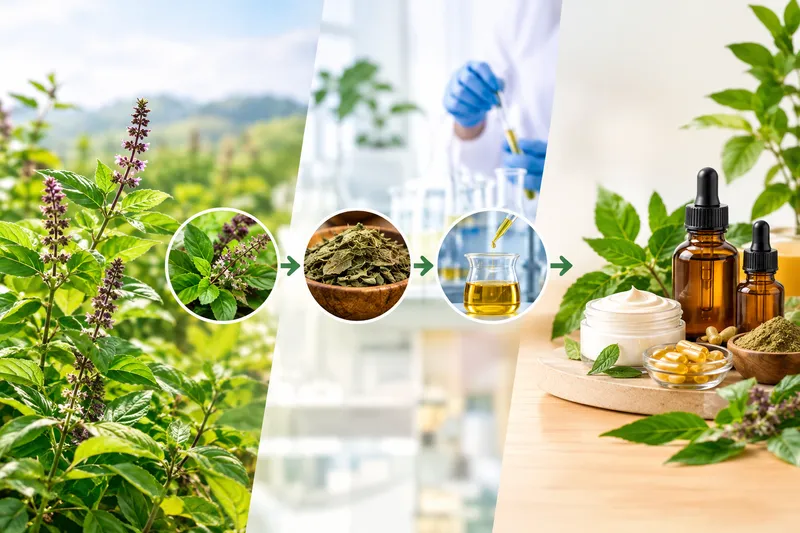
Thus, the future of herbal extracts lies in the combination of tradition and science. Research and innovations in the field of herbal extraction can provide consumers with quality, safe, and sustainable herbal extracts. The path from growing a plant to making its extract shows how natural botanical resources can be utilised in modern times.