From Fibre to Soil: What Actually Happens Inside a Compostable Textile
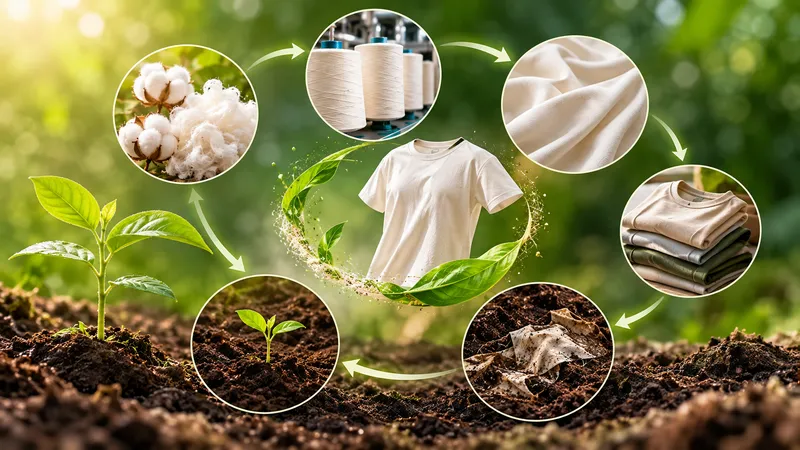
What if a garment could be converted into compost at the end of its useful life instead of remaining in a landfill for decades? This is the idea behind compostable textiles, an emerging area of material innovation attracting attention across the fashion and textile industries.
Unlike conventional fabrics that may contain synthetic fibres and finishes that persist in the environment, compostable textiles are designed to break down under specific composting conditions. They may use suitable natural fibres, regenerated cellulosic materials or biodegradable bio-based polymers, provided the finished product meets relevant compostability requirements.
However, there is an important difference between something being natural, biodegradable and compostable. A plant-based fibre is not automatically compostable, and a biodegradable material does not necessarily meet compostability requirements. The way a textile is manufactured, finished and assembled also matters.
What has to happen for a textile to be genuinely converted into compost?
Step 1: It Starts with the Fibre
The journey begins with choosing the right raw material. Cotton, hemp and other cellulosic fibres are among the materials being explored for compostable textile applications. Another option is polylactic acid (PLA), a bio-based polymer generally produced using renewable feedstocks such as corn starch or sugarcane.
These materials offer alternatives to some conventional fossil-based inputs, but their environmental performance depends on how they are processed and used. PLA, for example, generally requires controlled industrial composting conditions to break down effectively.
Once selected, fibres are prepared for manufacturing. Depending on the intended product, they may be spun into yarn for weaving and knitting or converted directly into nonwoven fabrics through web formation.
Compostable and biodegradable nonwovens are finding applications in areas such as wipes, hygiene products and selected technical textiles. Machinery manufacturers such as Trützschler and ANDRITZ support fibre preparation and nonwoven production processes that can be used with a range of alternative materials.
While these applications are developing, compostable apparel remains a smaller and more challenging area of the market because of factors such as fibre blends, durability requirements, garment components, certification costs and limited composting infrastructure.
Step 2: Turning Fibres into Fabric and Products
Once the fibres are ready, they must be converted into a usable textile. This can involve spinning, weaving, knitting or nonwoven production, followed by processes such as bonding, washing, dyeing and finishing.
This stage is particularly important because the chemicals and treatments used during manufacturing can influence how a material breaks down later.
For example, certain synthetic coatings, chemical finishes and incompatible dyes may affect the compostability of an otherwise suitable fibre.
The same consideration applies when the fabric becomes a finished garment. Stitching threads, zips, buttons, elastics, labels and prints all contribute to the final product's composition. A compostable fabric with conventional polyester stitching or plastic components cannot automatically be considered a compostable garment.
Indian plant-based fashion brand Jiwya offers an example of a production approach built around natural fibres, plant-derived colours and a soil-to-soil philosophy. Its work highlights how material selection and manufacturing choices can support a more circular approach to fashion.
The larger challenge is to ensure that every part of a product supports its intended end-of-life pathway.
Step 3: Testing, Certification and What Happens Next
A textile cannot simply be labelled compostable because it contains natural or plant-based materials. Its ability to break down must be established under defined conditions.
Standards such as EN 13432, ISO 17088 and ASTM D6400 provide frameworks for assessing the compostability of packaging or plastic materials, although their scopes and applications differ. EN 13432 specifically addresses packaging, while ISO 17088 and ASTM D6400 cover compostable plastics. These standards should not be treated as automatic certification for finished textile garments.
Certification organisations such as TÜV AUSTRIA and DIN CERTCO assess products under relevant certification schemes. Importantly, certification may cover a particular raw material or product rather than every item made using that material.
What Happens During Composting?
Under suitable composting conditions, microorganisms such as bacteria and fungi begin breaking down compostable materials. Their enzymes help convert complex organic structures into smaller compounds. For cellulose-based textiles, enzymes such as cellulases can help break down cellulose chains. These compounds are progressively metabolised, producing carbon dioxide, water and microbial biomass under aerobic conditions. Dyes, finishes, coatings and non-cellulosic components can influence how readily a finished textile decomposes.
There is also a difference between industrial and home composting. Industrial composting involves controlled conditions, with temperatures commonly reaching around 55–60°C during the thermophilic phase, depending on the process. A product designed for industrial composting may not break down effectively in a home compost heap.
Even when a textile is certified, its end-of-life journey depends on access to suitable composting facilities. Without appropriate collection and processing infrastructure, its potential environmental benefit may not be realised.
For Consumers: What Should You Check?
"Compostable" does not automatically mean suitable for a home compost bin. Before purchasing or disposing of a product, check whether it is certified for industrial or home composting, which materials and components the certification covers, and whether suitable composting facilities are available locally. Always follow the product's disposal instructions.
Companies Exploring New Possibilities
Several Indian and international companies are exploring alternative materials and production approaches relevant to the development of more sustainable textile products.
India
- Jiwya
- Bombay Dyeing
- AltMat
- Favourite Fab
International
- Stella McCartney × Balena
- Under Armour × UNLESS
- Infinited Fiber Company
Note - These companies represent different areas of material innovation, including plant-based fashion, biodegradable fibres, agricultural waste-based materials, PLA nonwovens and regenerated cellulose. Not all their products are certified compostable finished textiles, and individual material and product claims should be verified separately.
The Bigger Picture
The global bio-based textiles market was valued at USD 5.80 billion in 2024 and is projected to reach USD 17.31 billion by 2034, according to Polaris Market Research. Although this represents the broader bio-based textiles market rather than compostable textiles specifically, it indicates the growing commercial interest in alternative material solutions.
Compostable textiles offer an interesting direction for an industry looking to rethink how products are made and what happens after their useful life ends. However, the journey from fibre to soil involves more than selecting a natural raw material. Fabric construction, dyes, finishes, additional components, certification and disposal infrastructure all play a role.
The opportunity lies in bringing these elements together. As material developers, textile manufacturers and fashion brands continue to explore new possibilities, compostable textiles could become an important part of conversations around the future of textile production and waste management.
Sources and Further Reading
- EN 13432: Packaging Requirements for Composting and Biodegradation - https://www.bsigroup.com/en-GB/standards/
- TÜV AUSTRIA: Comparison of Industrial Compostability Standards - https://okcert.tuvaustria.com/wp-content/uploads/sites/76/2024/12/PD-BA-TABE-CERT-BIO-ID-415_comparison_standards_EN_2407.pdf
- Polaris Market Research: Bio-Based Textiles Market - https://www.polarismarketresearch.com/industry-analysis/bio-based-textiles-market
- FAO: Composting Principles and Processes - https://www.fao.org/4/y5104e/y5104e05.htm