From Fiber to Finished Composite: Inside Modern Composite Fabric Manufacturing
Tanvi Munjal
Composite fabrics power aircraft wings, electric vehicles, wind turbines, and defense systems. The composite textile production equipment market [1] reached USD 7.2 billion in 2025, projected to grow to USD 12.9 billion by 2035 (6% CAGR). Yet composite fabric production remains misunderstood. It’s not just chemistry. It’s advanced textile engineering working with matrix chemistry.
A composite fabric is not fabric coated in resin. It’s an engineered structure where textile reinforcement works with a matrix system to create properties neither achieves alone. Carbon, glass, aramid, and basalt fibers are woven, braided, or stitched into specific architectures:
- 0/90-degree weave: Balanced strength in two perpendicular directions
- +/-45-degree bias: Shear stress and torsional resistance
- Multiaxial non-crimp (0/90/+45/-45): stitched layers of unidirectional fibers that minimize crimp and maximize fiber utilization, enabling tailored load distribution across multiple directions
The matrix (epoxy in aerospace; polyester, vinyl ester, or thermoplastics in automotive) binds fibers and transfers loads. Result: composites can provide higher specific strength and stiffness than aluminum, with high strength and stiffness at relatively low structural weight.
THE PRODUCTION JOURNEY
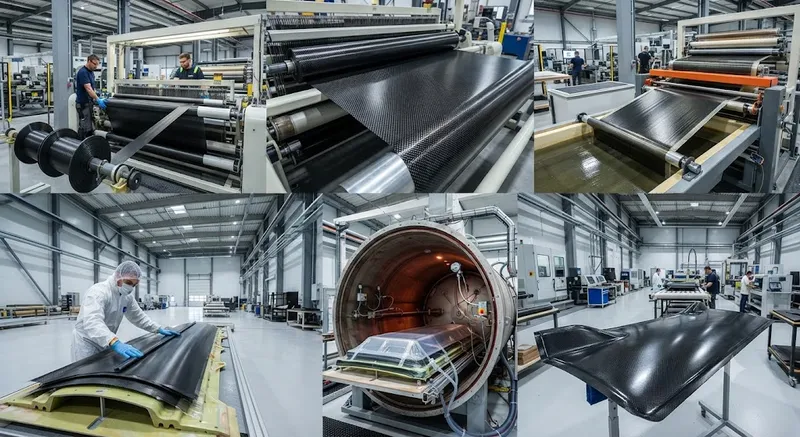
Stage 1: Fiber Preparation
Raw rovings arrive on creels. Sizing (silane-based for glass, proprietary for carbon) ensures matrix adhesion. Store in controlled humidity environments as specified by fiber suppliers. Verify traceability and fiber properties before weaving.
Stage 2: Weaving and Fabric Formation
DORNIER P2 [2] (for carbon, glass and aramid roving fabrics) rapier looms and KARL MAYER MAX GLASS ECO [3] (glass multiaxial) NCF lines are widely used for fabric formation. Loom speed depends strongly on fibre type, yarn/roving characteristics, fabric construction, width and required production quality. Non-crimp fabrics (NCF) reduce fibre crimp and can improve fibre utilisation and laminate mechanical performance compared with some woven architectures.
Stage 3: Lay-Up and Resin Infusion
Fabric is cut and stacked in predetermined layer sequences. Three major composite manufacturing routes are:
Method | Cost | Best For |
RTM (resin transfer moulding) | High tooling | Automotive, complex parts |
VARI (vacuum-assisted resin infusion) | Lower tooling cost | Large composite structures and selected aerospace applications |
Prepreg (pre-impregnated, typically autoclave-cured) | High material and processing cost | Aerospace and other high-performance composite structures |
Speed: Cycle times vary substantially with part size, resin system, laminate thickness, tooling, automation, and cure conditions. RTM can offer relatively short cycles in high-volume production, particularly with fast-cure HP-RTM systems, while vacuum infusion and prepreg/autoclave processing generally involve longer overall processing cycles.
Stage 4: Consolidation and Curing
Composite is heated and, depending on the process, consolidated under vacuum and/or external pressure according to the resin manufacturer’s specified cure cycle.
- Fiber volume fraction: typically ~55–65% for aerospace prepreg; ~40–50% for many wet layup/infusion laminates
- Void content: typically below 1% for many aerospace structural laminates; allowable levels for other applications depend on the process and customer specification.
Stage 5: Finishing and Quality Control
Visual inspection, ultrasonic C‑scan for internal voids, and mechanical testing of witness coupons (tensile, flexural, interlaminar shear strength). Acceptance criteria for void content and mechanical properties are defined by customer and aerospace/automotive specifications. Manufacturing defects can arise from lay-up errors, fiber misalignment, inadequate impregnation, porosity, contamination, or incomplete cure.
FABRIC ARCHITECTURE AND MACHINERY
Unidirectional reinforcements place most fibres in one direction, making them useful where loads are concentrated along a principal axis, including pultrusion and selected filament-winding applications. But real structures experience multi-directional forces. Multiaxial fabrics (0/90/+45/-45 degrees) reduce the number of plies required to achieve target mechanical properties, shrink thickness, and simplify manufacturing.
Areal weight varies widely according to fiber type, fabric architecture, laminate design and application.
Key machinery: DORNIER P2 Roving (rapier loom for carbon, glass and aramid roving fabrics), KARL MAYER MAX GLASS ECO (multiaxial NCF warp‑knitting line), and DORNIER TRITOS FLEX [4] (3D weaving for thick, complex preforms).
INDIA’S COMPOSITE OPPORTUNITY
India’s technical-textiles exports reached USD 2.92 billion in FY 2024–25. Indian companies have established capabilities in downstream composite-part manufacturing: Kineco Kaman [5] produces aerospace and defence composite parts and assemblies using carbon, glass and aramid prepregs with autoclave curing.
India remains dependent on imports for commercial carbon fibre, although domestic production capacity is now being developed.
Barriers | Opportunity |
Capital costs vary substantially by width, automation level, preform architecture and auxiliary equipment; avoid presenting USD 2–5 million per weaving line as a universal figure without supplier quotations. Key barriers are access to qualified fiber supply, process know-how, customer qualification cycles, and accredited test and certification infrastructure. | Glass-fiber reinforcement fabrics offer potential opportunities in ASEAN automotive, renewable-energy and industrial-composites markets, subject to customer qualification, competitive landed cost and reliable fibre supply. The National Technical Textiles Mission [6] has approved 168 research projects, including work involving carbon fibre, aramid, composites and machinery, with a mission outlay of ₹1,480 crore. |
INDUSTRY ADOPTION DRIVERS
Four converging trends accelerate adoption:
- Lightweighting: Carbon-fiber composites can achieve comparable structural performance at substantially lower mass than steel in suitably designed applications, making weight reduction particularly valuable in electric vehicles where battery mass is a major consideration.
- Proven reliability: New-generation widebody aircraft use high levels of composite materials. Boeing’s 787 [7] has an airframe composed of about 50% composites by weight, while the Airbus A350 [8] uses 53% CFRP in its fuselage, wings and tail. Years of commercial service provide substantial operational experience under demanding conditions.
- Automation: Automated fiber placement (AFP) and automated tape layup (ATL) reduce manual labor and process variability; integrated sensing and monitoring systems can enable in-situ defect detection and process monitoring.
- Cost: Carbon-fibre composites remain considerably more expensive than conventional metals in many applications, although costs can fall with higher production volumes, larger-tow fiber and process automation.
Barriers: Repair requires specialized training and certification (multi‑year aerospace pathways); thermoset recycling remains technically and economically challenging; qualified fiber and prepreg supply is concentrated among a limited set of global suppliers.
MARKET OUTLOOK
Strengths: Carbon-fiber composites can provide high specific strength and stiffness compared with conventional structural metals, along with corrosion resistance and the ability to tailor stiffness and strength through fiber orientation. Fatigue performance is highly dependent on fiber architecture, resin system, load spectrum, environment and design; universal ‘>100M cycles’ claims are not appropriate.
Challenges: Material costs remain substantially higher for carbon fibre than for aluminum, although the gap varies by fiber grade, volume and application. Aerospace-grade fibers and prepregs are particularly costly. Composite repair requires qualified personnel and controlled procedures, while thermoset recycling remains technically and economically challenging.
Growth Drivers: EV lightweighting, offshore-wind expansion, aircraft production and aftermarket demand, thermoplastic composites, and AI-assisted composite design and process monitoring.
Emerging Technologies (2025-2032):
- Digital twins, in-situ sensing and AI models for real-time process monitoring, defect detection and quality prediction
- Thermoplastic composites, which can enable minute-scale forming cycles in suitable processes and allow remelting-based reprocessing; some demonstrated automotive parts achieve 2–5 minute cycles
- Recycled carbon fibre, with improving collection and processing capacity, but continuing constraints on fiber length, property retention, qualification and feedstock consistency
- 3D woven and braided preforms, which can reduce manual lay-up and, in suitable designs, part count by producing near-net-shape reinforcement structures
- Natural-fiber composites, including flax, hemp and jute, for interior, exterior and selected semi-structural applications where low mass, damping and potentially lower embodied impacts are priorities
Commercial Now: Prepreg/autoclave processing, RTM, vacuum infusion, out-of-autoclave resin systems, and 3D-woven or braided preforms for selected aerospace, defence, industrial and automotive components.
Still Emerging at Scale: High-volume thermoplastic composite manufacturing across complex structures; recycled-carbon-fiber supply chains capable of consistent, aerospace-qualified reinforcement; AI-optimized lay-up with closed-loop process control; and increasingly autonomous fiber-placement systems.
CONCLUSION
Composite-fabric production is no longer a niche activity. It is a core capability in modern, high-performance manufacturing. The convergence of lightweighting mandates, aerospace reliability, renewable-energy growth and automotive electrification has made composite textiles essential across industries.
Textile professionals who combine traditional weaving and fabric-formation knowledge with understanding of matrix chemistry, resin-infusion science and quality control are increasingly relevant to the expanding composite manufacturing ecosystem. For India, the opportunity is to move beyond finished composite parts into upstream reinforcement-fabric production, targeting regional market share and creating high-value manufacturing jobs.
The technical skills exist. The weaving and textile infrastructure exists. What is needed is capital investment, long-term fiber-supply agreements and strategic partnerships with global OEMs.
The future of textiles is not only apparel. It is aerospace, defence, automotive and energy. And it starts with engineered composite fabric.
SOURCES
- https://www.futuremarketinsights.com/reports/composite-textile-production-equipment-market
- https://www.lindauerdornier.com/en/composite-systems/roving-weaving-machine-p2/
- https://www.karlmayer.com/en/products/technical-textiles/composite-machines/max-glass-eco/
- https://www.lindauerdornier.com/en/about-us/news/from-semi-finished-products-to-high-performance-components-dornier-presents-new-solutions-for-3d-weaving-and-scalable-composite-series-production-at-jec-2026/
- https://www.kinecogroup.com/kineco-kaman.php
- https://www.pib.gov.in/PressReleasePage.aspx?PRID=2222482®=3&lang=1
- https://www.boeing.com/commercial/787
- https://www.airbus.com/en/products-services/commercial-aircraft/passenger-aircraft/a350-family