Fraunhofer IAP Showcases Recyclable and Bio-Based Materials for Circular Plastics
Developments include PET waste recovery, textile-to-polymer conversion, recyclable PLA, bio-based PBS and renewable carbon fibres
Fraunhofer Institute for Applied Polymer Research IAP will showcase developments in recyclable and bio-based plastics, chemical recycling, functional polymers and bio-based carbon fibres at Fakuma 2026. The institute will also exhibit for the first time at the TecPart association booth following its membership of the TecPart – Association of Technical Plastic Products e. V.
The developments address the use of alternative raw materials, recycling of plastic and textile waste, improved material properties and the integration of new materials into established industrial processing systems.
Developing Materials for Existing Processing Systems
According to Fraunhofer IAP, plastics processors face challenges when introducing recycled, bio-based or newly developed materials because their composition, quality and processing behaviour can differ from conventional materials.
Recycled materials may vary in composition and quality, while bio-based and novel polymers can behave differently during processing. Additives, fillers and reinforcing fibres can also influence the structure and properties of plastics.
The institute therefore works on material development and processing methods together, considering the material, production process and final application as interconnected elements.
At Fakuma 2026, its exhibits will demonstrate approaches involving polymer chemistry, formulation, processing, process parameters and scale-up.
Modifying PLA for Flexible Film Applications
One of the developments presented is a flexible and recyclable film material based on polylactide (PLA).
Instead of using a conventional PLA compound, the material has been chemically modified to expand its property profile. The modification gives the originally rigid bioplastic greater flexibility for film applications and allows it to be processed on standard equipment in a manner similar to low-density polyethylene (LDPE).
Fraunhofer IAP is also demonstrating polymers with additional functional properties.
Its shape-memory polymer development allows materials to undergo programmable shape changes. After deformation, the material can return to a defined shape when exposed to a temperature stimulus.
In the FOIM exhibit, a 2.5-millimetre-thick polyurethane film expands into a 40-millimetre-high foam at 60°C, representing an expansion factor of 16.
Another demonstrator uses 4D printing to produce a shrinkable door opener. The component combines temperature-activated shape changes with additive manufacturing while retaining the possibility of mechanical recycling.
Designing Materials for Recycling
Recyclability is also being considered during material development.
Fraunhofer IAP is presenting the self-reinforced monomaterial Sc-PLA, in which the matrix and reinforcing fibres consist of the same polymer. This eliminates the need for labour-intensive separation of different material components during recycling.
The approach follows the “Design for Recycling” principle and combines bio-based raw materials with a material structure developed with recycling in mind.
Converting PET and Textile Waste into Raw Materials
Another area of development involves recovering raw materials from waste streams.
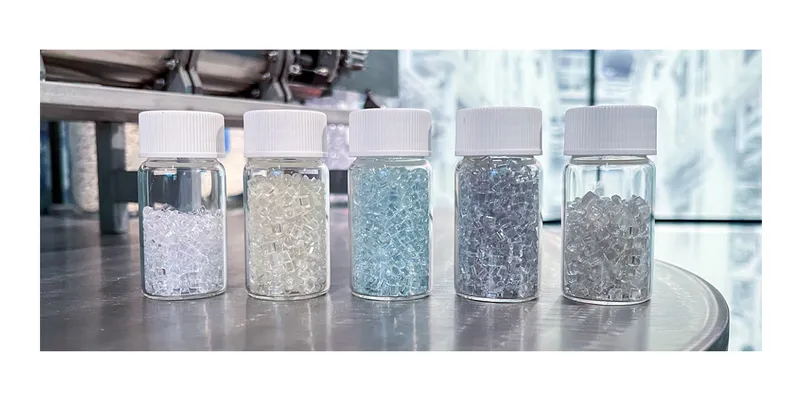
Fraunhofer IAP is recovering terephthalic acid from polyethylene terephthalate (PET) and using the recovered monomer to produce new polymers. The institute is also investigating characteristics such as mechanical properties and colour.
PET is widely used in bottles, fibres and films, making its recovery relevant to both plastics and textile-related applications.
The institute is also investigating textile waste that is difficult to recycle. One approach uses used textiles containing PET as a starting material for producing the biopolymer polyhydroxybutyrate (PHB).
This process aims to transform a textile waste stream into a raw material for new polymer production.
Bio-Based PBS for Multiple Processing Methods
Fraunhofer IAP has also worked with industry partners to develop new grades of the bioplastic polybutylene succinate (PBS).
The grades were produced on a pilot scale and processed using several methods, including:
- Injection moulding
- Blow moulding
- Thermoforming
- Extrusion
- Spinning
Potential applications include packaging, consumer goods and textiles.
The institute notes that the development of new plastics requires consideration of polymer structure, material properties, processing methods and the intended application together. Polymer synthesis, material development, characterisation and processing are therefore closely connected.
Bio-Based Carbon Fibres for Lightweight and Energy Applications
Fraunhofer IAP is also developing carbon fibres from renewable raw materials including cellulose and lignin.
Carbon fibres combine low weight with high strength and stiffness. The institute adjusts their properties by modifying the starting material, fibre structure and processing parameters.
The targeted properties include mechanical characteristics, porosity, geometry and electrical conductivity.
Depending on their properties, the bio-based carbon fibres can be used in areas including lightweight construction, batteries and fuel cells.
Material Development and Industrial Processing
The developments being presented at Fakuma 2026 cover several approaches to circular plastics, from alternative raw materials and recycling-oriented material design to new polymer and fibre systems.
Through its membership in TecPart, Fraunhofer IAP will also engage with manufacturers of technical plastic products, highlighting the connection between material development and industrial processing.